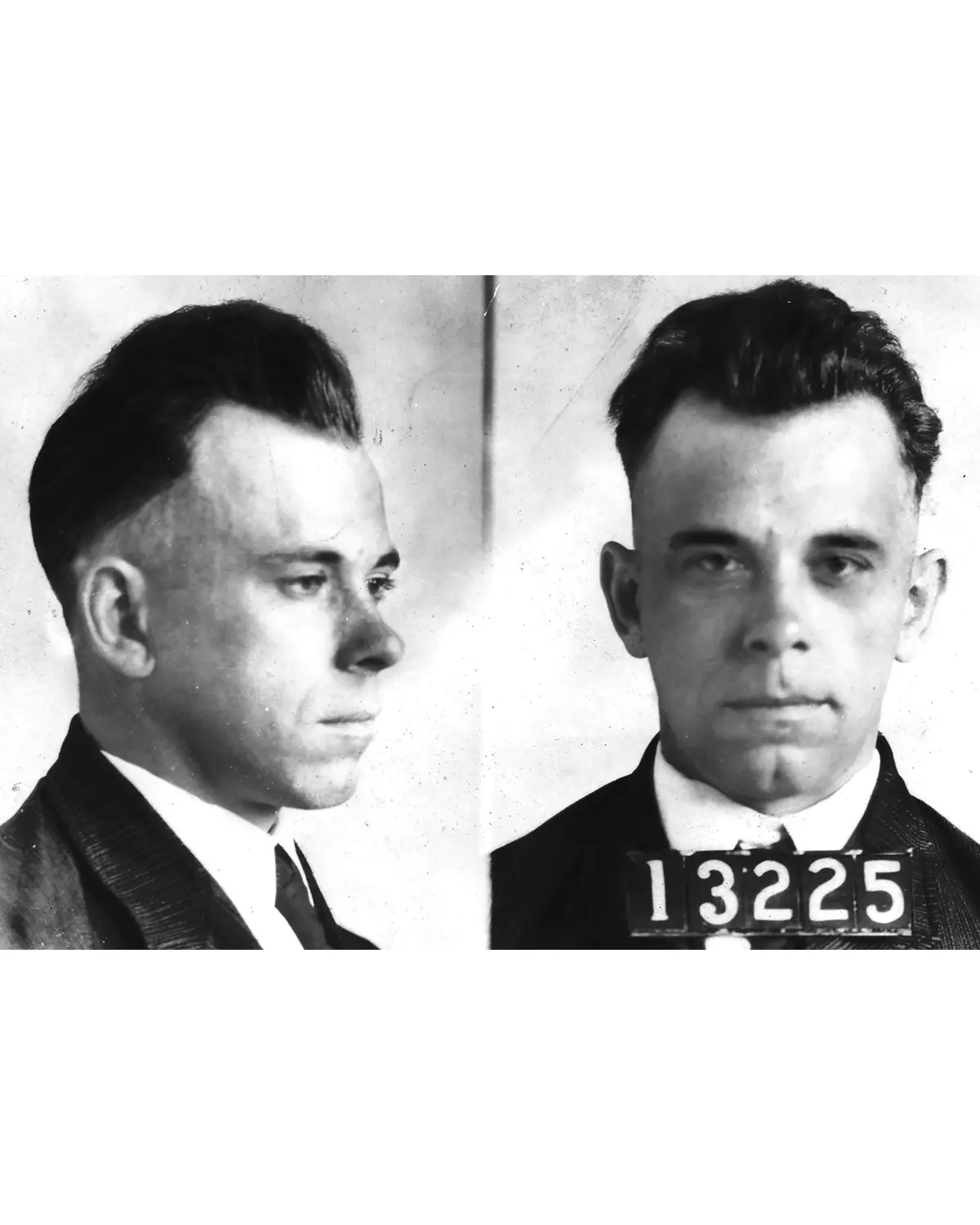
John Herbert Dillinger became the most famous American bank robber of the 1933–1934 “public enemy” era. His criminal career at national scale lasted less than a year, but it linked prison networks, bank robberies, jail breaks, police-arsenal raids and a rapidly expanding federal manhunt. By the time federal agents shot him outside Chicago’s Biograph Theater on July 22, 1934, Dillinger had become both a wanted fugitive and a mass-media symbol of Depression-era outlawry.
The documentary record is more useful than the legend. FBI files show a violent network that killed law-enforcement officers, stole weapons and repeatedly escaped custody. The same record also shows why Dillinger became historically important to federal law enforcement: his Crown Point escape and interstate flight gave the Bureau a federal motor-vehicle offense that helped transform a local criminal into a national federal target.
Early life and the 1924 robbery case
Dillinger was born in Indianapolis, Indiana, in June 1903. The FBI gives June 22 as his birth date, although other historical compilations have produced minor date conflicts.
As a young man he drifted through jobs, enlisted in the Navy and deserted, married, and then became involved in a robbery attempt with Ed Singleton. In 1924 the pair tried to rob a Mooresville grocer. Dillinger confessed and received a long Indiana prison sentence.
That sentence became the defining institution of his early adult life. He served time at the Indiana State Reformatory at Pendleton and later at Indiana State Prison in Michigan City. There he formed relationships with men who would later become part of his criminal network, including Harry Pierpont, Homer Van Meter and others.
Prison as the foundation of the Dillinger network
The gang later associated with Dillinger was not a stable organization with a fixed membership list. It was a shifting network built partly from prison relationships.
That matters because the 1933–1934 crime wave did not begin with Dillinger recruiting strangers after release. Many of the men who later robbed banks with him or helped free him from custody had already known one another inside Indiana’s prison system.
The prison network also connects Dillinger to the Michigan City prison escape of September 1933. Several men who escaped from Indiana State Prison soon became central participants in his next phase of criminal activity.
Parole, arrest and the Lima jail rescue
Dillinger was paroled in 1933 after roughly eight and a half years in custody. The FBI gives May 10 as the parole date, while some other records use later dates in May; the discrepancy should be preserved rather than converted into false precision.
Within months he was involved in bank robbery and was arrested in Dayton, Ohio, on September 22, 1933. Authorities held him in the county jail at Lima.
On October 12, Harry Pierpont and other associates arrived at the jail claiming to be officers returning Dillinger to Indiana. Sheriff Jess Sarber challenged them. Sarber was shot and fatally wounded, and Dillinger was freed.
The episode is a central junction in the network: Dillinger, Pierpont, Russell Clark and Charles Makley all connect through the rescue, while Sarber’s killing generated a separate murder prosecution.
Bank robberies and police arsenals
After the Lima escape, Dillinger’s circle robbed banks and raided police arsenals for weapons, ammunition and bulletproof vests. The FBI later summarized the group’s 1933–1934 run as a violent campaign across the Midwest.
The gang’s firepower was part of the reason contemporary police agencies struggled to respond. Thompson submachine guns, automatic weapons and stolen body armor made these crews far more difficult to confront than ordinary property offenders.
Dillinger’s public image sometimes became romanticized as that of a bank robber humiliating institutions during the Depression. That image obscures the violence surrounding the network, including killings committed during robberies, jail deliveries and confrontations with law enforcement.
Tucson arrest
In January 1934, Dillinger, Pierpont, Makley and Clark were arrested in Tucson, Arizona, after local authorities connected men staying under false names to a hotel fire and national wanted notices.
Police recovered weapons, bulletproof vests and cash. Dillinger was returned to Indiana and confined at the Lake County Jail in Crown Point to face the murder case arising from a bank robbery in East Chicago.
The Crown Point escape
On March 3, 1934, Dillinger escaped from the Crown Point jail. The most famous version of the story says he used a wooden pistol, although the exact details became part of the mythology surrounding him almost immediately.
What is legally more important is what happened next. Dillinger took the sheriff’s automobile and drove it across the Indiana-Illinois state line. Transporting a stolen automobile interstate violated federal law and gave federal investigators a clear jurisdictional basis to pursue him.
The Crown Point escape therefore marks a shift from a state murder defendant and bank robber to one of the federal government’s most visible fugitives.
St. Paul and the widening manhunt
Dillinger joined Evelyn Frechette and associates in St. Paul. FBI agents investigating a suspicious apartment encountered members of the group in March 1934. Gunfire followed, and Dillinger escaped while wounded.
He received assistance through Eddie Green’s circle before moving again. Frechette was later arrested and convicted for harboring a fugitive.
By this point, Dillinger’s network included Homer Van Meter, Lester “Baby Face Nelson” Gillis, John Hamilton and other highly wanted criminals. The overlapping crews make the period difficult to reduce to one “gang” roster.
Little Bohemia
On April 22, 1934, federal agents attempted to capture Dillinger and associates at the Little Bohemia Lodge near Manitowish Waters, Wisconsin. The raid failed to capture the principal fugitives and resulted in civilian and law-enforcement casualties.
Dillinger escaped. In the wider aftermath, Baby Face Nelson killed FBI Special Agent W. Carter Baum and wounded others during a separate confrontation.
Little Bohemia became a major institutional embarrassment for the Bureau and an important episode in the history of the federal manhunt.
Anna Sage and the Biograph Theater
By July 1934, Dillinger was hiding in Chicago. Anna Sage, facing immigration problems, gave authorities information about his movements and told investigators that she, Polly Hamilton and Dillinger planned to attend a movie at either the Biograph or Marbro theater.
On July 22, the group went to the Biograph to see Manhattan Melodrama. Federal agents and local officers positioned themselves around the theater.
When Dillinger emerged, agents moved in. The FBI account states that he ran toward an alley and reached for a pistol. Three agents—Charles Winstead, Clarence Hurt and Herman Hollis—fired. Dillinger was struck three times and was pronounced dead later that night at Alexian Brothers Hospital.
Death and burial
Dillinger died on July 22, 1934, in Chicago from gunshot wounds inflicted during the federal confrontation. His death is therefore classified as a homicide by law enforcement rather than a generic “other” death.
He was buried at Crown Hill Cemetery in Indianapolis.
His death did not end the broader public-enemy campaign. Baby Face Nelson remained at large until November 1934, when he was fatally wounded in the Battle of Barrington after a gunfight in which FBI agents Samuel Cowley and Herman Hollis were also killed.
Why Dillinger matters
Dillinger’s historical significance lies in the connection between a prison-built criminal network and the modernization of federal pursuit. His escapes, interstate movement and national publicity helped turn the Bureau’s campaign against mobile gangsters into a defining institutional story.
His profile also opens several connected paths: Indiana State Prison, Pendleton Reformatory, the Lima jail rescue, Tucson capture, Crown Point escape, Little Bohemia, the Biograph Theater and the Dillinger Gang story arc.
The legend made him a folk figure. The records show something more concrete: a repeat robber whose prison relationships became a violent interstate network, and whose short period as a fugitive helped reshape American law-enforcement history.
Core sources
– Federal Bureau of Investigation — John Dillinger: https://www.fbi.gov/history/cases-and-criminals/john-dillinger – Federal Bureau of Investigation — The FBI and the American Gangster, 1924–1938: https://www.fbi.gov/history/history-of-the-fbi/the-fbi-and-the-american-gangster – Federal Bureau of Investigation — John Dillinger’s Death Mask: https://www.fbi.gov/history/artifacts/john-dillingers-death-mask
Documented network
Harry Pierpont (person): They became acquainted in Indiana's prison system. Pierpont was among the escaped Michigan City prisoners who later freed Dillinger at Lima; both were later arrested in Tucson.
Lester 'Baby Face Nelson' Gillis (person): FBI records place Nelson with Dillinger's post-Crown Point circle and at Little Bohemia.
Homer Van Meter (person): PBS identifies Van Meter as a close prison friend and later gang associate; FBI places him with Dillinger in St. Paul and later crimes.
Charles Makley (person): Makley was one of the Michigan City escapees and one of the men involved in freeing Dillinger at Lima.
John Hamilton (person): Hamilton was part of the Michigan City escapee network and a member of the Dillinger criminal circle.
Russell Clark (person): Clark was one of the men the FBI identified in the Lima rescue and was later arrested with Dillinger's group in Tucson.
Eddie Green (person): FBI places Green in Dillinger's St. Paul circle; Dillinger went to Green's apartment after being wounded at Lincoln Court.
Dillinger Gang (organization): A fluid network of accomplices rather than a consistently fixed roster; Indiana State Archives explicitly recommends viewing it as a network.
Indiana State Reformatory (Pendleton) (prison): Dillinger served part of his sentence at Pendleton and formed relationships with future associates there.
Indiana State Prison (prison): Dillinger served later years of his sentence at Michigan City, where many future associates were also imprisoned.
Allen County Jail (Lima) (prison): Held here after Dayton arrest until Pierpont and associates freed him.
Lake County Jail (Crown Point) (prison): Held pending the East Chicago murder case; escaped March 3.
Biograph Theater (location): Dillinger attended 'Manhattan Melodrama' here with Anna Sage and Polly Hamilton and was shot after exiting.
Birth in Indianapolis (event): John Herbert Dillinger was born in Indianapolis. FBI and PBS use June 22; one Indianapolis encyclopedia uses June 23.
Timeline and case connections
Structured events are separated from general biography so a later audit can change a date, conviction, killing, organizational split or court outcome without rewriting unrelated portions of the page.
1903-06-22 — Birth in Indianapolis. John Herbert Dillinger was born in Indianapolis. FBI and PBS use June 22; one Indianapolis encyclopedia uses June 23.
1924-09-06 — Mooresville robbery attempt and arrest. Dillinger and Ed/Edgar Singleton attempted to rob grocer Frank Morgan; Dillinger was apprehended and later convicted.
1924-09-16 — Indiana imprisonment begins. Dillinger entered the Indiana correctional system after his robbery conviction.
1933-05-22 — Parole from Indiana prison. Dillinger was paroled after roughly nine years in prison. Sources disagree on the exact date.
1933-09-22 — Arrest in Dayton. Dayton police arrested Dillinger and he was held at Lima, Ohio, pending trial.
1933-10-12 — Lima jail rescue and Sheriff Sarber killing. Pierpont, Russell Clark, Charles Makley and Harry Copeland were identified by the FBI as the men who came to the jail and freed Dillinger; Sheriff Jesse Sarber was shot and died from the attack. Pierpont was later convicted of Sarber's murder.
1934-01-25 — Arrest in Tucson. Dillinger, Pierpont, Makley and Clark were arrested by local authorities after recognition linked to a hotel fire and investigation.
1934-03-03 — Crown Point jail escape. Dillinger escaped jail, allegedly using a fake wooden gun, seized weapons and fled in the sheriff's car. Interstate transport of the stolen car gave federal investigators a clear federal offense to pursue.
1934-04-22 — Little Bohemia escape. Federal agents raided the lodge; Dillinger escaped. Baby Face Nelson separately killed Special Agent W. Carter Baum during the wider incident.
1934-07-22 — Death outside the Biograph Theater. Federal agents confronted Dillinger after he left the Biograph Theater. The FBI says he reached for a pistol while fleeing; five shots were fired, three struck him, and he was pronounced dead at 10:50 p.m.
Date not specified in current profile sources — The Lima Jail Break and Murder of Sheriff Jess Sarber. Pierpont, Russell Clark, Charles Makley and Harry Copeland were identified by the FBI as the men who came to the jail and freed Dillinger; Sheriff Jesse Sarber was shot and died from the attack. Pierpont was later convicted of Sarber's murder.
Date not specified in current profile sources — The Tucson Capture. Dillinger, Pierpont, Makley and Clark were arrested by local authorities after recognition linked to a hotel fire and investigation.
Status and record
The structured birth record lists 1903-06-22 in Indianapolis, Indiana, United States. The death record lists 1934-07-22 in Chicago, Illinois, United States. Cause: Gunshot wounds. Federal agents confronted Dillinger after he left Chicago’s Biograph Theater on July 22, 1934. He was shot while fleeing and pronounced dead later that night.
Books and screen
Source record
The Master package currently attaches these sources to the profile: – John Dillinger — Federal Bureau of Investigation, Tier 1. – The FBI and the American Gangster, 1924-1938 — Federal Bureau of Investigation, Tier 1. – John Dillinger Part 1 of 3 — Federal Bureau of Investigation, The Vault, Tier 1. – Timeline — Federal Bureau of Investigation, Tier 1. – Dillinger Collection — Indiana Archives and Records Administration / Indiana State Archives, Tier 1. – Notes to Finding Aid – Dillinger Gang, Governor’s Collection, Governor Leslie (1929-1933) — Indiana Archives and Records Administration, Tier 1. – Dillinger, Denial, and Devotion: The Trials of Lena and Gilbert Pierpont — Indiana Historical Bureau, State of Indiana, Tier 2. – The Indianapolis Times EXTRA — Scene of Tragic Dillinger Jail-Break — The Indianapolis Times; digitized by Library of Congress Chronicling America, Tier 1. – The Daily Alaska Empire — 'Pierpont Dies, Electric Chair' — The Daily Alaska Empire; digitized by Library of Congress, Tier 1. – John Dillinger (1903-1934) — American Experience / PBS / WGBH, Tier 2. – John Dillinger Timeline — American Experience / PBS / WGBH, Tier 2. – Depression-Era Desperadoes — American Experience / PBS / WGBH, Tier 2. – John Herbert Dillinger — Encyclopedia of Indianapolis, Tier 2. – John Dillinger (Q243918) — Wikidata, Tier 3.
The presence of a source does not mean it supports every sentence. Claim-level references remain in structured data for later audits.
Evidence and editorial boundaries
For living subjects in particular, legal status and allegations require dated evidence. Future expansion should come from stronger records, court material, archives or newly processed canonical entities rather than generalized crime lore.
Key events
Birth in Indianapolis
John Herbert Dillinger was born in Indianapolis.
Indianapolis, IndianaMooresville robbery attempt and arrest
Dillinger and Ed/Edgar Singleton attempted to rob grocer Frank Morgan; Dillinger was apprehended and later convicted.
Mooresville, IndianaIndiana imprisonment begins
Dillinger entered the Indiana correctional system after his robbery conviction.
Indiana State Reformatory, Pendleton, IndianaParole from Indiana prison
Dillinger was paroled after roughly nine years in prison.
IndianaArrest in Dayton
Dayton police arrested Dillinger and he was held at Lima, Ohio, pending trial.
Dayton, OhioChicago detective killing attributed to Hamilton
FBI historical account attributes the fatal shooting of a Chicago police detective to Hamilton; underlying case file not retrieved.
ChicagoFrechette meets John Dillinger
Frechette's contemporary account and PBS profile place their meeting in a North Side Chicago cabaret in November 1933.
North Side cabaret/dance hall, Chicago, IllinoisFirst National Bank of East Chicago robbery — role audit
Hamilton is strongly associated with the robbery and reportedly wounded; personal shooter attribution for O'Malley remains unresolved here.
First National BankDillinger Escapes Crown Point Jail
Dillinger escaped the Lake County Jail, took weapons and fled in the sheriff’s car; crossing a state line in the stolen vehicle expanded federal…
Lake County Jail, Crown Point, IndianaInterstate flight in sheriff's vehicle
The escape party used the sheriff's vehicle; contemporary sources place coerced personnel in the car and their release near Peotone, Illinois, establishing interstate movement.
Crown Point, Indiana to Illinois; hostages released near PeotoneDeath sentence for Sheriff Sarber murder
Pierpont and Makley were sentenced to death for Sheriff Jesse Sarber's murder; Russell Clark received life imprisonment.
OhioGreen arranges medical help for wounded Dillinger
FBI history says Dillinger reached Green's apartment for treatment; Skinner interview material describes Green helping secure Dr.
Twin Cities, MinnesotaFBI bedside interview at Ancker Hospital
Special Agent Noonan recorded statements from Green over roughly six hours while Green was seriously wounded and intermittently delirious.
Ancker Hospital, St. Paul, MinnesotaFederal-agent shooting of Eddie Green
Federal agents shot Green during an operation.
St. Paul, MinnesotaArrest of Evelyn Frechette
Federal agents arrested Frechette.
Chicago, IllinoisDeath of Eddie Green
Preferred reconstruction: Green died eight days after the April 3 shooting.
St. Paul, MinnesotaExecution
Pierpont was executed by electrocution for Sheriff Jesse Sarber's murder.
Ohio Penitentiary, Columbus, OhioConviction and life sentence in Ohio
Clark was convicted in the Sarber murder prosecution and received life imprisonment, while Pierpont and Makley received death sentences.
Allen County courtWarsaw police-station arsenal robbery
FBI states John Dillinger and Homer Van Meter robbed a police station in Warsaw of guns and bulletproof vests.
Warsaw, IndianaWounded John Hamilton brought to Davis's Aurora location
In a later confidential statement, Davis said he personally drove wounded John Hamilton, John Dillinger and Homer Van Meter to Aurora after Doc Barker…
Aurora, Illinois, United StatesWhere this person was held
People, groups and places
Portrayed on Screen
Public Enemies
Portrayed by Johnny Depp.
References
-
[1]Sheriff Jess Sarber TributeTier 1SupportsView source ↗
-
[2]Bremer Kidnapping Part 175 — Bessie Skinner interview summaryTier 1Supports
-
[3]Charles Ross KidnappingTier 1Supports
-
[4]Dillinger CollectionTier 1Supports
-
[5]John DillingerTier 1SupportsMentionsView source ↗
-
[6]J. Edgar Hoover memorandum, April 9, 1934Tier 1Supports
-
[7]Baby Face Nelson Body ArmorTier 1SupportsView source ↗
-
[8]Biograph Theater in the 1930sTier 1SupportsView source ↗
-
[9]Bremer Investigation Summary Part 01 (Final)Tier 1SupportsView source ↗
-
[10]Bremer Kidnapping Part 157 — confidential Volney Davis 'My Career in Crime' statementTier 1SupportsView source ↗
-
[11]Dillinger Identification OrderTier 1SupportsView source ↗
-
[12]Dillinger Wanted Flyer Circa 1933Tier 1SupportsView source ↗
-
[13]FBI Chicago HistoryTier 1SupportsMentionsView source ↗
-
[14]John DillingerTier 1Supports
-
[15]John Dillinger in the 1930sTier 1MentionsView source ↗
-
[16]John Dillinger's Death MaskTier 1MentionsView source ↗
-
[17]Lessons at Little BohemiaTier 1SupportsView source ↗
-
[18]Lester Gillis (“Baby Face” Nelson)Tier 1SupportsView source ↗
-
[19]Lester Gillis (“Baby Face” Nelson)Tier 1Supports
-
[20]The FBI and the American Gangster, 1924-1938Tier 1SupportsMentionsView source ↗
-
[21]TimelineTier 1SupportsMentionsView source ↗
-
[22]W. Carter BaumTier 1SupportsView source ↗
-
[23]Telegram of SAC Melvin Purvis to Director Hoover, March 3, 1934Tier 1SupportsView source ↗
-
[24]John Dillinger Part 1 of 3Tier 1SupportsMentionsView source ↗
-
[25]Dillinger CollectionTier 1SupportsMentionsView source ↗
-
[26]Notes to Finding Aid – Dillinger Gang, Governor’s Collection, Governor Leslie (1929-1933)Tier 1MentionsView source ↗
-
[27]Statement of Ernest Blunk, March 3, 1934Tier 1SupportsView source ↗
-
[28]John DillingerTier 1Supports
-
[29]John Dillinger FBI file, section 10 (scan mirror)Tier 1Supports
-
[30]Makley v. State, 197 N.E. 339, 49 Ohio App. 359Tier 1Supports
-
[31]Makley v. State, 49 Ohio App. 359, 197 N.E. 339Tier 1SupportsView source ↗
-
[32]Pierpont v. State, 195 N.E. 264, 49 Ohio App. 77Tier 1Supports
-
[33]July 2024: John Dillinger and the National Motor Vehicle Theft ActTier 1SupportsView source ↗
-
[34]Verdict No. 6037, United States v. Evelyn Frechette, Clayton E. May, and Mrs. A. SaltTier 1SupportsView source ↗
-
[35]Depression-Era DesperadoesTier 2MentionsView source ↗
-
[36]John Dillinger (1903-1934)Tier 2SupportsMentionsView source ↗
-
[37]What I Knew About John Dillinger — By His SweetheartTier 2SupportsView source ↗
-
[38]Dillinger Gang Captured HereTier 2Supports
-
[39]Dillinger Timeline — October 1933Tier 2Supports
-
[40]Dillinger Timeline — September to December 1933Tier 2Supports
-
[41]John Herbert DillingerTier 2SupportsMentionsView source ↗
-
[42]Eugene Register-Guard, April 11, 1934 — 'Are U.S. Agents Shooting to Kill?'Tier 2Supports
-
[43]Hoosier Public Enemy: A Life of John DillingerTier 2Supports
-
[44]Dillinger, Denial, and Devotion: The Trials of Lena and Gilbert PierpontTier 2SupportsMentionsView source ↗
-
[45]Little Bohemia Lodge — HistoryTier 2Supports
-
[46]Lowell Tribune, March 22, 1934 — 'Youngblood Is Slain in Battle'Tier 2SupportsView source ↗
-
[47]Herman 'Baron' Lamm, the Father of Modern Bank RobberyTier 2Supports
-
[48]John Dillinger TimelineTier 2Supports
-
[49]Evelyn 'Billie' Frechette, 1907-1969Tier 2SupportsView source ↗
-
[50]John Dillinger TimelineTier 2SupportsMentionsView source ↗
-
[51]Dillinger Captured in TucsonTier 2SupportsView source ↗
-
[52]Pampa Daily News, March 4, 1934Tier 2SupportsView source ↗
-
[53]The Hotel Congress Fire and the Capture of John DillingerTier 2Supports
-
[54]April 1934 TimelineTier 3Supports
-
[55]April 1934 TimelineTier 3SupportsView source ↗
-
[56]January 1934 TimelineTier 3SupportsView source ↗
-
[57]Eddie Green (criminal)Tier 3Supports
-
[58]Harry Pierpont (Q14725165)Tier 3MentionsView source ↗
-
[59]John Dillinger (Q243918)Tier 3MentionsView source ↗
-
[60]File:John Dillinger 1924 Mugshot.jpgTier 3MentionsView source ↗
-
[61]Harry PierpontTier 3MentionsView source ↗