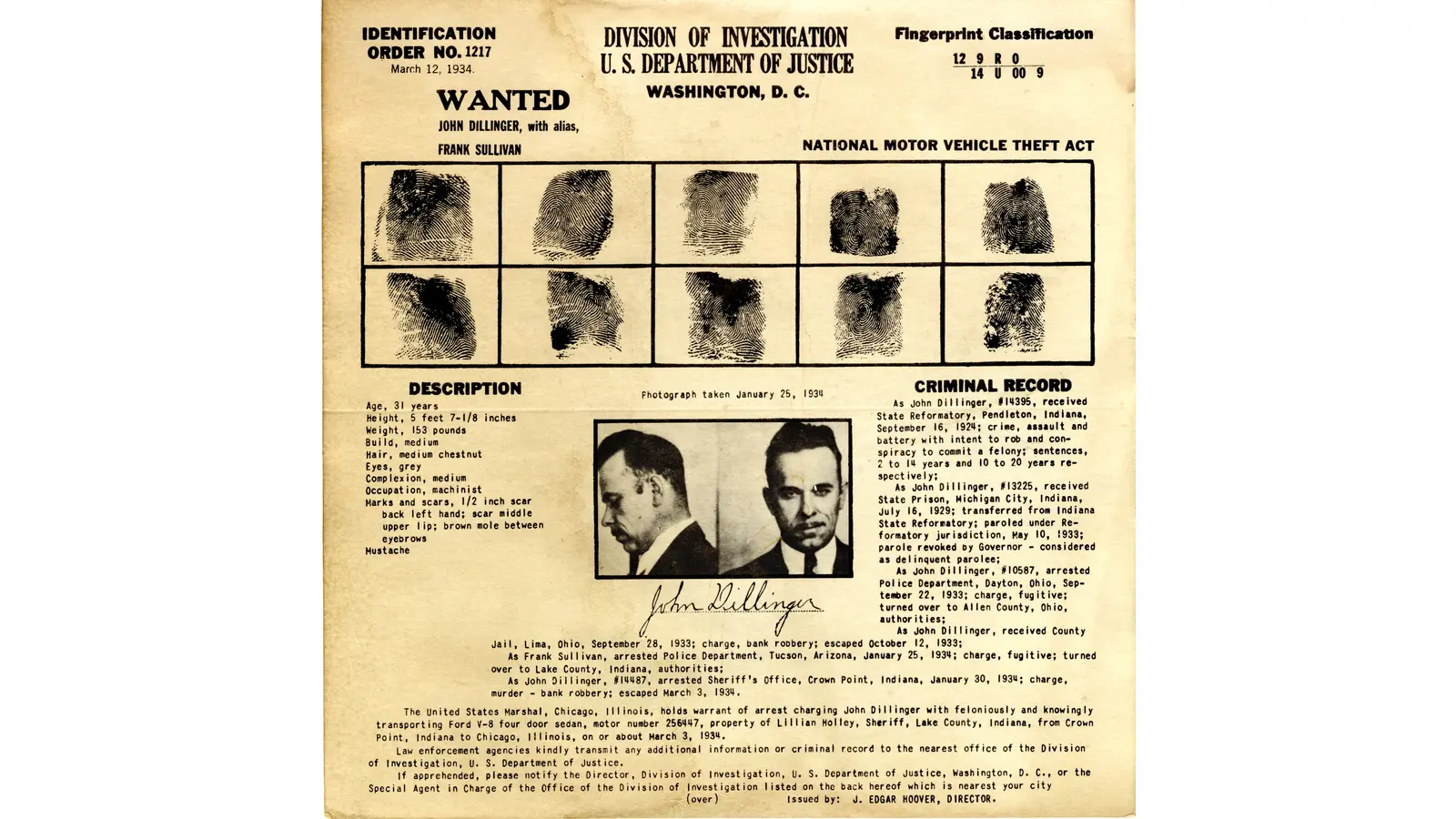
The Dillinger Gang was not a stable corporation with a fixed membership list. It was a shifting Depression-era robbery crew built around John Dillinger and a group of experienced criminals whose paths crossed in prisons, jail breaks, bank robberies and hideouts across the Midwest. Between 1933 and 1934, the gang became one of the most heavily publicized criminal groups in the United States and a major target of the expanding federal manhunt system.
Prison connections and the 1933 breakout
Dillinger's criminal network took shape through men he knew from Indiana prisons. Several future associates, including Harry Pierpont, Charles Makley and Russell Clark, were experienced robbers. When Dillinger was paroled in 1933, he helped arrange weapons that were smuggled into the Indiana State Prison at Michigan City. A group of inmates escaped in September. Dillinger himself had already been arrested in Ohio, but members of the escaped group later freed him from the Allen County jail in Lima, Ohio. During that jail break, Sheriff Jess Sarber was shot and killed.
The episode was critical because it converted a set of prison relationships into an active robbery crew. The men did not remain together continuously, and later accounts often use “Dillinger Gang” as shorthand for several overlapping combinations.
Bank robberies and police arsenals
Through late 1933 and early 1934, Dillinger and his associates robbed banks across the Midwest. They also raided police arsenals in Auburn and Peru, Indiana, taking firearms, ammunition and bullet-resistant vests. Those raids gave the gang military-style weapons that were far beyond the equipment available to many local departments at the time.
The gang's robberies helped create the public image that later made Dillinger a folk figure. Newspaper coverage emphasized speed, weapons, escapes and confrontations with police. Some members of the public romanticized bank robbers during the Depression, but the documented record includes killings, shootings and violent jail breaks. The mythology and the evidence are not the same thing.
Tucson and the Crown Point escape
In January 1934 several gang members were arrested in Tucson, Arizona after a hotel fire led firefighters and police to recognize them from widely circulated photographs. Dillinger, Pierpont, Makley and Clark were among those captured. Dillinger was returned to Indiana and confined in the Lake County jail at Crown Point while awaiting trial in connection with the East Chicago bank robbery and the killing of a police officer.
On March 3 Dillinger escaped. He later claimed to have used a wooden gun, though details of the escape became the subject of competing stories almost immediately. What mattered to federal investigators was what happened afterward: Dillinger took a sheriff's car and crossed a state line. That interstate vehicle theft created a federal offense and gave the Bureau of Investigation a much clearer legal basis to enter the hunt.
The second crew
After Crown Point, Dillinger operated with another circle that included Homer Van Meter, John Hamilton and Lester “Baby Face” Nelson, among others. This later crew robbed additional banks and moved through a network of apartments, lodges and associates who provided cars, shelter or information.
Associates, hideouts and helpers belong in the graph around the gang and its individual Stories.
Little Bohemia
The federal pursuit reached a turning point in April 1934 at the Little Bohemia Lodge in Wisconsin. Agents moved against the lodge after receiving information that Dillinger and other fugitives were there. The raid went badly. Agents fired on a car carrying civilians, killing one man and wounding others, while the wanted men escaped. Nearby, Baby Face Nelson encountered federal agents and local law enforcement, killing Special Agent W. Carter Baum and seriously wounding others.
Little Bohemia was both an operational failure and an institutional lesson. The pursuit of the gang exposed the limitations of communication, intelligence and field tactics during an era when federal law enforcement was rapidly changing.
The end of the gang
By summer 1934 the network was fragmenting under pressure. John Hamilton had been badly wounded earlier in the year and disappeared; contemporary accounts and later testimony placed his death in the spring of 1934. Other associates were arrested or killed.
Dillinger was located in Chicago in July after investigators developed information from people in his circle. On the night of July 22, agents watched the Biograph Theater. Dillinger left the theater, recognized the danger and ran toward an alley while reaching for a weapon. Three agents fired. Dillinger was hit and died shortly afterward at a hospital.
The death of Dillinger did not immediately end the broader public-enemy campaign. Baby Face Nelson remained active until he was fatally wounded in a November 1934 gun battle that also killed FBI agents Samuel Cowley and Herman Hollis. Other members and helpers faced state or federal prosecution.
Why the Dillinger Gang matters
The clean historical model is one canonical Dillinger Gang page supported by individual profiles and Story pages. That structure avoids counting the same group twice and allows uncertainty to stay attached to the specific event or person where it belongs.
Portrayed on Screen
Public Enemies
Public Enemies can function as the cinematic front door to RoguesBook’s already-deep Dillinger graph.
People who shaped this story
Events that define the record
Waterloo police shooting of Tommy Carroll
Contemporary reporting says detectives confronted Carroll, a pistol was involved, and officers shot him during the attempted apprehension.
Waterloo, IowaDeath of Russell Clark
A February 1969 UPI report states that Clark died on December 24, 1968, after having been paroled from the Ohio Penitentiary months earlier.
Detroit (reported in later sources)Crown Point train-passenger robbery conviction
Fort Wayne History Center material says Van Meter was arrested, tried and convicted for attempting to rob train passengers and received a ten-to-twenty-one-year sentence.
Crown Point, IndianaIndiana State Prison incarceration
Indiana State Archives identifies Homer VanMeter as Indiana State Prison prisoner no.
Indiana State Prison, Michigan City, IndianaReferences
-
[1]Charles Ross KidnappingTier 1Supports
-
[2]Dillinger CollectionTier 1Supports
-
[3]John DillingerTier 1MentionsSupportsView source ↗
-
[4]FBI Chicago HistoryTier 1MentionsSupportsView source ↗
-
[5]The FBI and the American Gangster, 1924-1938Tier 1MentionsSupportsView source ↗
-
[6]Dillinger CollectionTier 1MentionsSupportsView source ↗
-
[7]IARA: Dillinger CollectionTier 1Supports
-
[8]Indiana State Archives Finding Aid — Department of Correction, Dillinger GangTier 1Supports
-
[9]John DillingerTier 1Supports
-
[10]Died: Dillinger Gang Member Russell Clark Passes AwayTier 2Supports
-
[11]Dillinger, Denial, and Devotion: The Trials of Lena and Gilbert PierpontTier 2SupportsView source ↗
-
[12]Moberly Monitor Index, June 7, 1934 — Dillinger Gangster Shot Down in WaterlooTier 2Supports
-
[13]Reporter-Telegram / United Press, June 8, 1934 — Carroll death reportTier 2Supports
-
[14]Allen County historical references for Homer Van MeterTier 3Supports