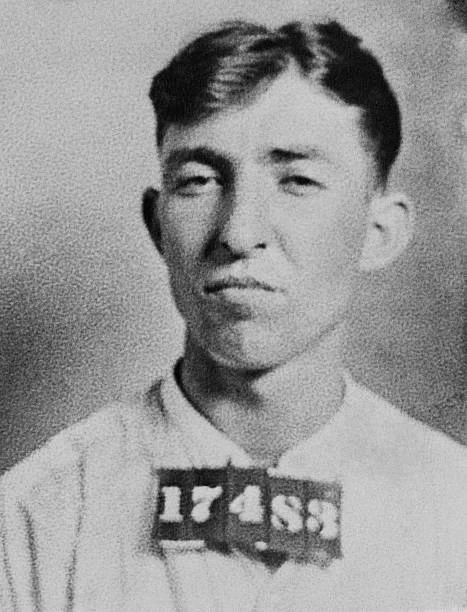
Eddie Green was a Minnesota underworld figure who became part of John Dillinger's Twin Cities network in 1934. He had a criminal record stretching back well before Dillinger arrived in St. Paul, and federal records place him among the men who helped provide shelter, contacts and logistics during one of the most intense phases of the Dillinger manhunt.
Early record
Fingerprint records connect Green to an arrest for grand larceny in Milwaukee in 1916. In 1922 he was committed to the Minnesota State Reformatory at St. Cloud for first-degree robbery, then transferred to the Minnesota State Prison at Stillwater the following year. He was paroled in July 1930.
These records matter because they show that Green was not simply a minor figure who appeared suddenly around Dillinger. He already had years of criminal experience and contacts in the Upper Midwest before the famous fugitives moved into the Twin Cities.
The Twin Cities network
After Dillinger escaped from Crown Point, Indiana, in March 1934, the gang moved through Chicago and St. Paul while federal agents expanded the manhunt. FBI history places Green in the group around Dillinger, Homer Van Meter, Baby Face Nelson and Tommy Carroll.
Green's value appears to have been partly logistical. He knew people, places and routines in Minnesota, and his connections gave the fugitives access to apartments, vehicles and medical help away from their better-known Indiana base.
Bank-robbery allegations
Later investigative material and witness statements associated Green with the March 1934 robberies at Sioux Falls, South Dakota, and Mason City, Iowa. The surviving evidence is not equally strong for every participant or every claimed role, so Green's exact involvement in those robberies should be treated more cautiously than his documented presence in the St. Paul network.
The distinction matters. Green was unquestionably connected to the Dillinger circle; the precise roster for individual robberies is less certain.
Lincoln Court and Dillinger's wound
On March 31, 1934, federal agents confronted members of the Dillinger group at the Lincoln Court Apartments in St. Paul. Homer Van Meter exchanged gunfire with law enforcement, and Dillinger and Evelyn Frechette escaped from the building.
The FBI later stated that Dillinger, wounded during the escape, went to Green's apartment. Statements collected during the investigation also describe Green helping arrange medical treatment through Dr. Clayton May.
That episode placed Green directly inside the support network that allowed the gang to remain mobile after violent encounters with federal agents.
Federal agents find Green
Agents located one of Green's St. Paul hideouts on April 3, 1934. The FBI's later history states that Green attempted to draw a gun and was shot by agents.
Contemporary and investigative accounts are not perfectly uniform about the opening moments of the shooting. That disagreement should remain visible rather than being flattened into a single dramatic version.
Green survived the initial shooting and was taken to a hospital in St. Paul.
The hospital interview
While badly wounded, Green was interviewed by federal investigators. An investigative report describes a lengthy bedside interview while his condition was serious and at times unstable.
The interview became useful to investigators because Green sat at the intersection of several people they were trying to locate. Even so, statements made by a gravely wounded prisoner have to be read with care and alongside other records.
Death and aftermath
Green never recovered from the wounds he received on April 3. The FBI's history of the Dillinger case states that he died in a hospital eight days after the shooting, placing his death on April 11, 1934.
Some later secondary accounts give April 10, but April 11 is the stronger reconstruction in the source set used here. Green was 35 years old.
A specialist chronology reports that he was buried at St. Peter's Cemetery in Mendota, Minnesota. Because a separate official cemetery record has not yet been located, the burial location should be treated as reported rather than independently confirmed.
Green's death removed an important Twin Cities contact just as federal pressure on Dillinger's circle was increasing. Within months, several of the network's best-known figures would also be dead, imprisoned or fugitives under intense nationwide pursuit.
Why Green mattered
Green was never as famous as Dillinger, Nelson or Van Meter, but that is precisely why his role is useful. Fugitive gangs depended on less famous associates who could supply shelter, transportation, medical contacts and local knowledge.
His short period beside the Dillinger gang illustrates how these networks functioned away from the headlines: not as a fixed roster moving everywhere together, but as overlapping circles of fugitives, local criminals, partners and helpers.
Historical reputation
Green is often reduced to a footnote in larger Dillinger narratives. The documentary record gives him a more specific place: an experienced Minnesota criminal who became a practical connection point for the gang during the St. Paul phase of the 1934 manhunt.
That role is more historically useful than inflating him into a major gang leader or assigning him every crime later associated with the group.
Documented network
John Dillinger (person): Direct St. Paul criminal-network associate; FBI states Dillinger teamed with Green and later fled to Green's apartment after Lincoln Court.
Homer Van Meter (person): Skinner told FBI Van Meter had known Green since about Jan. 1 1934 and Harry Sawyer put them in contact; Van Meter went to Green's apartment after Lincoln Court.
Tommy Carroll (person): Both appear in the post-Crown Point/Twin Cities network; Green's hospital utterances referenced Carroll and FBI/archives place them in the same network.
Lester Joseph Gillis / Baby Face Nelson (person): Both identified in the St. Paul Dillinger group and Indiana Archives 'Merger with Nelson' network phase.
Bessie Skinner (person): Skinner used aliases including Mrs. Edward Green and lived with Green under Stevens/Stephens names; later convicted of harboring Dillinger.
Dr. Clayton E. May (person): Green contacted May in connection with treatment for wounded Dillinger according to Skinner's FBI account.
Harry Sawyer (person): Skinner's FBI account says Sawyer put Van Meter in touch with Green.
Minnesota State Reformatory, St. Cloud (prison): First-degree robbery commitment prior to transfer.
Minnesota State Prison, Stillwater (prison): Transferred from St. Cloud; paroled July 1 1930.
Dillinger criminal network (organization): Use as a descriptive network entity, not evidence of a formal incorporated or fixed-membership organization.
Milwaukee grand larceny arrest (event): Fingerprint-linked record lists Eugene Green arrested for grand larceny.
St. Cloud first degree robbery commitment (event): Eddie Green was received at the state reformatory for first-degree robbery.
Transfer to Minnesota State Prison (event): Transferred from St. Cloud to Minnesota State Prison for first-degree robbery.
Parole from Minnesota State Prison (event): FBI fingerprint record lists parole on July 1, 1930.
Timeline and case connections
Structured events are kept separate from general biography so later audits can update dates, convictions, killings, organizational changes or court outcomes without rewriting unrelated material.
1916-08-11 — Milwaukee grand-larceny arrest. Fingerprint-linked record lists Eugene Green arrested for grand larceny.
1922-11-15 — St. Cloud first-degree robbery commitment. Eddie Green was received at the state reformatory for first-degree robbery.
1923-07-26 — Transfer to Minnesota State Prison. Transferred from St. Cloud to Minnesota State Prison for first-degree robbery.
1930-07-01 — Parole from Minnesota State Prison. FBI fingerprint record lists parole on July 1, 1930.
1934-03-06 — Security National Bank robbery, Sioux Falls. Later specialist chronology and FBI interview material attribute Green to the Sioux Falls robbery alongside Dillinger, Van Meter, Carroll and Nelson. The package does not elevate roster-level participation beyond the evidence located.
1934-03-13 — First National Bank robbery, Mason City. Bessie Skinner later named Green among participants and specialist chronologies repeat the attribution. Exact individual roles require event-level primary corroboration.
1934-03-31 — Lincoln Court Apartments shootout and escape. FBI agents encountered Van Meter and then gunfire from the Hellman apartment. Dillinger, Frechette and Van Meter escaped to Green-connected shelter/logistics.
1934-03-31 — Green arranges medical help for wounded Dillinger. FBI history says Dillinger reached Green's apartment for treatment; Skinner interview material describes Green helping secure Dr. Clayton May for Dillinger.
1934-04-03 — Federal-agent shooting of Eddie Green. Federal agents shot Green during an operation. The modern FBI account says he attempted to draw a gun; a contemporary newspaper photo caption reports witnesses saying agents opened fire as he approached the house; Agent Wood's FBI account states he did not see Green when shooting began.
1934-04-03 — FBI bedside interview at Ancker Hospital. Special Agent Noonan recorded statements from Green over roughly six hours while Green was seriously wounded and intermittently delirious.
1934-04-11 — Death of Eddie Green. Preferred reconstruction: Green died eight days after the April 3 shooting. Exact day conflicts with tertiary April 10 claims.
1934-04-11 — Reported burial of Eddie Green. A specialist timeline reports burial at St. Peter's Cemetery; no cemetery/official burial record was located in this pass.
Status and record
The structured birth record lists 1898-11-02 in Pueblo, Colorado, United States. The death record lists 1934-04-11 in St. Paul, Minnesota, United States. Cause: Gunshot wounds. Green was shot by federal agents in St. Paul on April 3, 1934 and died in a hospital eight days later, on April 11.
Source record
The Master package currently attaches these sources to the profile: – John Dillinger — Tier 1. – Bremer Investigation Summary Part 01 (FBI fingerprint/criminal record for Eddie Green) — Tier 1. – Bremer Kidnapping Part 175 — Bessie Skinner interview summary — Tier 1. – John Dillinger FBI file, section 10 (scan mirror) — Tier 1. – Bremer Kidnapping Part 57 — fingerprint comparison letter — Tier 1. – Charles Ross Kidnapping — Tier 1. – Criminal history file: Carroll, Thomas — Tier 1. – Dillinger Collection — Tier 1. – John Dillinger's Crime Spree — The Dillinger Situation — Tier 1. – Some Gave All — Trooper Eugene Teague — Tier 1. – FBI Law Enforcement Bulletin, December 1933 — James Jenkins status — Tier 1. – La Grande Evening Observer, March 16, 1934 — Herbert Youngblood death — Tier 2. – Moberly Monitor Index, June 7, 1934 — Dillinger Gangster Shot Down in Waterloo — Tier 2. – Reporter-Telegram / United Press, June 8, 1934 — Carroll death report — Tier 2.
Claim-level source references remain in the structured data so later audits can trace evidence rather than relying on a generic bibliography.
Evidence and editorial boundaries
For living subjects especially, legal status and allegations require dated evidence. Future expansion should come from stronger records, court material, archives or newly processed canonical entities rather than generalized crime lore.
Key events
Milwaukee grand-larceny arrest
Fingerprint-linked record lists Eugene Green arrested for grand larceny.
Milwaukee, WisconsinSt. Cloud first-degree robbery commitment
Eddie Green was received at the state reformatory for first-degree robbery.
St. Cloud, MinnesotaTransfer to Minnesota State Prison
Transferred from St.
Stillwater, MinnesotaParole from Minnesota State Prison
FBI fingerprint record lists parole on July 1, 1930.
MinnesotaSecurity National Bank robbery, Sioux Falls
Later specialist chronology and FBI interview material attribute Green to the Sioux Falls robbery alongside Dillinger, Van Meter, Carroll and Nelson.
Sioux Falls, South DakotaFirst National Bank of Mason City robbery
Institutional Iowa history lists Hamilton among participants; specialist chronology says he was wounded.
First National BankGreen arranges medical help for wounded Dillinger
FBI history says Dillinger reached Green's apartment for treatment; Skinner interview material describes Green helping secure Dr.
Twin Cities, MinnesotaLincoln Court Apartments shootout and escape
FBI agents encountered Van Meter and then gunfire from the Hellman apartment.
Lincoln Court Apartments, St. Paul, MinnesotaFBI bedside interview at Ancker Hospital
Special Agent Noonan recorded statements from Green over roughly six hours while Green was seriously wounded and intermittently delirious.
Ancker Hospital, St. Paul, MinnesotaFederal-agent shooting of Eddie Green
Federal agents shot Green during an operation.
St. Paul, MinnesotaDeath of Eddie Green
Preferred reconstruction: Green died eight days after the April 3 shooting.
St. Paul, MinnesotaReported burial of Eddie Green
A specialist timeline reports burial at St.
St. Peter’s Cemetery, Mendota, MinnesotaWhere this person was held
People, groups and places
References
-
[1]Bremer Investigation Summary Part 01 (FBI fingerprint/criminal record for Eddie Green)Tier 1SupportsMentions
-
[2]Bremer Kidnapping Part 175 — Bessie Skinner interview summaryTier 1SupportsMentions
-
[3]Bremer Kidnapping Part 57 — fingerprint comparison letterTier 1Mentions
-
[4]Bremer Kidnapping Part 58Tier 1Mentions
-
[5]Charles Ross KidnappingTier 1Mentions
-
[6]Congressional Record — Senate, June 18, 1936Tier 1Mentions
-
[7]Criminal history file: Carroll, ThomasTier 1Mentions
-
[8]Dillinger CollectionTier 1MentionsSupports
-
[9]John DillingerTier 1SupportsView source ↗
-
[10]FBI Law Enforcement Bulletin, December 1933 — James Jenkins statusTier 1Mentions
-
[11]J. Edgar Hoover memorandum, April 9, 1934Tier 1Supports
-
[12]John DillingerTier 1Supports
-
[13]Historic Minnesota bank robbery compilationTier 1Mentions
-
[14]John DillingerTier 1SupportsMentions
-
[15]John Dillinger FBI file, section 10 (scan mirror)Tier 1SupportsMentions
-
[16]John Dillinger's Crime Spree — The Dillinger SituationTier 1Mentions
-
[17]Some Gave All — Trooper Eugene TeagueTier 1Mentions
-
[18]July 2024: John Dillinger and the National Motor Vehicle Theft ActTier 1SupportsView source ↗
-
[19]American Experience: John Dillinger timeline/people and eventsTier 2Mentions
-
[20]Dillinger Captured in TucsonTier 2Mentions
-
[21]Eugene Register-Guard, April 11, 1934 — 'Are U.S. Agents Shooting to Kill?'Tier 2SupportsMentions
-
[22]Indianapolis Times, January 29, 1934 — 'Dillinger Gang Is Arraigned in Tucson Court' / 'terror mob'Tier 2Mentions
-
[23]Indianapolis Times, November 20, 1933 — Copeland 'Indiana terror mob' coverageTier 2Mentions
-
[24]La Grande Evening Observer, March 16, 1934 — Herbert Youngblood deathTier 2Mentions
-
[25]Moberly Monitor Index, June 7, 1934 — Dillinger Gangster Shot Down in WaterlooTier 2Mentions
-
[26]Reporter-Telegram / United Press, June 8, 1934 — Carroll death reportTier 2Mentions
-
[27]Bandits in Iowa (John Dillinger / Bonnie and Clyde)Tier 2SupportsView source ↗
-
[28]April 1934 TimelineTier 3SupportsMentions
-
[29]May 1934 / crime-spree chronologyTier 3SupportsView source ↗
-
[30]Eddie Green (criminal)Tier 3SupportsMentions
-
[31]File:Eddie Green.jpgTier 3Mentions
-
[32]File:Tommy Carroll Photo.jpgTier 3Mentions
-
[33]June 1934 TimelineTier 3Mentions
-
[34]March 1934 TimelineTier 3SupportsMentions
-
[35]Tommy Carroll (criminal)Tier 3Mentions