In October 1965, motorcycles and the Vietnam War protest movement collided on the streets of the Bay Area. The confrontation quickly became part of a much larger argument about the Hells Angels.
On October 16, 1965, the Hells Angels stopped being an exotic accessory to the Bay Area counterculture and became participants in one of its political street confrontations.
A Vietnam Day Committee march moved through Berkeley toward the Oakland boundary. The city of Oakland had refused to allow the march to continue toward the Army terminal. Police established a cordon at the border. On the sidewalk nearby stood members of the Hells Angels.
What followed is unusually well documented because the march later became part of federal litigation.
The court record gives us a rare contemporary account
In Hurwitt v. City of Oakland, a federal district court summarized affidavits describing the October demonstrations. According to the record, march organizers had recruited monitors and coordinated with Berkeley police. When the October 16 march reached the city boundary, it stopped before the Oakland police line.
The affidavit then describes several Hells Angels breaking through a police line, taking the march’s front banner and moving toward the monitors from behind. Monitors linked arms. Violence followed. A Berkeley police officer suffered a broken leg and several monitors were injured.
That description is valuable because it is contemporaneous and embedded in a legal proceeding rather than reconstructed decades later.
The marchers and the club represented different kinds of rebellion
Only weeks earlier, Hells Angels members had socialized in the orbit of Ken Kesey, the Merry Pranksters and writers associated with the counterculture.
The Vietnam march exposed how misleading the word “counterculture” can be when it is treated as a single political identity.
The Vietnam Day Committee represented an organized antiwar movement. The Hells Angels did not automatically share its politics simply because both groups rejected conventional middle-class norms.
The clash made that difference physical.
Police were not passive background
The confrontation took place inside a much larger dispute over whether the march could enter Oakland. Police had already blocked the route. Pro-war spectators were also present. The Hells Angels were one element in a tense environment rather than the only source of conflict.
That broader setting matters because simplified retellings can make the event sound like two groups arranging a private fight.
It was a political demonstration at a city boundary, with police, protesters, spectators, motorcycle-club members and constitutional questions all occupying the same space.
The violence changed the public conversation
The incident produced arrests and extensive coverage. It also pushed the Hells Angels into explicitly political news.
The club’s public identity had previously been built around motorcycles, violence allegations, outlaw imagery and lifestyle journalism. The October confrontation associated members with opposition to antiwar demonstrators at a moment when Vietnam was becoming one of the central political conflicts in the United States.
The result complicated the romantic image some bohemian observers had begun to project onto the club.
Allen Ginsberg and the attempt to prevent a second clash
The story did not end at the border.
In the weeks that followed, antiwar organizers and representatives of motorcycle clubs met in an effort to prevent violence at another planned demonstration. Contemporary San Francisco Chronicle archival reporting documents the strange scene: Allen Ginsberg and other activists debating motorcycle-club representatives.
Barger later publicly said Hells Angels members would not interfere with the next march.
The episode is remarkable because it shows how quickly a street clash created an improvised political negotiation between groups that had no conventional institutional relationship.
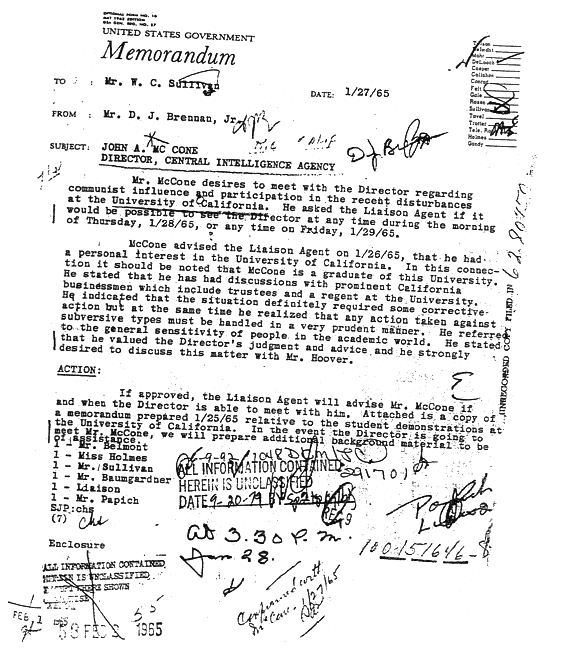
The FBI record shows how closely the protests were watched
Federal records from the period document government attention to Berkeley antiwar activity. A surviving FBI memorandum concerning UC Berkeley protests is used as the featured archival document for this Story.
The memo is not evidence that the FBI directed the Hells Angels or that the club was acting on behalf of authorities.
Its value is contextual: it shows that the protest environment around Berkeley and Oakland was being monitored at high levels of government while local police, activists and hostile spectators were confronting one another on the street.
Barger and patriotic rhetoric
Accounts from the period describe Barger presenting the Hells Angels as strongly anti-communist and supportive of the U.S. war effort. He publicly offered members for service in Vietnam in a message directed to President Lyndon Johnson.
Those statements became part of the club’s political image.
They do not establish that every member held identical political beliefs. The Hells Angels were not a political party with a published platform.
But Barger's public rhetoric helped place the organization on the opposite side of the antiwar movement in a highly visible moment.
Why this Story matters to the larger arc
The 1965 clash demonstrates why Hells Angels history cannot be told as a simple progression from motorcycles to organized crime.
The club became famous at the intersection of law enforcement, media and culture. Political conflict was another part of that visibility.
The Berkeley-Oakland confrontation also changes how we read the nearby chapters of this arc.
La Honda shows social overlap with the psychedelic scene. The border clash shows ideological distance. Thompson’s later book records both fascination and violence. Altamont takes the uneasy relationship between the club and the rock counterculture and puts it under movie cameras in front of a huge crowd.
Established: Hells Angels members confronted Vietnam Day Committee marchers at the Berkeley-Oakland boundary on October 16, 1965; the court record describes members breaking through a police line, seizing a banner and an ensuing violent clash in which people were injured.
Not established: that the club was acting as an agent of law enforcement or government. The existence of police and FBI surveillance does not prove coordination with the Hells Angels.
What the record establishes — and what it does not
A federal court record describes Hells Angels members breaking through a police line, seizing a march banner and an ensuing clash in which a police officer and monitors were injured.
The existence of police lines and FBI surveillance does not establish that the Hells Angels acted as agents of law enforcement or government.
People and groups in this story
Don’t stop here
References
- LD 38 – Chapter 3: Organized Crime Gangs · California Commission on Peace Officer Standards and Training · View source ↗
- McCone-Hoover, UC Berkeley 1965 · FBI record / Wikimedia Commons · View source ↗
- Hurwitt v. City of Oakland, 247 F. Supp. 995 · U.S. District Court / Justia · View source ↗
- Sonny Barger, counterculture force and face of the Hells Angels, dies · Los Angeles Times · View source ↗
- Hells Angels vs. Allen Ginsberg: The unlikely Vietnam War-era confrontation · San Francisco Chronicle · View source ↗