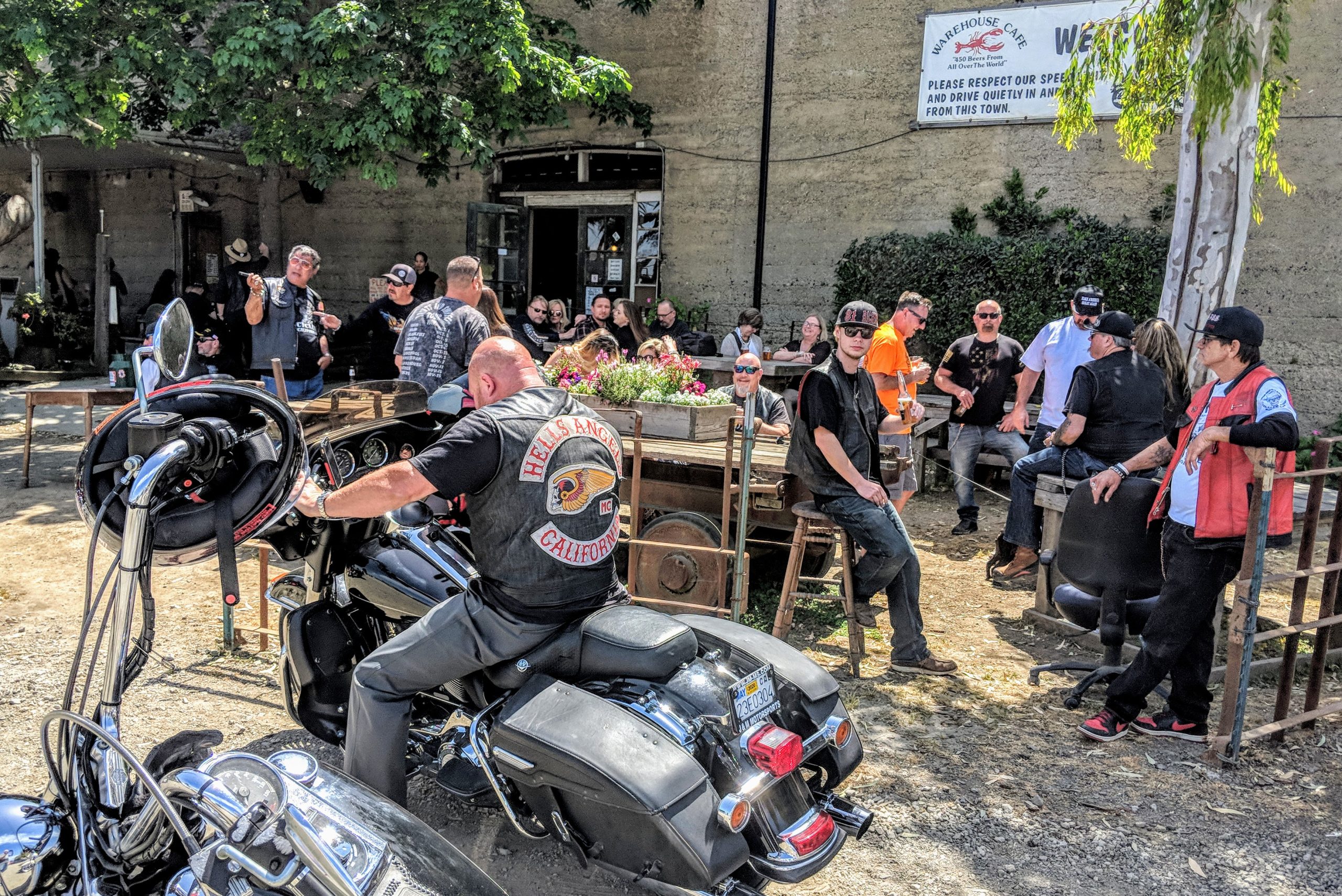
The Hells Angels and Ken Kesey’s counterculture occupied very different worlds. Their encounter in 1965 produced one of the era’s strangest cultural overlaps—and decades of retelling.
In the summer of 1965, the Hells Angels entered a very different kind of American story.
Until then, much of the attention surrounding the club came from police files and alarmed newspaper coverage. At Ken Kesey’s property in La Honda, south of San Francisco, members instead moved through the emerging psychedelic counterculture: writers, musicians, Merry Pranksters, experimental film, amplified music and a social world that was deliberately testing conventional limits.
The meeting did not make the Hells Angels hippies. It showed how close very different forms of rebellion could temporarily come to one another.
Thompson was the bridge
Hunter S. Thompson had been spending time around Hells Angels members while researching the work that would become his first major book. Through that access, he helped connect members with Ken Kesey and the Merry Pranksters.
Accounts of the period describe a gathering at Kesey’s La Honda property in August 1965. The location was already becoming associated with the experimental social scene that would soon produce the Acid Tests.
The Pranksters’ 1965 handbills survive as unusually vivid artifacts of that world. Their typography and improvised design look almost impossibly distant from a California justice report issued the same year.
Yet the Hells Angels existed in both worlds at once.
Why the meeting fascinated writers
The Angels and the Pranksters shared some superficial traits: hostility to conventional respectability, enthusiasm for loud machinery and music, a taste for spectacle and a willingness to occupy social space aggressively.
The similarities ended quickly.
Kesey’s circle was experimenting with psychedelics, communal performance and a philosophy that imagined consciousness itself could be transformed. The Hells Angels were a male motorcycle club built around loyalty, territory, toughness and internal hierarchy.
The encounter worked because neither side required ideological agreement in order to enjoy a party.
That made it historically revealing.
The motorcycle sound became part of the spectacle
Contemporary descriptions of Hells Angels gatherings often emphasize sound: engines arriving before the riders could be seen, bikes clustered around a property, exhaust and mechanical noise mixing with amplified music.
At La Honda, motorcycles were not simply transportation. They were part of the atmosphere.
The visual iconography that newspapers had framed as threatening could be reinterpreted by the counterculture as theatrical, anti-bourgeois and exciting.
This was one of the moments when the Hells Angels image became culturally portable. The same colors that frightened a town council could make a psychedelic party seem more dangerous and authentic.
Publicity changed both sides
The Hells Angels gained something from proximity to writers and artists: access to audiences far beyond motorcycle culture.
The counterculture gained something too. The presence of the Angels allowed parties and stories to flirt with real physical danger rather than only symbolic rebellion.
That exchange created a problem that would recur through the decade. Outsiders could be fascinated by the club’s reputation while underestimating how quickly violence could replace performance.
Thompson understood this better over time. His reporting became increasingly resistant to romantic outlaw mythology even as his prose helped make the mythology famous.
The Acid Test image belongs to the same moment
That distinction matters.
In this case, the handbill records the Merry Prankster visual world that emerged from the same 1965 network of people and places.
A temporary alliance, not a shared movement
Later nostalgia sometimes compresses the 1960s into one counterculture. That makes the Hells Angels, Beat poets, antiwar organizers, psychedelic musicians and Merry Pranksters look like different wings of the same rebellion.
They were not.
The club’s relationship with the antiwar left would become openly hostile only weeks after the La Honda gathering. In October, Hells Angels members confronted Vietnam Day Committee marchers at the Berkeley-Oakland border.
That sequence is one of the best reasons to keep events in chronological order.
La Honda makes the October confrontation surprising. The confrontation makes La Honda easier to understand: the social overlap had never meant political unity.
Thompson’s access becomes historically important
Without Thompson, much of the period might survive as police statistics on one side and participant mythology on the other. His position gave him access to both the ordinary social world around members and the violence that could erupt inside it.
His eventual falling-out with Hells Angels members is often treated as a colorful end to the reporting project. More importantly, it demonstrated the limits of journalistic immersion.
A reporter can become accepted without becoming a member. He can understand internal logic without endorsing it. He can also discover that friendship does not remove the risk created by unequal power and group violence.
Why La Honda belongs in the Hells Angels arc
This event did not produce a major criminal case. No government agency reorganized because of it. Its importance is cultural.
The Hells Angels were becoming more than a police subject. They were entering literature, music and the visual language of the 1960s.
That cultural visibility would make every later confrontation larger. When club members appeared at a protest or stood beside the stage at Altamont, the public was already primed to interpret the image.
Established: Hells Angels members entered Kesey’s La Honda social circle in 1965 through the network that included Hunter S. Thompson; the encounter became part of the documented Bay Area counterculture story.
Not established: that the club and the psychedelic movement shared a coherent ideology or political program. Their later conflicts show the opposite.
What the record establishes — and what it does not
Hells Angels members entered Kesey’s La Honda social circle in 1965 through the network that included Hunter S. Thompson.
The event did not make the Hells Angels part of a unified psychedelic or left-wing political movement.
People and groups in this story
Don’t stop here
References
- Original 1965 Acid Test Flyer Print · Wikimedia Commons · View source ↗
- Ken Kesey, Hunter S. Thompson and the Hell’s Angels at La Honda: August 7th, 1965 · American Short Fiction · View source ↗
- Sonny Barger, counterculture force and face of the Hells Angels, dies · Los Angeles Times · View source ↗