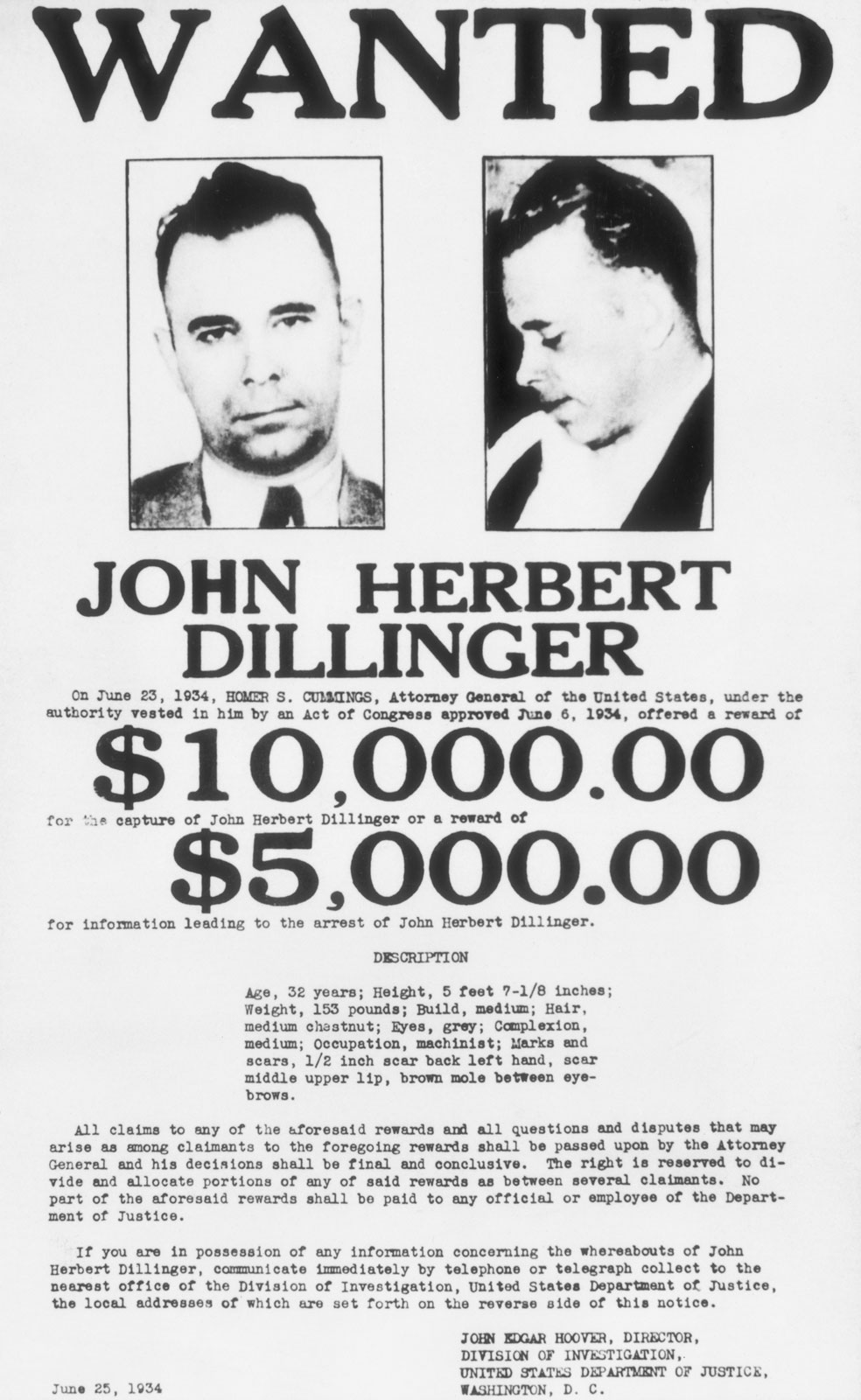
The image used with this Story is a federal wanted poster from the Dillinger manhunt period. It is not presented as a photograph of the South Bend robbery. That distinction matters. For several events in 1934, surviving images of the exact crime scene either carry unclear reuse rights or are not readily available; an authentic contemporary document is better than an invented reconstruction.
On June 30, 1934, John Dillinger, Baby Face Nelson and Homer Van Meter participated in the robbery of Merchants National Bank in South Bend, Indiana. By this point Dillinger had escaped Crown Point, survived the failed federal raid at Little Bohemia and remained the subject of an expanding national pursuit.
The robbery was violent. South Bend police responded, gunfire followed, and police officer Howard Wagner was killed. The available FBI historical material confirms the participation of Dillinger, Nelson and Van Meter, but it does not settle in the source we are using which robber fired the fatal shot that killed Wagner.
That restraint is important because famous criminal biographies tend to absorb every act committed by a group into the name of its best-known member. The result can be a false precision: readers are told exactly who fired a shot even when contemporary accounts disagree or later summaries do not establish it. The better approach is to preserve what is clear—who participated, who died, when and where—and mark the unresolved part honestly.
By summer 1934, bank robbery was no longer just a local matter in public perception. Newspapers linked crimes across state lines into a national “public enemy” narrative, while federal agencies were gaining new statutory powers. The wanted poster belongs to this environment. It turns a fugitive into a standardized set of identifying information meant to travel farther and faster than the person being pursued.
South Bend also shows how little time remained. The robbery happened less than a month before Dillinger’s death. The group around him was fragmenting. Some associates had been arrested or killed; others were operating in smaller combinations. Nelson, who participated at South Bend, would outlive Dillinger by only four months.
The death of Officer Wagner should remain central to the story. The robbery was not a performance for newspapers or a challenge to a bank’s insurance company. Armed men entered a city, took money and exchanged gunfire with police. A public servant died responding to the crime. That consequence is part of the event’s historical significance, regardless of which robber’s bullet proved fatal.
After South Bend, the story shifts from robberies to intelligence and surveillance. Federal investigators were increasingly focused on Dillinger’s social circle in Chicago. Anna Sage, facing immigration problems, became a source. She told authorities that she expected to attend a movie with Dillinger and Polly Hamilton on July 22.
That evening, the manhunt converged on the Biograph Theater.
Historical imagery requires the same evidentiary care as written claims. A document, map, genuine location photograph or even no image is preferable to an unlabeled reconstruction presented as historical evidence.
The robbery itself still supplies strong narrative movement. It links the Little Bohemia fugitives to the final weeks of the Dillinger chase and keeps Nelson and Van Meter inside the same network. It also gives Officer Wagner a specific place in the arc rather than leaving him as a footnote in a famous outlaw’s chronology.
What the record establishes — and what it does not
FBI history confirms Dillinger, Nelson and Van Meter participated in the June 30 robbery and that a police officer was killed.
The source used here does not establish which robber fired the fatal shot that killed Officer Howard Wagner.
People and groups in this story
Don’t stop here
References
- John Dillinger · FBI · View source ↗
- Lester Gillis (“Baby Face” Nelson) · Federal Bureau of Investigation · View source ↗
- Lester Gillis (“Baby Face” Nelson) · Federal Bureau of Investigation
- The FBI and the American Gangster, 1924-1938 · Federal Bureau of Investigation · View source ↗