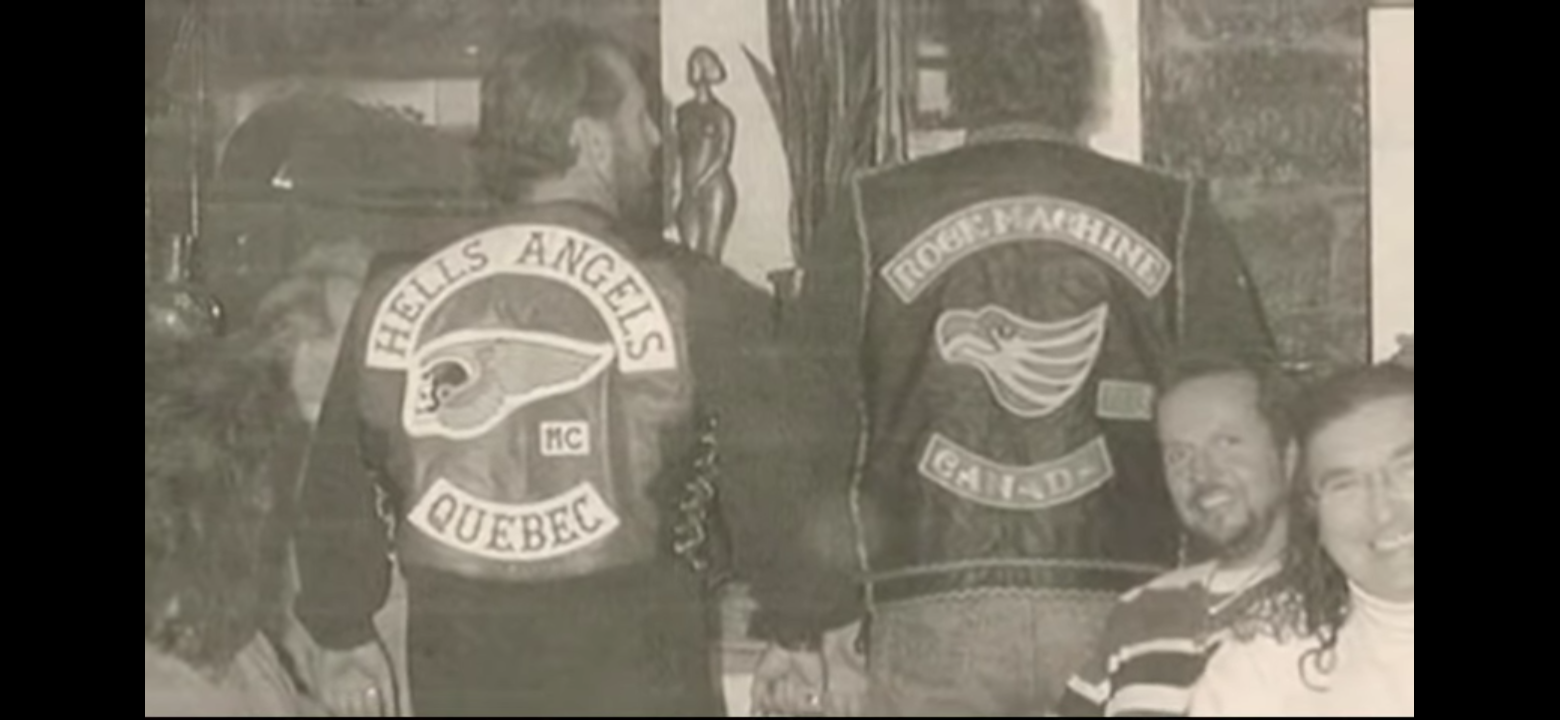
It was not one fight in a bar. The Quebec Biker War escalated into years of shootings, bombings and deadly competition in the province’s illicit markets—with consequences reaching far beyond the clubs.
The Quebec biker war was not one shootout, one feud or one criminal prosecution. It was a prolonged struggle over power in Quebec’s illicit markets that ran from 1994 into the early 2000s and repeatedly spilled into public space.
The simplest label is Hells Angels versus Rock Machine. That headline is useful, but it hides the structure underneath. The conflict involved Hells Angels chapters, the elite Quebec Nomads chapter, affiliated groups, the Rock Machine and its allies, independent traffickers, contract killers, shifting loyalties and a police response that grew larger as the violence became harder to contain.
At the center was money. Control of cocaine and other drug-distribution networks meant revenue, territorial leverage and the ability to decide who could operate in particular markets. The patches were visible. The market was the engine.
Why the war began
By the early 1990s, the Hells Angels were already an established force in Quebec organized crime. The organization’s expansion created pressure on dealers and groups that did not want to operate under Hells Angels influence.
The Rock Machine became the best-known rival bloc. It was not simply a motorcycle-club dispute over identity or prestige. Academic analysis of the conflict emphasizes competition in illicit drug markets, especially cocaine distribution, as a central structural cause.
That distinction matters. A personal insult can trigger a shooting, but it does not explain years of violence. A profitable market can.
When access to territory, supply and wholesale distribution is at stake, removing one person does not necessarily end the dispute. Another person can take the route, the clientele or the territory. That is one reason the Quebec conflict proved so persistent.
1994: open conflict
Sources differ on the exact incident that should be called the opening shot. Long criminal conflicts rarely begin as neatly as conventional wars.
What matters more than the label attached to one killing is what followed: retaliation became systematic. Shootings, bombings and arson accumulated. People connected to rival networks were targeted in homes, vehicles, businesses and public places.
The violence developed its own momentum. Each attack could change alliances, generate revenge and create openings in the drug market. The conflict therefore became both a struggle for criminal-market control and a cycle of retaliation.
Maurice Boucher and the Quebec Nomads
Maurice “Mom” Boucher became one of the most important Hells Angels figures in Quebec during this period.
Public Safety Canada research describes Boucher as leader of the elite Quebec Hells Angels Nomads chapter. Unlike an ordinary geographically fixed chapter, the Nomads concept carried a different symbolic and organizational weight. In Quebec, the chapter became closely associated with Boucher and with the Hells Angels’ most aggressive period of expansion.
That is also why reducing the conflict to “Boucher versus the Rock Machine” is too simple. Boucher was a major figure, but the war involved organizations and networks larger than any one person.
The Rock Machine as the rival bloc
The Rock Machine became the most recognizable organized resistance to Hells Angels-aligned expansion.
Its importance was not that it mirrored the Hells Angels perfectly. The two sides were not equal armies with identical structures. Rather, the Rock Machine became a rallying center for people and networks unwilling to accept Hells Angels dominance.
Alliances changed. Individuals moved between groups. Associates could be more important operationally than formal members. Some violence was linked directly to club structures; other incidents involved people in the wider criminal ecosystem.
That fluidity is essential to understanding the war. A static membership chart gives a false sense of order to a conflict that was constantly changing.
Bombings made the war a public crisis
Organized-crime violence can remain politically distant when the public believes criminals are only attacking one another. Bombs destroy that separation.
Explosives do not respect the boundaries of a criminal feud. They damage surrounding buildings and vehicles. They endanger families, pedestrians and people who happen to be nearby.
The death of 11-year-old Daniel Desrochers in 1995 became one of the defining public tragedies of the Quebec biker war. He was fatally injured by an explosion associated with the conflict. His death intensified public anger because it demonstrated, in the starkest possible way, that the war could kill people who had no part in it.
That moment belongs in the central history of the conflict, not as a sensational detail but as evidence of why the political response hardened.
Violence, markets and intimidation
The war combined several forms of coercion.
There were killings and attempted killings. There were bombings and arsons. There was intimidation designed to make rivals withdraw from territories or supply relationships. There were attacks whose precise authorship remained contested or unresolved.
What can be said with confidence is that the aggregate pattern was severe enough to reshape policing and legislation in Canada.
The market behind the violence
Public Safety Canada research on organized drug trafficking provides useful context for why Quebec’s biker organizations mattered beyond street-level dealing.
Research on trafficking through the Port of Montreal describes cooperation during the 1990s and early 2000s among major criminal networks, including Hells Angels figures, the Montreal Mafia and the West End Gang. The point is not that these organizations became one unified group. They performed different roles within trafficking and distribution networks.
That kind of specialization helps explain the value of territorial control. A group did not need to own every stage of the supply chain to profit. It could dominate a particular stage — import access, transportation, wholesale distribution, enforcement or regional retail — and cooperate with other criminal networks where interests aligned.
In that environment, control over distribution territory was economically significant enough to sustain prolonged violence.
Police had to change too
The biker war forced law enforcement to work across the boundaries that organized crime was already crossing.
Local investigations could solve individual offences, but a province-wide network required a broader picture. Investigators needed to connect murders, drug trafficking, firearms, money, club structures and relationships across municipalities and police jurisdictions.
Specialized anti-gang and joint investigative teams became increasingly important. The state’s response also moved toward legal tools aimed at criminal organizations rather than treating every offence as an isolated act.
This did not end the war immediately. It changed the institutional environment in which the war was being fought.
Operation Springtime
By 2001 the response had reached a different scale.
Operation Springtime became one of the major police blows against the Hells Angels and associated networks in Quebec. The operation belongs inside the biker-war story because it represented the accumulated law-enforcement response to years of violence and trafficking investigations.
The Nomads chapter was central to that investigative landscape. Later reporting described Operation Springtime as having crippled the Hells Angels Nomads chapter run by Boucher.
The operation did not magically erase organized crime in Quebec. No single raid can do that. But it altered leadership, disrupted networks and demonstrated how far the police response had evolved since the early years of the war.
Why 2002 is used as the closing marker
Many histories describe the Quebec biker war as running from 1994 to 2002.
That does not mean every feud, prosecution or criminal relationship ended at midnight on a particular date. Historical periods are rarely that tidy.
The 2002 marker is useful because the combination of arrests, prosecutions, organizational changes and the weakening of the wartime structure had transformed the conflict. The period of sustained violence commonly identified as the biker war had largely passed into a different phase.
The consequences continued for years in courtrooms and prisons.
The casualty problem
Published accounts often cite more than 150 or more than 160 deaths associated with the war, together with large numbers of wounded people. Those totals vary depending on which incidents and years a source includes.
The uncontested point is scale: this was not a small sequence of isolated gang killings. It was one of the most sustained episodes of organized-crime violence in modern Canadian history, with participants, associates and bystanders among the dead and injured.
A war that changed public policy
The Quebec conflict became politically important because it exposed the limits of older approaches to organized crime.
A network could operate across municipal boundaries. Members and associates could perform specialized roles. Violence could be outsourced. Drug markets could survive the removal of individual participants. Criminal organizations could use reputation itself as a tool of coercion.
The response therefore expanded beyond homicide investigation. It increasingly included conspiracy cases, criminal-organization provisions, financial investigation, intelligence sharing and coordinated raids.
That institutional change is part of the legacy of the war.
What the Hells Angels label does — and does not — prove
The Hells Angels were one of the central organizations in the conflict. The Quebec Nomads were a significant Hells Angels formation. Maurice Boucher was a major Hells Angels figure. The Rock Machine was the principal rival bloc.
Those statements describe organizational history.
They do not mean every Hells Angels member participated in every violent act, every Rock Machine member knew about every attack, or every unsolved incident can be assigned to a side merely because it occurred during the war.
That distinction is crucial for a source-bound archive. The broader conflict can be established without turning organizational association into proof of individual criminal responsibility.
The Quebec war inside the larger Hells Angels story
For this archive, the Quebec biker war is the central chapter in a larger sequence.
The 1985 Lennoxville purge belongs to the earlier history of Hells Angels consolidation and internal violence in Quebec. The 1994–2002 biker war shows the organization confronting an external rival network over illicit-market power. Operation Springtime in 2001 represents the large-scale police counterattack that developed in response to years of violence and investigation.
The newly created Hells Angels Nomads (Quebec) entity sits in the middle of that sequence.
Lennoxville → Hells Angels expansion → Maurice Boucher → Quebec Nomads → Quebec Biker War → Rock Machine → Operation Springtime → prosecutions and imprisonment.
The value of that graph is not decorative. It allows each article to explain one part of the story while still making the larger system visible.
Legacy
The Quebec biker war changed the public image of outlaw motorcycle clubs in Canada, but its larger significance was institutional.
It demonstrated how violence, illicit markets, alliances and organizational identity could reinforce one another over years. It forced police agencies to coordinate at a scale the conflict demanded. It contributed to public pressure for stronger organized-crime tools. And it left a long trail of prosecutions, prison sentences and historical disputes over individual events.
For the Hells Angels, Quebec became one of the most consequential chapters in the organization’s history outside California.
For Quebec, the war was a reminder that an underworld conflict can become a public-security crisis long before most of the public understands the network behind it.
Inside the Story: The Evidence and Its Consequences
This was not a feud confined to clubhouses. A fight over illicit market power brought shootings, bombings and the death of a child into Quebec’s streets — and eventually forced a sweeping police response.
- Main period1994–2001, with some chronologies extending to 2002
- Main rivalsHells Angels-linked networks and Rock Machine-aligned rivals
- Research focusCompetition for Quebec cocaine markets
- Police responseAnti-gang units, Project HARM, Operation Springtime
Timeline: what happened, and when
- 1994: Violence escalates following the killing of a member of an Hells Angels-affiliated group, according to public-safety research.
- 1995: A bombing kills eleven-year-old Daniel Desrochers, increasing public pressure to confront biker violence.
- October 1995: Provincial anti-gang enforcement intensifies in the wake of public outrage.
- 1997: Two Quebec prison guards are murdered; Maurice Boucher is later convicted of ordering their murders.
- 1997–1999: Project HARM targets street-level violence; the conflict remains unresolved.
- September 2000: Journalist Michel Auger survives a shooting, deepening concern over the violence.
- March 28, 2001: Operation Springtime launches a major police offensive against Hells Angels-linked networks.
- 2002: The legal aftermath continues; Maurice Boucher is convicted in the prison-guard murders.
What was the Quebec Biker War really about?
Canada’s Public Safety research describes an important reversal in Montreal’s illicit cocaine market. Earlier, major criminal networks operated within a relatively stable arrangement of overlapping interests. According to the research, a drive to consolidate and monopolize parts of that market upset the balance and triggered violent competition. The conflict was therefore not merely about club insignia or wounded pride; it involved who could exercise power over distribution and revenue.
The Hells Angels and Rock Machine were the most recognizable rival identities, but the wider conflict included affiliated groups, independent traffickers and other criminal networks. Treating every actor as a card-carrying member of one of two clubs strips away the economic and organizational picture that explains why the violence spread.
Why 1994 is the beginning — and why the ending is disputed
Public Safety Canada’s case study places the outbreak of war in 1994, after the killing of a member of a Hells Angels-affiliated gang. Retaliation expanded into a pattern of violence. Researchers examining the conflict often use 1994–2001, when a major police operation disrupted prominent networks. Other historical summaries use 1994–2002 to include the legal and organizational aftermath.
Both ranges are defensible for different purposes, but they cannot be mixed carelessly. This timeline labels 2001 as a major enforcement turning point and 2002 as part of the extended aftermath, not as proof that every local confrontation ceased on a single date.
The bombing that killed Daniel Desrochers
An eleven-year-old boy, Daniel Desrochers, was killed by a car bombing in Montreal in 1995. The case moved the conflict far outside the world of rival traffickers. Parliament later referred to the child’s death while discussing the climate of fear and the need for anti-organized-crime legislation. The official US Office of Justice Programs archive likewise singled out the death of an innocent boy during the bombing campaign.
A careful account should not imply that mere association with a particular club proves individual responsibility for the killing. The established significance of this incident is the human cost to the public and its role in reshaping the political and policing response.
How a bombing campaign changed public life
A 1999 account archived by the US Office of Justice Programs describes killings, attempted murders, arson and explosives directed at clubhouses, businesses, homes, vehicles and other sites. Bombing attacks imposed risks on residents, employees and passers-by who had nothing to do with the dispute. The violence spread beyond combatants and turned an underworld competition into a public-security emergency.
The same archive reports the creation of a provincial anti-gang squad in October 1995 and later street-level police work under Project HARM. These details are worth separating from later raids: the policing response evolved over several years rather than arriving as one decisive operation.
Maurice Boucher, the Nomads and an escalating legal crisis
Maurice “Mom” Boucher became a central figure in the Quebec Hells Angels history of the period, closely associated with the Nomads chapter. His importance should be grounded in identifiable leadership roles and court outcomes, not an assumption that he personally directed every violent act attributed to the wider war.
Two prison guards, Diane Lavigne and Pierre Rondeau, were murdered in 1997. Boucher was subsequently convicted of ordering their murders after an earlier acquittal was overturned and he was tried again. These convictions are part of the documented legal aftermath; the chronology of acquittal, appeal and retrial matters because a person’s legal status changed over time.
Journalists and the threat to public accountability
The shooting of crime reporter Michel Auger in 2000 became another emblem of the climate in which organized-crime investigations and reporting occurred. A journalist being attacked while covering criminal networks is distinct from a shootout among rival criminal associates: it raises questions about intimidation of the people who bring facts to public attention.
That is one reason a responsible history of the conflict cannot be told as a catalogue of biker battles alone. It also has to describe the pressure exerted on witnesses, prison employees, journalists, courts and ordinary citizens.
Operation Springtime was a turning point, not a magic ending
Operation Springtime began on March 28, 2001, after a lengthy investigation. Contemporary criminal-intelligence reporting shows that dozens of members and associates of Hells Angels-linked networks faced proceedings involving drug trafficking, money laundering, gangsterism and alleged conspiracies. Charges varied across defendants; the fact of arrest did not establish guilt on every count.
The operation changed the shape of Quebec’s underworld and generated major court cases. Yet criminal markets adapt, and law-enforcement success is not measured only by the number of arrests on one morning. The deeper question is which organizations were disrupted, what evidence survived court scrutiny and how the remaining networks evolved.
How many died — and why the number needs a source label
Retrospective Canadian reporting frequently describes the Quebec biker conflict as claiming roughly 160 lives. That figure is an estimate attached to a broad multi-year conflict, not a list of 160 convictions or a claim that all deaths occurred in precisely the same operational period. Different studies delimit the war differently and may count deaths or collateral victims using different definitions.
For readers, the most reliable approach is to identify the source and date attached to any toll, keep killed and injured separate, and avoid turning an uncertain total into a falsely precise running scoreboard. The documented loss of civilian life is important regardless of the exact boundary used for the count.
Why the rival network mattered as much as the club badge
Rock Machine’s role cannot be reduced to an isolated motorcycle club without examining the alliances and independent criminal actors around it. An academic public-safety case study argues that a push to monopolize a previously more stable illegal market drove repeated confrontations. This is an explanatory model, not evidence that every local killing was committed for the same motive.
It also explains why a rabbit-hole reading path should move from club profiles to real events, documented alliances, investigations and court outcomes. The goal is to show how the conflict worked rather than merely repeat nicknames and violent anecdotes.
Where the story goes after the war
The visible consequence was intensified policing. The deeper aftermath lay in criminal-organization prosecutions, judicial scrutiny, law-enforcement coordination and continuing questions about the reach of competing networks. The 2001 Springtime operation and the later 2009 SHARQC offensive belong in separate event timelines because they arose from different investigative phases.
To follow the chronology responsibly, read the Lennoxville purge as a pre-war internal event, the Quebec Biker War as a later external conflict, then Operation Springtime and SHARQC as institutional responses. Their relationship is historical, not a single continuous conspiracy proven across every year.
Research sources
- Public Safety Canada — Violence, Organized Crime and Illicit Markets (2015)
- US Department of Justice / NCJRS — Hells Angels vs. the Rock Machine (1999)
- Parliament of Canada, House of Commons — September 18, 2000 debate
- Criminal Intelligence Service Canada — Annual Report 2002 (public PDF)
- TVA Nouvelles — Operation Springtime, police investigation and aftermath (2021)
- Journal de Montréal / QUB — Maurice Boucher chronology
What the record establishes — and what it does not
Government, academic and major-news sources document a prolonged conflict tied to illicit-drug-market competition, involving killings, attempted killings, bombings and arson. Maurice Boucher led the elite Quebec Hells Angels Nomads chapter during the period, and major police operations later targeted Hells Angels and Nomads networks.
The conflict involved shifting alliances and many individual incidents. Club affiliation alone does not establish responsibility for a particular unsolved attack, and published casualty totals and precise start/end markers vary by source.
People and groups in this story
Don’t stop here
References
- Violence, organized crime, and illicit drug markets: a Canadian case study · Champ pénal / Penal Field · View source ↗
- Couture c. R., 2007 QCCA 1609 · Court of Appeal of Quebec (UNODC case-law mirror) · View source ↗
- Expert Panel on Emerging Crimes — biker gangs in Quebec · Department of Justice Canada · View source ↗
- Organized Crime - Research Highlights 2015-H002 · Public Safety Canada · View source ↗
- Organized Crime and Smuggling in Canada: research discussing criminal networks and the Port of Montreal · Public Safety Canada · View source ↗
- Proportion of Criminal Incidents Associated with Organized Crime · Public Safety Canada · View source ↗
- Public Safety Canada study discussing Operation Springtime 2001 · Public Safety Canada · View source ↗
- Research on the impact of Hells Angels incarceration and Quebec anti-gang enforcement · Public Safety Canada · View source ↗
- 2009 Report on Organized Crime · Public Safety Canada / Government of Canada archive · View source ↗
- Organized Crime: Law Enforcement and Public Safety · Public Safety Canada / Government of Canada archive · View source ↗
- Liaison 12-2 (1986): outlaw motorcycle gang violence in Canada · Public Safety Canada archive · View source ↗
- Annual Review 2001 · Service de police de la Ville de Montréal · View source ↗
- Supreme Court bulletin — case summary 32431 · Supreme Court of Canada · View source ↗
- Supreme Court of Canada case file 31061 · Supreme Court of Canada · View source ↗
- Supreme Court of Canada case file 35372 · Supreme Court of Canada · View source ↗
- Sylvain Moreau v. Her Majesty the Queen — Case 32433 · Supreme Court of Canada · View source ↗
- Hells Angels vs. The Rock Machine: The War in Quebec · U.S. Department of Justice, Office of Justice Programs / NCJRS · View source ↗
- Analyse de la position des groupes et des individus dans un réseau criminel structuré autour des motards criminalisés · Université de Montréal / Library and Archives Canada · View source ↗
- Lennoxville — Registre historique du milieu motard · Atlas Noir / archival newspaper index · View source ↗
- Historical Quebec press references on the Rockers of Montreal and Luc Bordeleau · Atlas Noir index to Bibliothèque et Archives nationales du Québec press archive · View source ↗
- Dans l’antichambre d’une guerre sans merci · Le Journal de Québec · View source ↗
- Il y a 30 ans, la tuerie de Lennoxville · Le Journal de Québec · View source ↗
- Les policiers font le ménage du printemps chez les Hells · TVA Nouvelles · View source ↗