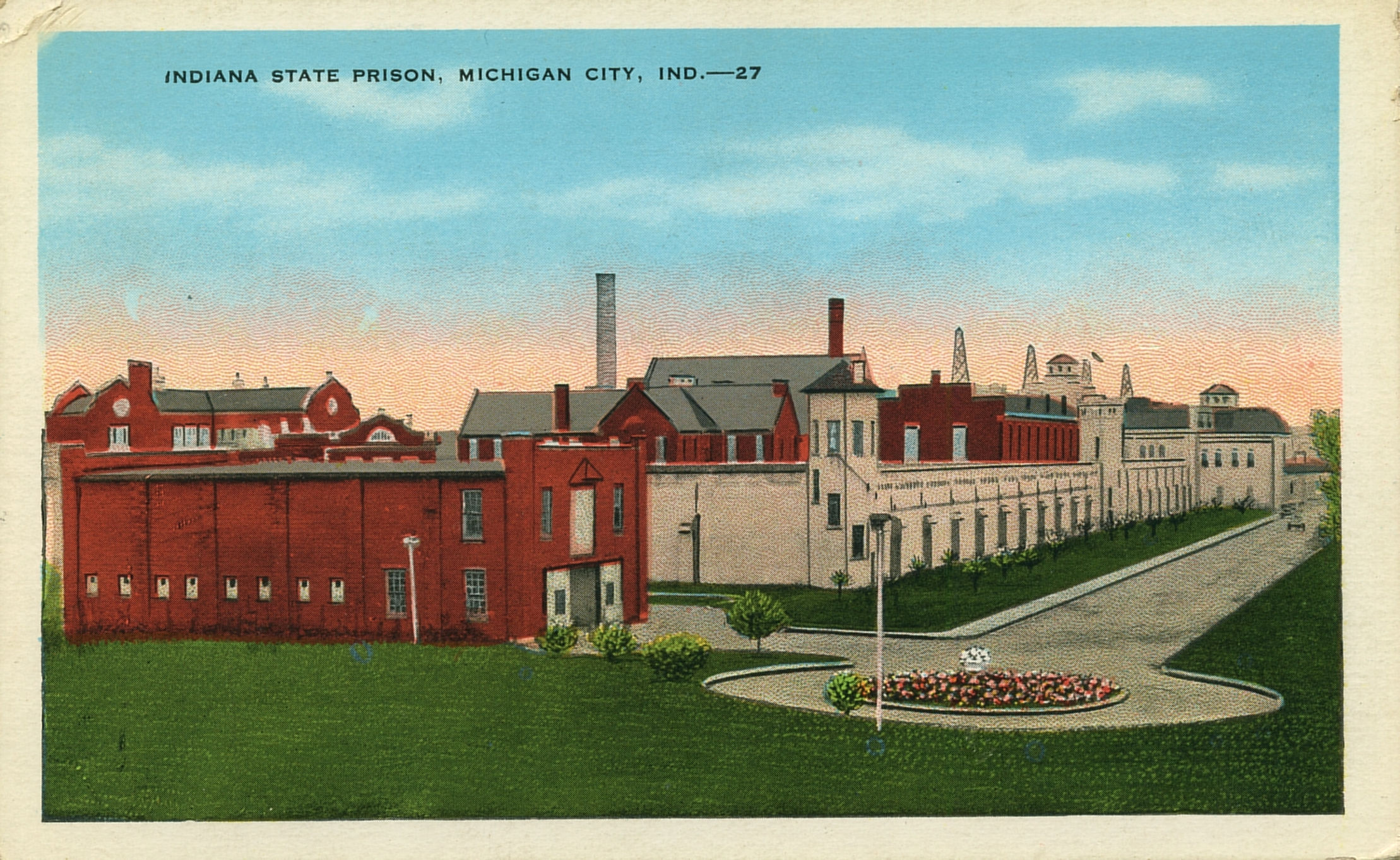
The photograph attached to this story shows Indiana State Prison at Michigan City as it looked in the 1920s: a large, fortified institution that was supposed to separate convicted men from the outside world. On September 26, 1933, that assumption failed. Eight prisoners escaped, and several of the men who got out would soon become part of the violent network surrounding John Dillinger.
The image matters because this was not simply a colorful jailbreak in the background of Dillinger’s biography. It was one of the mechanisms by which his later gang came together. Dillinger himself had been released from Indiana State Prison earlier in 1933. He had spent years in Indiana’s prison system and knew men such as Harry Pierpont, Charles Makley, John Hamilton and others who would become central figures in the next phase of his criminal career.
Four days before the Michigan City escape, police had arrested Dillinger in Dayton, Ohio. He was then moved to the Allen County Jail in Lima. According to the FBI’s historical account, authorities found plans connected to an escape from Indiana State Prison among his possessions. The FBI also records the broader claim that guns had been smuggled to prisoners before the break. What can be stated with confidence is that the prison escape and Dillinger’s arrest happened within days of one another, and that the men who escaped quickly became involved in freeing him.
On September 26, eight men broke out of the prison. The escape was violent. Guards were attacked and firearms were used. Among the escapees were men already linked to Dillinger through imprisonment and criminal association. Their freedom transformed what had been a scattered set of relationships into a mobile group capable of armed rescues, robberies and raids on police arsenals.
This is where the popular image of “the Dillinger gang” can be misleading. The network was not a fixed club with a single membership list that remained unchanged. Men moved in and out of the group; some were captured, killed, imprisoned or replaced. Prison connections mattered because they supplied trusted associates at moments when Dillinger needed them. Michigan City was therefore less a formal founding ceremony than a point at which a prison network became operational on the outside.
The timing made the consequences immediate. Dillinger was sitting in the Lima jail while several of the men best positioned to rescue him had just regained their freedom. Within a little more than two weeks, armed men entered the jail. Sheriff Jess Sarber was shot and killed, Dillinger was freed, and the group escaped. That next event turned a prison break into a chain of killings and robberies that attracted national attention.
The photograph of the prison should also keep the story grounded. The escape was not an adventure set-piece. Guards were injured, public employees faced armed men, and the prison break helped put heavily armed fugitives back on Midwestern roads. The consequences were borne by people who encountered the gang afterward, including police officers and civilians.
By early 1934, many of the same names would appear again in Tucson, where local police captured Dillinger, Pierpont, Makley and Russell Clark.
The next chapter is Lima. There, the network created by imprisonment and escape stopped being merely a group of fugitives and became responsible for the death of a sheriff during an armed jail break.## A prison network becomes a street network
The importance of Michigan City is easier to see when the later events are placed beside it. Pierpont, Makley, Hamilton and other men were not strangers who happened to meet after a newspaper headline made Dillinger famous. Prison had already created familiarity, reputation and trust. When some of those men escaped, they carried those relationships outside with them. That helps explain why later operations could be organized quickly even though the group itself remained fluid.
It also changes how the word “gang” should be read. A static roster encourages a celebrity-centered story in which Dillinger is assumed to have directed every action. A network model is more accurate: some associates acted together before him, some acted without him, and some continued after his death. The Michigan City escape is valuable because it exposes that structure at the beginning of the arc.
The institutional side of the story matters too. Prison records, mug shots and identification files later became essential tools for linking men who appeared under aliases in different states. The same correctional system that had brought future associates into contact also produced records law enforcement could use to identify them. The story is therefore not simply “prisoners escaped.” It is a point where two networks begin to take shape at once: a criminal network built from prison relationships and a law-enforcement information network built from records, fingerprints and circulated photographs.
That tension runs through the rest of the arc. The fugitives depended on movement, aliases, stolen cars and trusted contacts. Authorities depended increasingly on information that could move faster than they did.
What the record establishes — and what it does not
The September 26 escape and participation of Dillinger-linked prisoners are established in FBI/state historical records.
Later retellings differ on some details of how weapons and plans were supplied; this Story avoids assigning unproved orchestration to Dillinger.
People and groups in this story
Don’t stop here
References
- Dillinger Collection
- John Dillinger · FBI · View source ↗
- Fugitives Wanted — December 1933 · FBI Law Enforcement Bulletin archive · View source ↗
- The FBI and the American Gangster, 1924-1938 · Federal Bureau of Investigation · View source ↗
- Fugitives Wanted By Police — December 1933
- Dillinger Collection · IARA · View source ↗
- Dillinger Collection · Indiana Archives and Records Administration
- Pierpont v. State, 195 N.E. 264, 49 Ohio App. 77
- Fugitives Wanted by Police — November 1933 · U.S. Department of Justice / Division of Investigation
- Dillinger Timeline — September to December 1933
- John Dillinger Timeline