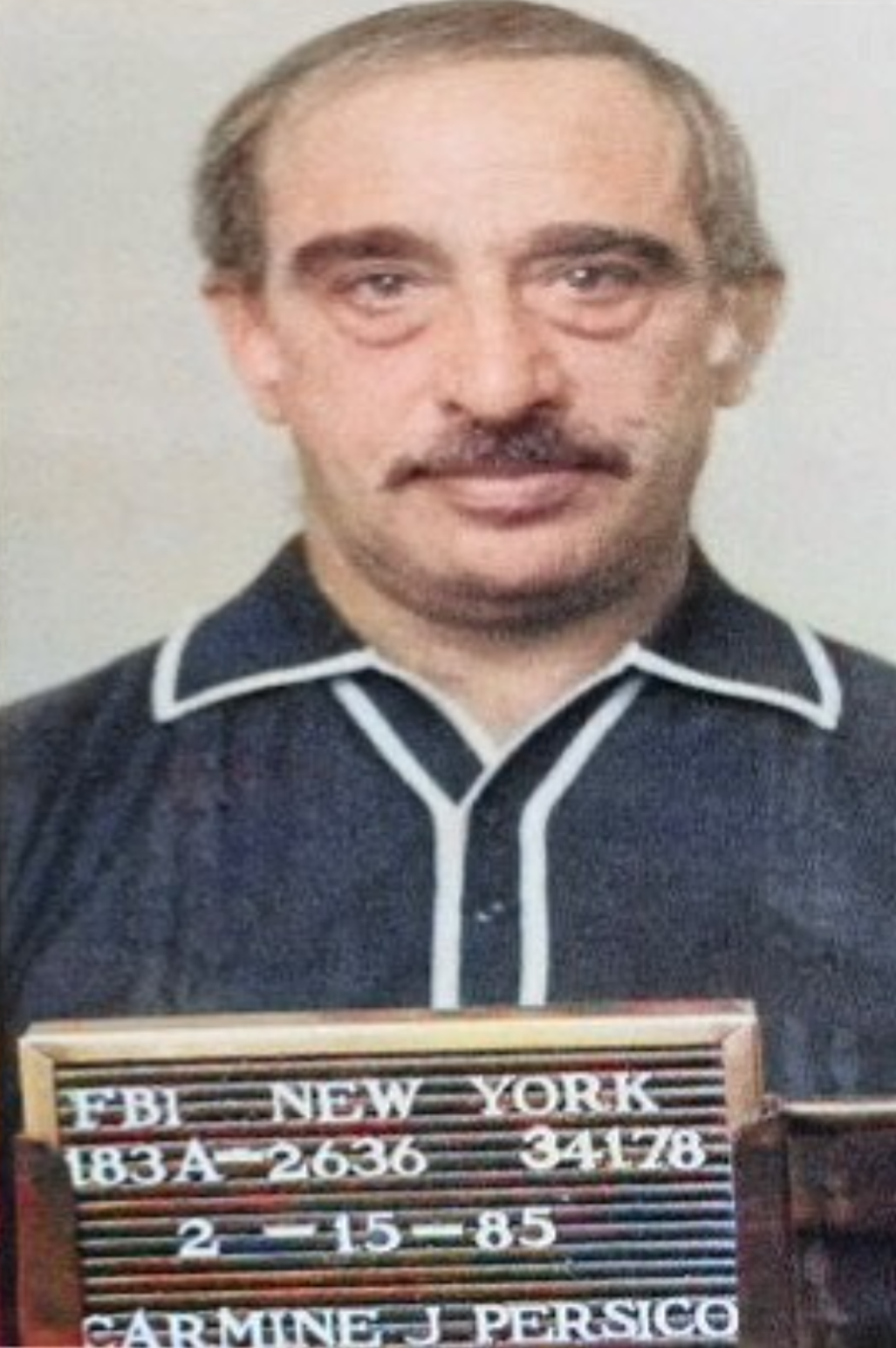
Carmine Persico was the long-serving boss of the Colombo crime family and one of the defendants whose conviction in the Mafia Commission case symbolized the collapse of an older generation of New York Mafia leadership. Known as “The Snake” in press and law-enforcement accounts, Persico spent much of his reign in prison yet remained an important figure in family politics for decades.
Born in Brooklyn in 1933, Persico entered organized crime while still young. He became associated with the Profaci organization, the family later renamed for Joseph Colombo. During the internal rebellion led by the Gallo faction, Persico initially moved around the same underworld circle but ultimately sided with boss Joe Profaci and became a significant enemy of Joe Gallo’s faction.
Persico’s rise therefore begins inside the violent internal struggles that reshaped the family in the 1960s. Joe Profaci died in 1962, Joseph Magliocco briefly succeeded him, and Joseph Colombo then became boss. After Colombo was shot in 1971 and left incapacitated, the organization went through another difficult transition.
Becoming Colombo boss
Persico emerged as the family’s dominant long-term leader during the 1970s. His control was complicated by repeated prison terms, so acting bosses and senior lieutenants often handled day-to-day affairs. That arrangement would become a defining feature of the Colombo family: formal authority remained associated with Persico even when he was physically removed from the street.
Federal investigators increasingly viewed Persico not merely as a local racketeer but as one of the bosses participating in the broader Commission structure. FBI records identify him as the Colombo boss and place him among the leaders targeted in the 1985 Commission prosecution.
The case used RICO to attack the governing structure of La Cosa Nostra. Prosecutors alleged that the bosses coordinated criminal activity through the Commission and were responsible for racketeering schemes that reached into construction and labor. Persico was convicted in 1986 and received a 100-year sentence in the Commission case.
Prison and continued influence
The sentence did not immediately end Persico’s influence. The Colombo family continued to recognize his authority, while relatives and trusted figures held important positions outside prison.
That structure produced a new crisis in the early 1990s. Victor Orena, who had been serving as acting boss, challenged the Persico faction for control. The resulting Colombo war produced murders, attempted murders and a series of federal prosecutions.
Gregory Scarpa, a Colombo captain and longtime FBI informant, became one of the most controversial figures in that conflict. Justice Department reviews later examined the FBI’s handling of Scarpa and the information exchanged between him and his handler. Those controversies did not erase Persico’s role in the family struggle, but they complicated several prosecutions arising from the war.
Persico and the Commission era
Persico’s career spans an unusually long section of Colombo history. He was present during the Profaci-Gallo conflict, rose after the Colombo era, became a Commission defendant in the 1980s and remained a symbolic boss through the internal war of the 1990s.
That longevity is partly why his story is more important than a list of convictions. His career demonstrates how Mafia authority could survive imprisonment through family ties, acting leadership and loyalty networks. It also shows the limits of that model: long-distance control contributed to factionalism and repeated instability.
Persico died on March 7, 2019, while still serving his federal sentence. He was eighty-five.
By the time of his death, the Colombo family had been transformed by decades of prosecutions, informants and internal violence. Persico nevertheless remained one of the last direct links to the generation that had fought in the Profaci wars. His life connects Joe Profaci, Joe Gallo and Joseph Colombo to the Commission trial, Gregory Scarpa and the final major Colombo civil war of the twentieth century.
Death
Carmine Persico died on March 7, 2019. The documented cause of death was Illness.
Documented network
Colombo Crime Family (organization): FBI records identify Persico as longtime boss of the Colombo family.
Joe Gallo (person): Persico sided with Profaci leadership against the Gallo faction during the family’s early-1960s civil conflict.
The Commission (organization): Persico was charged and convicted in the federal Mafia Commission prosecution.
Gregory Scarpa (person): Scarpa aligned with the Persico faction during the early-1990s Colombo war.
Timeline and case connections
Structured events are kept separate from general biography so later audits can update dates, convictions, killings, organizational changes or court outcomes without rewriting unrelated material.
March 7, 2019 — Death of Carmine Persico. Persico died while serving his federal sentence.
Status and record
The structured birth record lists August 8, 1933 in Brooklyn, New York City, United States. The death record lists March 7, 2019. Cause: Illness. Persico died while serving his federal sentence.
Source record
The Master package currently attaches these sources to the profile: – Carmine John Persico, Jr. FBI Vault — Federal Bureau of Investigation, Tier 1. – The FBI’s Compliance with the Attorney General’s Investigative Guidelines — Scarpa Case Study — U.S. Department of Justice Office of the Inspector General, Tier 1. – Five Families: The Rise, Decline, and Resurgence of America’s Most Powerful Mafia Empires — Thomas Dunne Books, Tier 1. – FBI mugshot of Carmine J Persico 02-15-1985.png — Wikimedia Commons / FBI, Tier 2.
Claim-level source references remain in the structured data so later audits can trace evidence rather than relying on a generic bibliography.
Evidence and editorial boundaries
For living subjects especially, legal status and allegations require dated evidence. Future expansion should come from stronger records, court material, archives or newly processed canonical entities rather than generalized crime lore.
Key events
Born
Birth of Carmine Persico.
Brooklyn, New York City, United StatesDeath
Death of Carmine Persico.
People, groups and places
References
-
[1]Federal organized-crime recordTier 1MentionsSupportsView source ↗
-
[2]La Cosa NostraTier 1SupportsView source ↗
-
[3]Five Families: The Rise, Decline, and Resurgence of America’s Most Powerful Mafia EmpiresTier 1MentionsSupports
-
[4]The FBI’s Compliance with the Attorney General’s Investigative Guidelines — Scarpa Case StudyTier 1MentionsSupportsView source ↗
-
[5]FBI mugshot of Carmine J Persico 02-15-1985.pngTier 2MentionsView source ↗