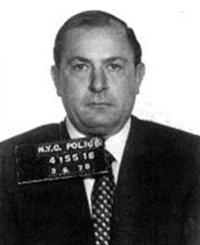
The Colombo crime family is one of New York City’s Five Families. It is the smallest of the five by reputation and historical scale, yet few American Mafia organizations have experienced as many internal wars, leadership crises and public controversies. The family traces its institutional history to Joseph Profaci, passed through a short Magliocco interlude, took its modern name from Joseph Colombo and later spent decades under the influence of Carmine Persico.
Its history matters because it shows how a Mafia organization can survive repeated violence without remaining stable. The Colombo family endured open rebellion in the early 1960s, the shooting of Joseph Colombo in 1971, a long period of leadership from prison, and another civil war in the early 1990s. Federal prosecutions continued into the twenty-first century, including a 2021 case that charged what prosecutors described as the family’s entire administration.
From Profaci to the Five Families
Joseph Profaci led the organization that became the Colombo family during the 1931 reorganization of New York’s Italian-American Mafia. The family operated principally in Brooklyn and other parts of the metropolitan area and participated in the rackets common to La Cosa Nostra: illegal gambling, loansharking, extortion, labor influence and other enterprise crime.
Profaci’s authority was never as secure as later Mafia mythology sometimes suggests. By the late 1950s and early 1960s, a faction associated with the Gallo brothers rebelled against his leadership. The conflict involved kidnappings, shootings and shifting alliances and became the first of the family’s major internal wars.
Profaci died in 1962. Joseph Magliocco briefly succeeded him, but his position collapsed after a failed plot against rival Mafia leaders damaged his standing with the Commission. Joseph Colombo then emerged as boss with Commission support.
Joseph Colombo and unprecedented publicity
Joseph Colombo became one of the most publicly visible Mafia bosses in American history. In 1970 he founded the Italian-American Civil Rights League, presenting it as a campaign against stereotyping and discrimination against Italian Americans. The organization attracted major rallies, television coverage and political attention.
For a Mafia boss, that visibility was extraordinary. It also made Colombo controversial inside organized crime. On June 28, 1971, he was shot at an Italian-American Unity Day rally in Columbus Circle. He survived the attack but was left severely disabled and never returned to active leadership. He died in 1978.
The shooting created another prolonged succession problem. Formal titles, acting bosses and practical authority did not always line up neatly, and the family entered a period in which Carmine Persico became increasingly dominant.
Carmine Persico and leadership from prison
Persico eventually became the central figure in the modern Colombo family. Federal records describe him as the organization’s boss, and his career became inseparable from major racketeering prosecutions of New York Mafia leadership.
In the 1980s, Persico was prosecuted in the federal Mafia Commission Case. He was convicted and received a sentence that kept him imprisoned for the remainder of his life. Yet imprisonment did not immediately end his influence. The family continued to operate through acting bosses, captains and loyalists who claimed authority in his name.
This arrangement created a structural vulnerability. A boss serving a long federal sentence could still command loyalty, but day-to-day power necessarily passed through people on the street. That gap between formal authority and practical control helped produce the family’s third major war.
The Orena-Persico war
In the early 1990s, acting boss Victor Orena and supporters of Carmine Persico fought for control of the family. The conflict produced murders, attempted murders and shootings across New York.
Federal prosecutions later reconstructed parts of that war. In a major 2011 Mafia takedown, the Department of Justice described the 1993 murder of Colombo underboss Joseph Scopo as one of the violent acts connected to the internal conflict. Other cases established the participation of Colombo crews in murder conspiracies and racketeering during the same period.
The war did more than eliminate individual members. It weakened the family’s manpower, encouraged cooperation with law enforcement and gave investigators new opportunities to penetrate its structure.
Greg Scarpa and the informant controversy
Gregory Scarpa became one of the most controversial people connected to the Colombo family because he combined two roles that were fundamentally in tension: he was a violent Mafia member and a longtime FBI informant.
FBI files and later litigation made Scarpa’s relationship with his handler a major case study in informant management. The controversy showed why an informant’s cooperation cannot be treated as proof that the person has stopped participating in criminal activity. It also complicated later prosecutions because defense lawyers challenged investigative conduct and the reliability of information produced through the relationship.
Scarpa’s story belongs inside the Colombo history because the family’s internal war and law-enforcement penetration were not separate phenomena. They interacted directly.
Racketeering and labor influence
The Colombo family’s criminal activity has included illegal gambling, loansharking, extortion, fraud, labor racketeering, money laundering and violence used to enforce enterprise interests.
A 2021 federal indictment illustrates the persistence of those methods long after the family’s best-known internal wars. Prosecutors charged 14 defendants, including what the U.S. Attorney’s Office described as the entire Colombo administration. The alleged schemes included efforts to control a Queens-based labor union and its health fund through extortion, threats and vendor arrangements that benefited the crime family.
The case is important because it shows continuity. The names and leadership generations changed, but labor influence, extortion and enterprise crime remained central themes.
The Colombo family within La Cosa Nostra
The Colombo family is one branch of the larger New York La Cosa Nostra system. Its bosses participated in the same Commission-era structure that linked the Gambino, Genovese, Lucchese, Bonanno and Colombo families.
That wider system matters when reading Colombo history. Internal wars were local to the family, but leadership legitimacy, alliances and sanctions were shaped by relationships with other New York families. A boss could not operate entirely in isolation from the Commission and the broader Mafia environment.
Why the family survived
The family’s survival after repeated wars demonstrates the resilience of crew-based criminal organizations. Even when a boss is imprisoned, a faction is defeated or an administration is indicted, lower-level relationships and rackets can persist.
That does not mean the organization remained equally powerful across time. The repeated conflicts weakened the family and exposed members to prosecution. But the Colombo name continued to appear in federal organized-crime cases decades after the first Gallo revolt.
Historical significance
The Colombo crime family is best understood through four linked themes: internal rebellion, leadership from prison, unusually public Mafia politics and deep law-enforcement penetration.
Joseph Profaci represents the family’s pre-Colombo roots. Joseph Colombo represents the brief experiment in overt public activism. Carmine Persico represents long-term authority exercised under extreme legal pressure. Victor Orena represents the danger of contested acting leadership. Greg Scarpa represents the complications created when a violent insider also becomes a government source.
Taken together, those careers explain why the Colombo family occupies a distinctive place among the Five Families. Its history is less a story of uninterrupted dominance than one of repeated institutional survival after self-inflicted crises.
Core sources
– Federal Bureau of Investigation — La Cosa Nostra: https://www.fbi.gov/history/cases-and-criminals/la-cosa-nostra – U.S. Department of Justice — 91 Leaders, Members and Associates of La Cosa Nostra Families Charged (2011): https://www.justice.gov/archives/opa/pr/91-leaders-members-and-associates-la-cosa-nostra-families-four-districts-charged-racketeering – U.S. Attorney’s Office, Eastern District of New York — 14 Defendants Indicted, Including the Entire Administration of the Colombo Organized Crime Family (2021): https://www.justice.gov/usao-edny/pr/14-defendants-indicted-including-entire-administration-colombo-organized-crime-family – FBI Vault — Carmine John Persico Jr. and Gregory Scarpa collections: https://vault.fbi.gov/organized-crime
People who shaped this story
Rivals, allies and counterpart organizations
References
-
[1]Federal organized-crime recordTier 1SupportsView source ↗
-
[2]Gregory Scarpa, Sr. FBI VaultTier 1SupportsView source ↗
-
[3]Joe Pistone, Undercover AgentTier 1MentionsSupportsView source ↗
-
[4]La Cosa NostraTier 1SupportsMentionsView source ↗
-
[5]Mafia Takedown: Largest Coordinated Arrest in FBI HistoryTier 1MentionsSupportsView source ↗
-
[6]Who Were the Mafia’s Five Families?Tier 1SupportsView source ↗
-
[7]Five Families: The Rise, Decline, and Resurgence of America’s Most Powerful Mafia EmpiresTier 1Supports
-
[8]14 Defendants Indicted, Including the Entire Administration of the Colombo Organized Crime FamilyTier 1MentionsView source ↗
-
[9]91 Leaders, Members and Associates of La Cosa Nostra Families ChargedTier 1MentionsSupportsView source ↗
-
[10]The FBI’s Compliance with the Attorney General’s Investigative Guidelines — Scarpa Case StudyTier 1SupportsView source ↗
-
[11]Joe Gallo’s “Crazy” celebrity statusTier 2SupportsView source ↗
-
[12]The life and death of Joe ColomboTier 2SupportsView source ↗