The John Dillinger story is often told as if one famous outlaw simply moved from robbery to escape to shootout while the country watched. The record is messier and more interesting. Dillinger’s brief period of national notoriety was built around a changing network of prison associates, armed robbers, girlfriends, police officers, federal agents, local sheriffs and civilians who repeatedly collided across the Midwest between the autumn of 1933 and the end of 1934.
This Story Arc follows eight connected events. Read separately, each can look like an isolated headline: a prison break, a murdered sheriff, a dramatic arrest, another escape, a failed raid, a bank robbery, a killing outside a theater and finally a gun battle near Barrington. Read in order, they show something else: how a criminal network formed, how law enforcement struggled to coordinate across jurisdictions, and how each encounter changed the conditions of the next.
The archival images matter for the same reason. They are not decoration and they are not AI reconstructions of scenes that no camera captured. A prison postcard, a wanted flyer, a federal identification order, a photograph of Little Bohemia, the Biograph Theater and a bullet-damaged getaway car all reveal different parts of the machinery around the story. They show places, faces, records and physical evidence that survived the headlines.
Chapter 1 — Michigan City: the network gets out
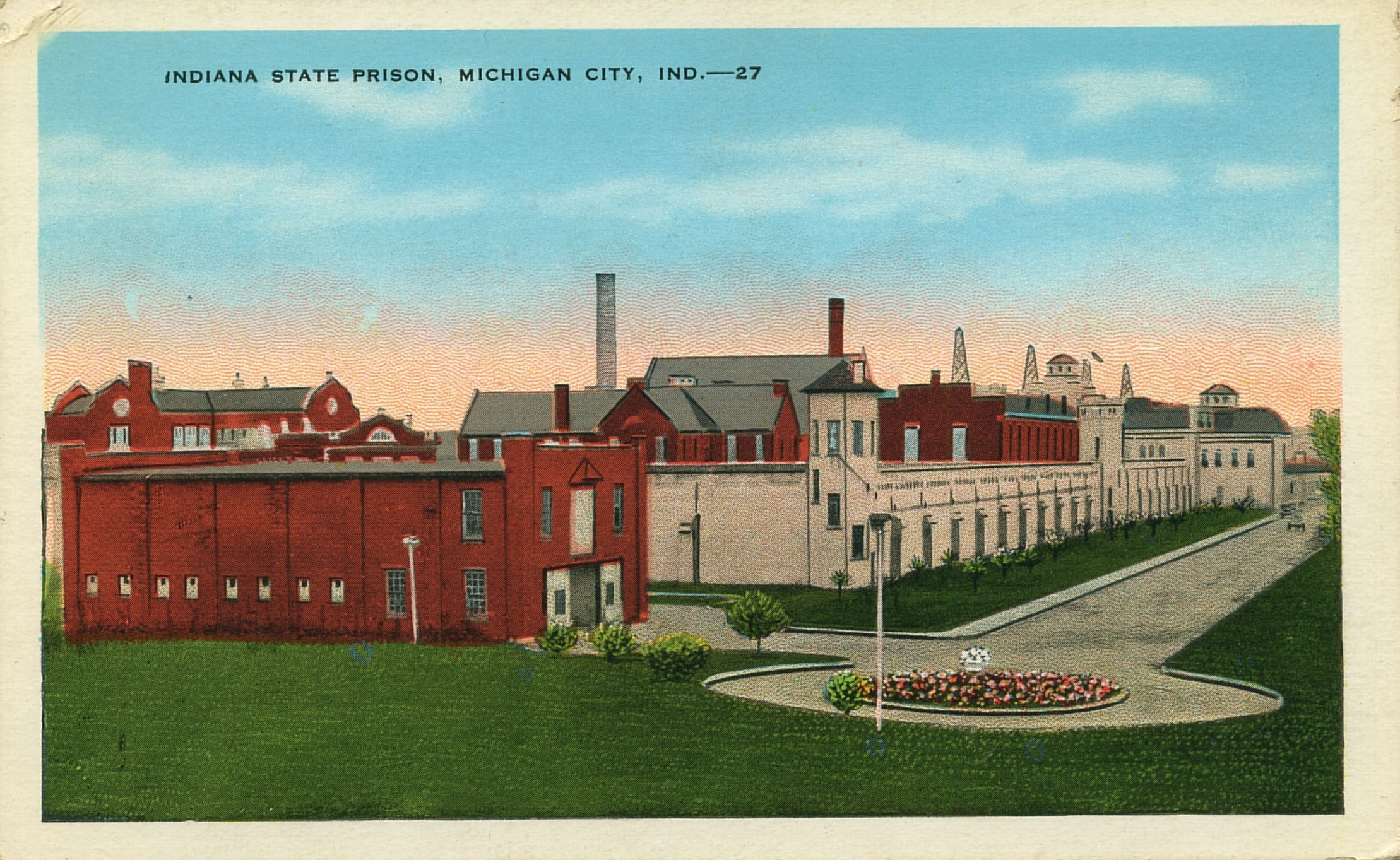
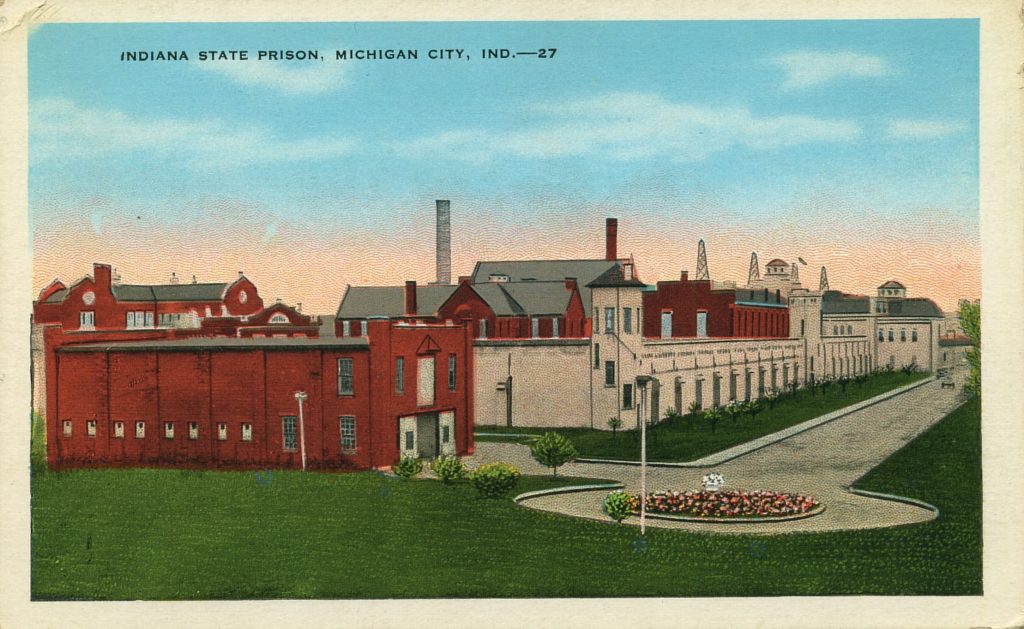
The arc begins at the Indiana State Prison in Michigan City on September 26, 1933. Several prisoners escaped using firearms that had been smuggled into the institution. Among the men tied to the escape were figures who would soon reappear around Dillinger, including Harry Pierpont, Charles Makley, Russell Clark and John Hamilton.
A 1920s view of the prison is a useful first image because it replaces abstraction with a real institution. Dillinger had spent years there before his parole in May 1933. His later gang did not emerge from nowhere. The prison had created relationships among men who knew one another’s histories, capabilities and willingness to participate in serious crime.
Dillinger himself was not among the men escaping that day. He had already been arrested in Ohio. But the timing mattered. His former prison associates were newly free while he was sitting in the Allen County Jail in Lima. Within weeks, some of those men would come for him.
The first chapter therefore establishes the basic structure of the arc: Dillinger is central, but he is not alone. The network is the story.
Chapter 2 — Lima: an escape becomes a murder case
On October 12, 1933, armed associates entered the Allen County Jail under false pretenses and freed Dillinger. Sheriff Jess Sarber was shot and fatally wounded. His wife and Deputy Wilbur Sharp were confined while the attackers obtained the keys and released the prisoner.
The period wanted material that followed is striking because it is so ordinary-looking. The flyer lists descriptions and instructions to law enforcement, including the fact that Dillinger was wanted in connection with murder at Lima. That paper trail captures a major shift. What had been a local robbery prosecution was now connected to a killing and a growing interstate search.
Lima is the hinge of the entire arc. It strips away the temptation to treat repeated escapes as entertainment. A sheriff died so that Dillinger could leave that jail. Pierpont and Makley would later receive death sentences, while Clark received a life sentence, according to the Allen County Sheriff’s historical account.
The aftermath also illustrates the changing role of identification technology. The FBI later described how fingerprint cards for men involved in the rescue were flagged in its Identification Division. In the early 1930s, a national infrastructure of fingerprint records, wanted notices and identification orders was becoming increasingly important against fugitives who could cross state lines faster than local information could travel.
Chapter 3 — Tucson: publicity catches up with the fugitives
For several months the network continued to rob banks, steal weapons and move through different states. Then, in January 1934, a hotel fire in Tucson, Arizona, created an unexpected opening. Firefighters recognized men from photographs and publicity. Local police began making arrests.
Dillinger, Pierpont, Makley and Clark were taken into custody. Police also recovered weapons, bulletproof vests and cash. The capture matters because it demonstrates the other side of notoriety. Publicity could help fugitives intimidate, but it could also make their faces recognizable far from the places where their crimes occurred.
An FBI identification order from the period shows how law enforcement formalized that recognition. Front and side views, measurements, scars, fingerprints and aliases were tools for making a mobile suspect legible to agencies that might never have encountered him in person.
Tucson briefly appeared to end the problem. Instead, it redistributed it. Different prisoners were returned to different jurisdictions for prosecution. Dillinger went back to Indiana and was held at Crown Point. The men connected to Sarber’s killing were returned toward Ohio proceedings. The next phase began almost immediately.
Chapter 4 — Crown Point: the escape that expands federal leverage
Dillinger was placed in the Lake County Jail at Crown Point to await trial. Authorities publicly treated the facility as secure. On March 3, 1934, he escaped.
The most famous detail is the supposed wooden or carved gun. Contemporary and later accounts differ about what exactly he used to intimidate guards, so the colorful versions should be treated as uncertain rather than as established fact. The more important point is what happened after he gained control inside the jail: guards and trustees were confined, weapons were taken, and Dillinger left in a stolen sheriff’s car.
That car mattered. Driving a stolen vehicle across state lines created a clearer federal hook under the National Motor Vehicle Theft Act. The escape therefore did more than put Dillinger back on the road. It strengthened the legal basis for federal pursuit.
A surviving telegram from Chicago Special Agent in Charge Melvin Purvis to Director J. Edgar Hoover records the Bureau’s contemporary understanding of the Crown Point escape. This is exactly the kind of document that makes a historical Story stronger than a retelling built from legend. It shows what federal investigators were reporting in real time, before decades of movies and folklore accumulated around the event.
Chapter 5 — Little Bohemia: a failed raid changes the hunt
By April 1934, federal agents were receiving information that Dillinger and several associates were at Little Bohemia Lodge in northern Wisconsin. Agents from Chicago and St. Paul moved quickly to the site on April 22.
The raid went badly. The fugitives escaped. Gunfire struck people who were not members of the gang. Special Agent W. Carter Baum was later killed by Baby Face Nelson during the broader encounter in the area, and other law-enforcement personnel were wounded.
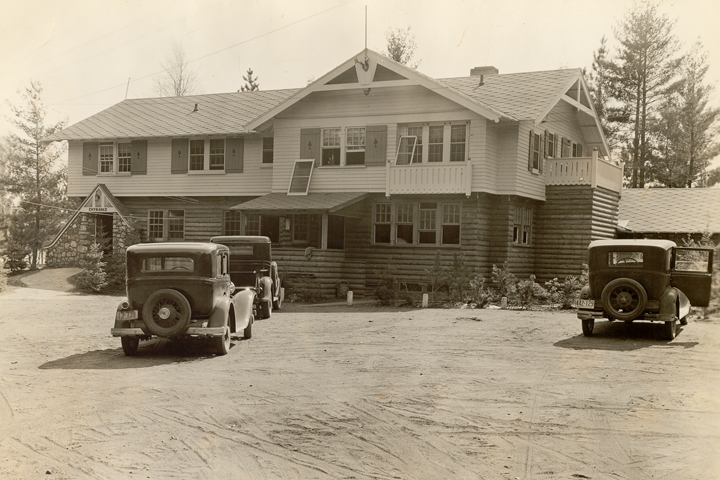
The FBI’s historical photograph of Little Bohemia is valuable because it forces the reader to look at the actual place: a vacation lodge in a wooded region, not an abstract movie set. The environment helps explain the operational difficulty. Darkness, automobiles, limited coverage of the building and uncertain identification all mattered.
Little Bohemia became an institutional lesson as much as a criminal-history episode. The failure exposed weaknesses in planning and coordination. It also increased pressure on the Bureau at a moment when federal law enforcement was being asked to handle increasingly visible interstate crime.
For the Story Arc, the chapter marks another escalation. After Crown Point, Dillinger was a high-profile fugitive with strong federal attention. After Little Bohemia, the pursuit had also produced a dead federal agent and a public failure that the Bureau could not ignore.
Chapter 6 — South Bend: the robberies continue while the net tightens
On June 30, 1934, the Merchants National Bank in South Bend, Indiana, was robbed. FBI history identifies Dillinger, Baby Face Nelson and Homer Van Meter among the participants. A police officer was killed during the robbery.
The significance of South Bend is not that it was the most ingenious robbery in the arc. It is that serious armed crime continued even after the fugitives had become nationally recognizable and after federal resources had been concentrated on them.
By this point, wanted posters and identification orders were being circulated widely. The documents give the modern reader a sense of how the pursuit actually worked: not through a single national police force with instant databases, but through photographs, fingerprints, telephones, telegraph messages, local tips and cooperation among agencies with different authority.
South Bend also brings Baby Face Nelson more clearly into the center of the narrative. That matters because the arc does not truly end when Dillinger dies. Nelson would become central to the violent final chapter in Barrington months later.
Chapter 7 — The Biograph: Dillinger’s story ends in Chicago
Late in July, information from Anna Sage gave federal agents a chance to locate Dillinger in Chicago. She told investigators that Dillinger would likely attend a movie with her and Polly Hamilton and identified the possible theaters. On July 22, agents positioned themselves around the Biograph Theater.
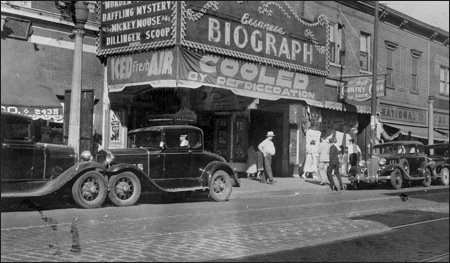
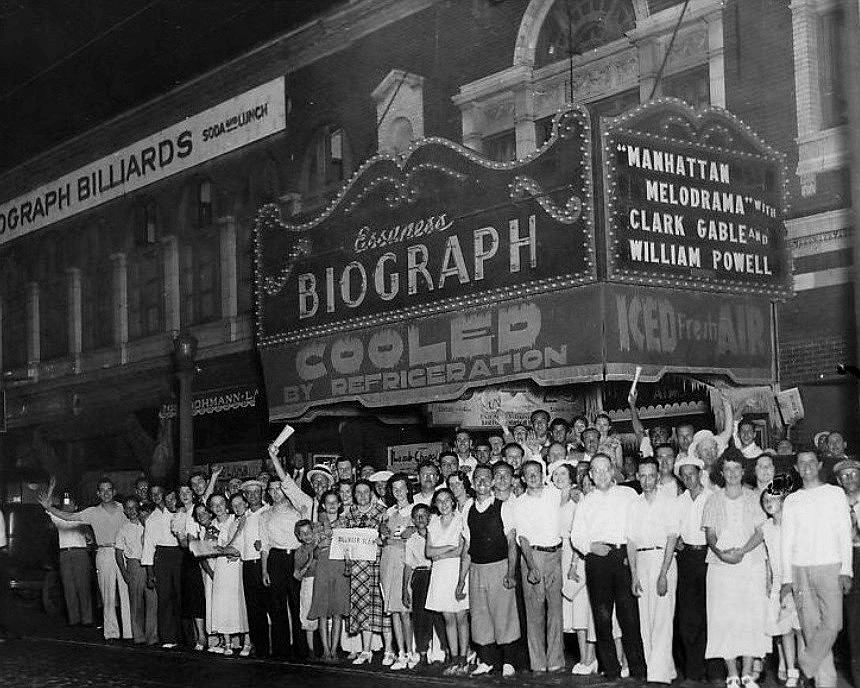
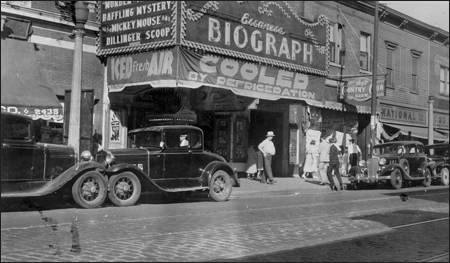
A 1934 FBI photograph of the Biograph is one of the strongest images in the entire arc because it shows the real building connected to the event. Dillinger watched Manhattan Melodrama inside. When he left the theater, agents moved to confront him. The FBI account says he reached for a pistol while trying to flee. Agents fired, and Dillinger was fatally wounded.
The crowd that gathered outside afterward became part of the spectacle almost immediately. Period photographs show people massing around the theater. That image is a reminder that Dillinger’s death was already public theater within minutes of occurring. The outlaw had been transformed into a national media figure, and his death became another event consumed by the crowd.
The point is not to recreate the shooting cinematically. The point is to show how intelligence, surveillance, local information and a planned federal operation converged at one location—and how quickly the result entered public memory.
Dillinger’s death ended the central biography, but it did not end the network or the federal campaign against the men associated with it.
Chapter 8 — Barrington: the violence continues after Dillinger
On November 27, 1934, agents encountered Lester Gillis, better known as Baby Face Nelson, along with Helen Gillis and John Paul Chase near Barrington, Illinois. What followed became one of the deadliest confrontations associated with the gangster era.
Agents first located the group in a car. During the pursuit and exchange of gunfire, Nelson’s vehicle was damaged. Later, Inspector Samuel Cowley and Special Agent Herman Hollis confronted Nelson and Chase. Hollis was killed, Cowley was mortally wounded and died the following morning, and Nelson was severely wounded. Nelson died later that evening.
A surviving newspaper photograph of the bullet-damaged automobile is a powerful closing image because it shows the physical reality left by the gun battle: a windshield marked by gunfire, examined after the fugitives had abandoned the car. FBI material from the same period preserves Nelson’s body armor and the institutional record of Cowley and Hollis.
Barrington matters to the arc because it corrects a common narrative shortcut. Dillinger’s death was not the instant end of the gangster problem his story had come to symbolize. The network had shifted. Nelson remained active and extraordinarily dangerous. Federal agents were still being killed months after the Biograph.
What actually changes across these eight chapters
Seen as a sequence, the arc is less about one outlaw’s personality than about systems adapting to each other.
The fugitives use prison relationships, stolen cars, interstate movement, aliases, heavily armed robberies and safe locations. Law enforcement responds with fingerprint databases, circulated photographs, identification orders, interstate statutes, coordinated field offices and increasingly aggressive surveillance and pursuit.
Neither side changes in a straight line. Crown Point is a humiliation for local custody. Little Bohemia is a serious federal failure. Tucson shows that local police and ordinary recognition can succeed where larger searches had not. The Biograph shows the value of informant intelligence and concentrated surveillance. Barrington shows that even successful identification can end in lethal violence.
The archival record makes that evolution visible. The Indiana State Prison postcard is about place and origin. The Lima wanted flyer is about a local killing becoming a wider hunt. The federal identification order is about standardizing a fugitive’s identity. Little Bohemia photographs document a failed operation. The Biograph image fixes the final confrontation to a real Chicago street. The Barrington car shows what a high-powered gun battle physically left behind.
That is why this Story Arc should not be read as eight disconnected summaries. Each chapter changes the next. Michigan City supplies the associates who go to Lima. Lima makes the network more dangerous and legally consequential. Tucson interrupts it. Crown Point restarts the chase and expands federal leverage. Little Bohemia deepens the federal commitment. South Bend proves the robberies are continuing. The Biograph removes Dillinger. Barrington closes the sequence by showing that the violence and pursuit outlasted him.
The right way to read the Dillinger story
The most useful question is not whether Dillinger was charismatic, clever or reckless. Those judgments have dominated popular retellings for decades and often encourage romanticization. The historical record supports a better set of questions.
Who enabled each escape? Which people were victims rather than supporting characters? Which agencies had authority at each stage? What changed when a stolen car crossed a state line? How were fingerprints and photographs used? Which claims come from contemporary records and which belong to later legend? What happened to the associates after the famous central figure was gone?
From Lima, follow Harry Pierpont into the Ohio murder case. From Little Bohemia, follow W. Carter Baum and Baby Face Nelson. From the Biograph, follow Melvin Purvis, Anna Sage or the federal surveillance operation. From Barrington, follow Samuel Cowley, Herman Hollis and John Paul Chase.
The arc is therefore not a closed biography. It is a map of a network under pressure. Dillinger is the most recognizable name in it, but the history becomes much clearer once the other people, institutions, documents and places are allowed back into the story.
Images and documents across the manhunt


1 connected stories
References
- John Dillinger · FBI · View source ↗
- Lester Gillis (“Baby Face” Nelson) · Federal Bureau of Investigation · View source ↗
- The FBI and the American Gangster, 1924-1938 · Federal Bureau of Investigation · View source ↗
- John Dillinger Timeline · PBS American Experience / WGBH · View source ↗