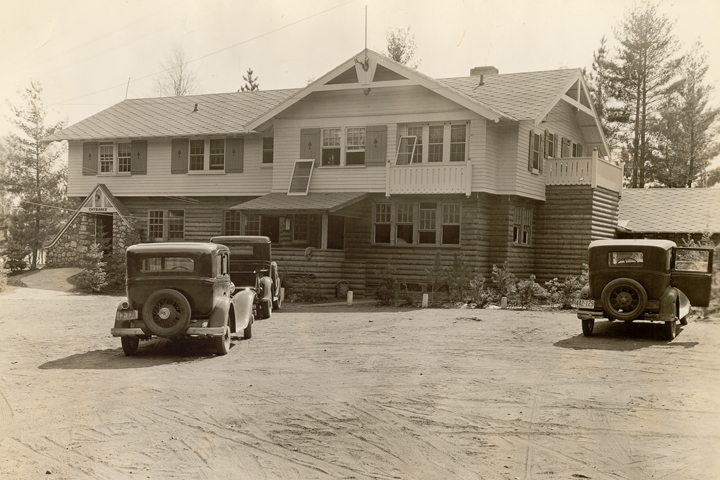
The archival photograph attached to this Story shows the entrance to Little Bohemia Lodge in northern Wisconsin. It is an unassuming setting for an operation that became one of the most damaging failures of the early federal campaign against the Dillinger group. On April 22, 1934, agents converged on the lodge after learning that John Dillinger and associates were staying there.
The lodge matters because the geography shaped the outcome. It sat in a wooded resort area near Manitowish Waters, far from the dense city streets associated with Dillinger’s robberies. Agents had to approach a site with civilians, vehicles and multiple routes into the surrounding darkness. The FBI says barking dogs helped alert the fugitives to the arrival of law enforcement.
The raid did not begin as a clean encirclement. Men leaving the lodge in a car were fired upon after agents believed they were gang members. They were civilians. One, Eugene Boisneau, was killed and others were wounded. Inside and around the lodge, confusion gave the fugitives time. By the next morning, agents found women associates left behind, while Dillinger and five others had escaped through a back window before the building was completely surrounded.
The violence did not end at the lodge. Baby Face Nelson separated from the main group and forced his way into a nearby home, taking hostages. Special Agent W. Carter Baum, another agent and a local constable arrived to investigate a disturbance. According to the FBI’s account, Nelson confronted them and opened fire. Baum was killed; the other agent and the constable were wounded.
This is why the Little Bohemia Story should not be framed simply as “Dillinger escapes again.” The event included a failed federal operation, civilian casualties, the death of an agent and a separate armed escape by Nelson. Each part changed the stakes of the manhunt.
The FBI later treated Little Bohemia as a lesson in the risks of hurried tactical action. The Bureau of 1934 was not yet the institution later generations would recognize. Federal powers, training and coordination were evolving rapidly during the gangster era. Failures such as Little Bohemia became part of that development, alongside new crime laws and expanded authority for agents.
For Dillinger, the escape bought only a few more months. The net tightened. Federal investigators focused more intensely on people who provided shelter, money, transportation and information. In Chicago, the search would eventually turn on Anna Sage, who told authorities that Dillinger might accompany her and Polly Hamilton to a movie.
For Nelson, Little Bohemia was another step toward a separate ending. The killing of Baum made him an even higher-priority target. After Dillinger’s death, Nelson remained at large and would later kill Agents Herman Hollis and Samuel Cowley in the Barrington firefight before dying from his own wounds.
The photograph of the lodge provides a corrective to later dramatizations. It does not show gunmen firing or agents advancing. It shows a place. That place became significant because people made decisions there under pressure, some of them catastrophic. The historical record is stronger when the real location and the real casualties stay visible.
The next chapter in this arc returns to bank robbery. On June 30, Dillinger, Nelson and Homer Van Meter participated in the robbery of Merchants National Bank in South Bend, Indiana. A police officer was killed. It would be the last major bank robbery associated with Dillinger before the Biograph Theater confrontation in July.## Civilians in the line of fire
The civilian casualties are essential to understanding why Little Bohemia became more than another failed arrest. People who had no part in the gang were placed in danger by a fast-moving operation conducted at night around a public lodge. The mistaken firing on a departing car exposed the cost of poor identification under pressure. That part of the record belongs alongside the later focus on Baum’s death; otherwise the event becomes a duel between famous gangsters and federal agents with the civilians edited out.
The failure also had consequences inside the Bureau. The gangster era was a formative period for federal law enforcement, and operational mistakes became lessons. Communications, weapons, tactical preparation, surveillance and coordination were all under pressure to improve as Congress expanded federal crime laws and agents received greater authority. Little Bohemia is one of the clearest moments where the institution’s developing capabilities and its limitations appear in the same event.
One raid, several different escapes
Another source of confusion is the tendency to compress everything that happened that night into one firefight at the lodge. Dillinger and several associates escaped from the immediate lodge area. Nelson’s later confrontation with Baum occurred nearby but was a distinct episode within the wider manhunt. Keeping those pieces separate clarifies responsibility and geography.
The distinction also improves the Story graph. The lodge is one Place. The nearby location where Nelson encountered Baum and the other officers is another event site. Dillinger’s escape path is a sequence of movements. A single flat paragraph cannot represent those relationships as well as a graph-linked Story can.
What the raid changed
After Little Bohemia, there was less room for the idea that the hunt might end through a routine arrest. Dillinger remained free, Nelson had killed a federal agent, and public scrutiny of the Bureau intensified. The pressure on informants and associates increased. Within three months, the Biograph operation would be built not around a frontal assault on a hideout, but around information about a planned movie outing and surveillance of a public space.
That contrast—Little Bohemia’s failed raid and the later Biograph surveillance—is one of the strongest reasons to read the events in sequence. The second operation was shaped by a law-enforcement campaign that had already learned, painfully, what could go wrong.
A historical photograph of the lodge shows the actual geography of the site without implying that a camera captured the gunfire of the raid itself.
What the record establishes — and what it does not
FBI sources establish the April 22 raid, Dillinger’s escape, civilian casualties, and Nelson’s killing of Agent Baum during the wider incident.
This Story does not collapse the lodge gunfire and Nelson’s separate nearby confrontation into one simplified shootout.
People and groups in this story
Don’t stop here
References
- Bremer Kidnapping Part 58
- John Dillinger · FBI · View source ↗
- John Dillinger · Federal Bureau of Investigation
- Lessons at Little Bohemia · Federal Bureau of Investigation · View source ↗
- The FBI and the American Gangster, 1924-1938 · Federal Bureau of Investigation · View source ↗
- W. Carter Baum · Federal Bureau of Investigation · View source ↗
- John Dillinger
- Little Bohemia Lodge — History · Little Bohemia Lodge
- John Dillinger Timeline · PBS American Experience / WGBH · View source ↗
- April 1934 Timeline · Dillinger LLC · View source ↗