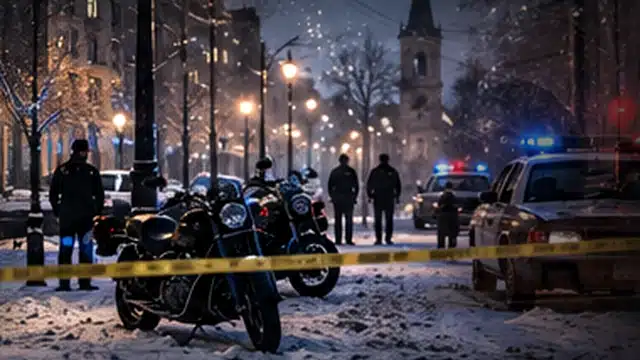
The feud between the Hells Angels and Mongols became one of America’s most documented biker rivalries. A confrontation in Laughlin in 2002 turned that long-running conflict into international headlines.
The rivalry between the Hells Angels Motorcycle Club and the Mongols Motorcycle Club is one of the most documented conflicts in modern American motorcycle-club history.
It developed over decades rather than beginning with one incident. Federal sources trace the conflict to competition in the western United States, particularly Southern California, and describe violent encounters before the confrontation that made the rivalry nationally famous: Laughlin, Nevada, in 2002.
Understanding the rivalry requires separating three things that are often blended together: territorial competition between organizations, criminal acts by particular members and the mythology created by decades of news coverage.
Why Southern California mattered
The Hells Angels had deep roots in California long before the Mongols were founded in 1969.
The Mongols developed in the Los Angeles area and built a strong presence in Southern California. Federal historical profiles later stated that the Mongols challenged Hells Angels control in the region during the 1980s.
That did not mean every confrontation was centrally directed or that the two clubs were in a continuous formal “war.” It meant that they increasingly occupied overlapping motorcycle-club territory and came to regard one another as major rivals.
Territory is more than a map
In motorcycle-club culture, territorial competition can involve more than geographic control.
It can include where colors are displayed, which clubs recruit in an area, who attends or dominates public motorcycle events, relationships with support clubs and the symbolic reputation of a chapter.
Those pressures can produce conflict without any single written declaration of war.
That distinction helps explain why federal records describe multiple violent encounters before Laughlin rather than one clear starting date.
Clashes before Laughlin
The 2003 federal indictment arising from Laughlin stated that violent encounters between Hells Angels and Mongols members had occurred previously in San Diego and Modesto, California, and Reno, Nevada.
Those incidents are important because they show that the confrontation in Laughlin did not appear without context.
By 2002, prosecutors were describing a relationship with an established history of violence.
Laughlin changes the scale
On April 27, 2002, the rivalry exploded into public view inside Harrah's during the Laughlin River Run.
More than 60,000 people were attending the event, according to federal prosecutors. Members of both clubs were present. A confrontation inside the casino left three people dead.
The setting made the event especially visible. This was not a remote clubhouse dispute. It happened during a huge public motorcycle gathering, inside a major casino, surrounded by tourists and cameras.
Laughlin became shorthand for the rivalry.
Federal prosecutions after Laughlin
The legal aftermath lasted for years.
In December 2003, a federal grand jury indicted 42 Hells Angels members on racketeering and firearms charges connected to the confrontation. A superseding indictment in 2005 expanded the case.
Those charging documents are part of the historical record, but they must be read carefully. An indictment states allegations. It is not itself proof of guilt.
The prosecutions nevertheless demonstrate the scale at which federal authorities treated the incident.
The rivalry continues beyond one casino
Laughlin did not end the conflict.
Federal descriptions of the Mongols in later years continued to identify the Hells Angels as their principal rival. The rivalry also appeared in later criminal cases involving individual members.
That continuity is one reason the subject attracts so much search interest. Readers are not looking for one shootout. They are trying to understand a relationship that spans decades, states and chapters.
The 2008 Mongols crackdown
A major federal operation against the Mongols in 2008 added another layer to the story.
Authorities executed searches in multiple states and arrested numerous defendants. The government described the Mongols as an enterprise involved in violent crime and drug trafficking and referred explicitly to the escalating conflict with the Hells Angels.
The operation was not a prosecution of the rivalry itself. It was a broader racketeering investigation.
But the rivalry formed part of the context federal authorities used to explain the organization.
Rivalries and alliances
Federal reports have historically described the Mongols as aligned with several other clubs opposed to the Hells Angels, including the Bandidos, Outlaws, Sons of Silence and Pagans.
That should not be read as a permanent global coalition. Motorcycle-club relationships vary by region and era.
Still, the pattern matters because the Hells Angels–Mongols rivalry sits inside a larger network of alliances, hostilities and local competition.
Myth versus documented history
Biker rivalries attract exaggerated storytelling.
Body counts are combined across unrelated incidents. Local disputes are described as global wars. Allegations become “facts” through repetition.
A better approach is to anchor the story in court records, government reports and specific dated events.
What is documented is already substantial: a long rivalry, repeated violent encounters, the 2002 Laughlin confrontation and major federal investigations touching both organizations.
There is no need to inflate it.
Organizational responsibility versus individual responsibility
The rivalry is between organizations, but crimes are prosecuted against people.
That distinction is essential.
A person may commit violence because of club allegiance, status or a chapter dispute. A prosecution may allege that conduct benefited an enterprise. Those facts do not automatically establish that every member approved the act or that every chapter participated.
This is why individual cases and organizational history should be connected without being collapsed into one another.
Why this rivalry matters
The Hells Angels–Mongols rivalry is important because it connects several major themes in modern biker history:
California origins, territorial competition, club identity, public motorcycle events, federal racketeering law, chapter networks and the way violence between a small number of people can reshape the public image of much larger organizations.
For the Hells Angels, the Mongols became one of the most visible American rivals.
For the Mongols, confrontation with the Hells Angels became part of the club's national identity.
And for the public, Laughlin became the event that put a decades-long rivalry into one unforgettable place and date.
1 connected stories
References
- Federal authorities arrest dozens of Mongols members in nationwide racketeering operation · U.S. Attorney's Office, Central District of California · View source ↗
- Federal Racketeering Charges Brought Against 42 Members of the Hells Angels Motorcycle Club · U.S. Attorney's Office, District of Nevada · View source ↗
- Superseding Indictment Returned by Federal Grand Jury in Hells Angels Prosecution · U.S. Attorney's Office, District of Nevada · View source ↗
- 54-Count Federal Indictment Charges Members and Associates of Mongols Motorcycle Gang · U.S. Department of Justice · View source ↗
- Outlaw Motorcycle Gangs (OMGs) · U.S. Department of Justice · View source ↗