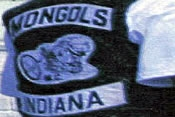
Born in Southern California in 1969, the Mongols emerged as one of the Hells Angels’ best-known rivals. Years of competition and violent incidents culminated in public clashes and major investigations.
The Mongols Motorcycle Club emerged in Southern California in 1969 and developed into one of the most prominent motorcycle-club networks in the United States. Its history intersects with Southern California street culture, federal racketeering investigations, international chapter expansion and a long rivalry with the Hells Angels.
The club is often discussed through the language used by law enforcement. U.S. federal agencies have repeatedly classified the Mongols as an outlaw motorcycle gang and have investigated members and associates for violent crime, drug trafficking, firearms offenses and racketeering. Those cases are important evidence about particular defendants and chapters, but they should not be treated as proof that every person wearing the club's patch committed a crime.
Southern California origins
The Mongols were founded in Southern California in 1969. The Los Angeles region was already home to a dense motorcycle-club scene, and the new organization developed in territory where the Hells Angels also had a significant presence.
Federal historical profiles later described the Mongols as becoming especially strong in Southern California and the Southwest. By the 1980s, those profiles said, the club had challenged Hells Angels influence in the region.
That territorial history became one of the defining themes of both organizations.
Growth beyond California
The Mongols did not remain a local Los Angeles-area club.
Federal cases and Justice Department records describe chapters in numerous U.S. states and, by the 2010s, in countries outside the United States. The network therefore evolved from a Southern California organization into a national and international club.
The scale of that expansion matters because it changed the nature of the organization. A club with multiple chapters is not a single neighborhood group. Local leadership, regional culture and individual criminal cases can differ significantly from chapter to chapter.
Rivalry with the Hells Angels
The Mongols are most widely known for their rivalry with the Hells Angels Motorcycle Club.
Federal sources describe the two clubs as long-term rivals, particularly in the western United States. Earlier confrontations were reported in places including San Diego, Modesto and Reno before the rivalry became nationally visible in Laughlin, Nevada, in 2002.
The rivalry is sometimes reduced to a simple claim about “territory.” In practice, motorcycle-club competition can involve chapter recruitment, public events, the right to display colors, relationships with other clubs and the symbolic control of particular areas.
That makes the rivalry larger than any single fight.
Laughlin 2002
On April 27, 2002, members of the Mongols and Hells Angels confronted one another inside Harrah's during the annual Laughlin River Run in Nevada.
Federal prosecutors later described the gathering as an event attended by more than 60,000 people. The confrontation left three people dead and became the most famous violent episode associated with the two clubs' rivalry.
The federal cases that followed focused heavily on Hells Angels defendants, but the event itself involved members of both clubs.
Laughlin matters because it transformed a rivalry familiar to law enforcement and motorcycle-club circles into a national news story.
Major federal investigations
The Mongols have been the subject of several large federal investigations.
In 2008, a major ATF-led operation resulted in arrests and searches across multiple states. Federal authorities reported seizures of firearms, narcotics and motorcycles and described the investigation as targeting a racketeering enterprise.
The case also produced one of the strangest legal chapters in motorcycle-club history: litigation over whether the government could obtain rights connected to the Mongols' insignia through criminal forfeiture.
The patch was not just decoration. It became the subject of constitutional, trademark and forfeiture arguments.
The meaning of the patch
For motorcycle clubs, patches communicate membership, chapter identity and status. For prosecutors, the Mongols insignia became part of the evidence used to describe the organization as an enterprise.
Attempts to seize or restrict the insignia raised a difficult question: how far can criminal forfeiture reach when a symbol is also used by people who have not been convicted of a crime?
That dispute gave the Mongols unusual significance beyond motorcycle-club history.
Membership and ethnicity
Older federal reports emphasized that many Mongols members in Southern California were Hispanic and that some had previous ties to street gangs.
That information belongs in the historical record because it influenced how law enforcement described the club and how the club differentiated itself in Southern California.
It should not be generalized into assumptions about Hispanic motorcyclists or communities. The subject is a specific organization, not an ethnic group.
Alliances and rival clubs
Federal reports have described the Mongols as maintaining relationships with other clubs opposed to the Hells Angels, including the Bandidos, Outlaws, Sons of Silence and Pagans.
Those relationships have varied by place and period. They should not be treated as a permanent worldwide alliance system.
Motorcycle-club politics are often local. A relationship documented in one region or decade may not describe another.
From regional club to international organization
By 2018, Justice Department records described Mongols chapters not only across numerous U.S. states but also in countries including Australia, Canada, Denmark, Germany, Indonesia, Malaysia, Mexico, Singapore, Switzerland and Thailand.
That international expansion changed the SEO and historical importance of the club. The Mongols are no longer only a Southern California subject.
Their story connects regional U.S. biker history to international chapter networks, federal organized-crime prosecutions and cross-border motorcycle culture.
What criminal cases prove
A recurring problem in writing about motorcycle clubs is confusing an indictment against members with a judgment against every member of the organization.
The distinction matters.
Federal cases can establish that prosecutors charged particular people with acting for or through an enterprise. Convictions can establish criminal responsibility for particular defendants. Neither fact automatically proves criminal conduct by every member of every chapter.
This profile therefore treats federal records as evidence about documented cases, structures and allegations, not as a shortcut for collective guilt.
Why the Mongols matter
The Mongols matter because several major strands of modern motorcycle-club history meet in one organization:
Southern California territorial competition, the Hells Angels rivalry, nationwide federal investigations, international expansion and the unusual fight over the legal status of a club patch.
For readers following the Hells Angels story, the Mongols are not a side note. They are one of the principal rival organizations needed to understand how the U.S. motorcycle-club landscape developed after the 1960s.
The most important next chapter is Laughlin in 2002, where the rivalry became impossible to treat as background.
Events that define the record
Laughlin River Run confrontation: Hells Angels and Mongols (2002)
On April 27, 2002, members of the Hells Angels and Mongols clashed inside Harrah’s in Laughlin during the River Run, leaving three people dead…
Laughlin, Nevada, United StatesRivals, allies and counterpart organizations
Related series
References
-
[1]2011 National Gang Threat AssessmentTier 1MentionsSupportsView source ↗
-
[2]Federal authorities arrest dozens of Mongols members in nationwide racketeering operationTier 1MentionsSupportsView source ↗
-
[3]Federal Racketeering Charges Brought Against 42 Members of the Hells Angels Motorcycle ClubTier 1SupportsMentionsView source ↗
-
[4]Superseding Indictment Returned by Federal Grand Jury in Hells Angels ProsecutionTier 1SupportsMentionsView source ↗
-
[5]54-Count Federal Indictment Charges Members and Associates of Mongols Motorcycle GangTier 1MentionsSupportsView source ↗
-
[6]Outlaw Motorcycle Gangs (OMGs)Tier 1SupportsMentionsView source ↗