Why read it
This book is useful here because it opens directly into the real people, organizations and events behind the story.
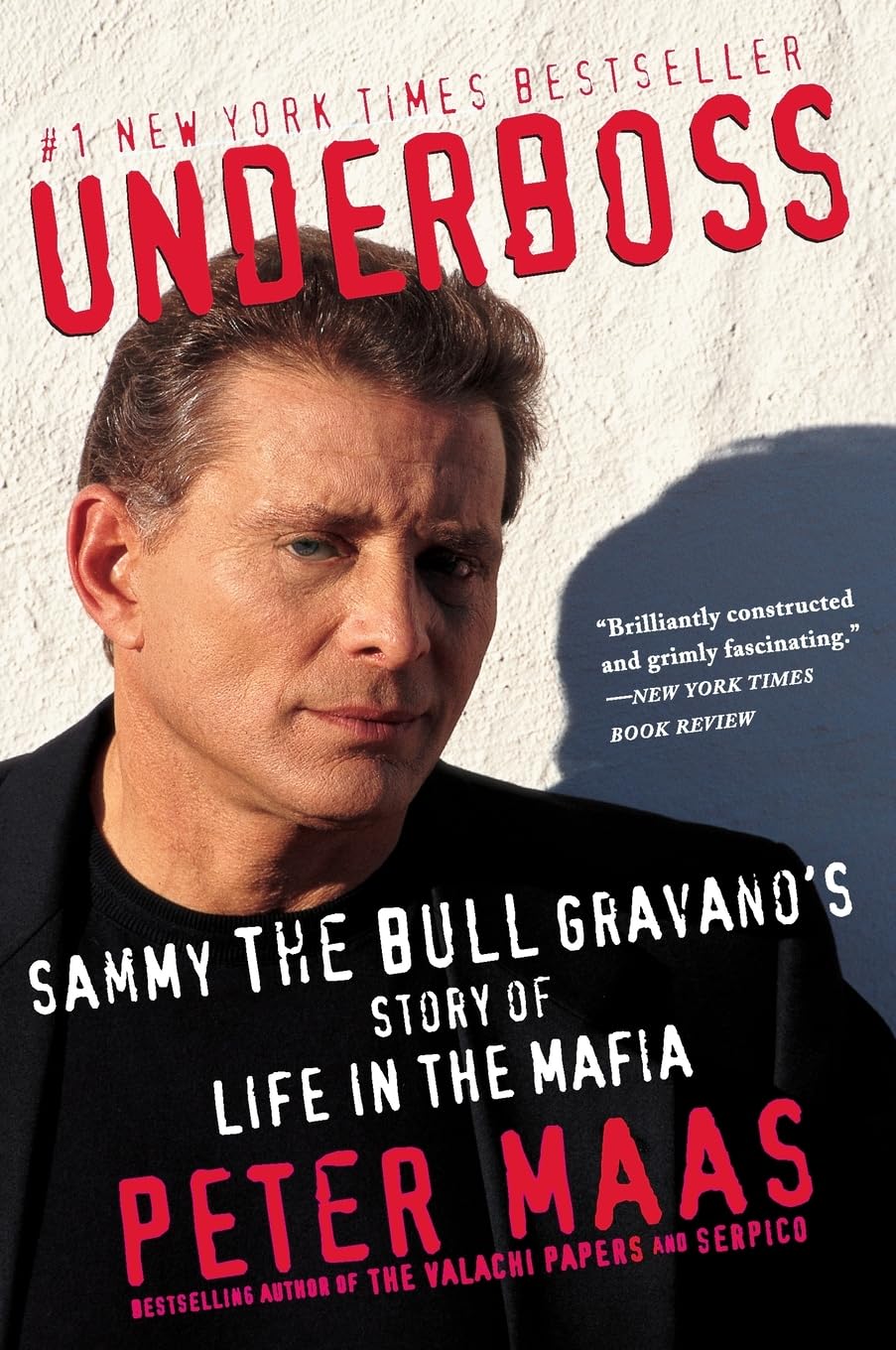
As an Amazon Associate, RoguesBook earns from qualifying purchases. Prices and availability are confirmed on Amazon.
Peter Maas’s biography of Salvatore “Sammy the Bull” Gravano, tracing his rise in the Gambino family, the Castellano murder, the Gotti era and his decision to cooperate.
This book is useful here because it opens directly into the real people, organizations and events behind the story.
Gambino Crime Family · The Commission · John Gotti · Paul Castellano
Underboss is Peter Maas’s account of Salvatore “Sammy the Bull” Gravano, the Gambino crime family underboss whose cooperation became one of the most consequential Mafia defections of the late twentieth century. Built from extensive access to Gravano, the book follows his criminal career from neighborhood violence and crew life into the upper levels of the Gambino family, then through the collapse of his alliance with John Gotti.
Gravano’s story illustrates how Mafia careers could develop through a mixture of earning ability, reputation, violence and sponsorship. The book moves through his associations and rise inside the Gambino organization, explaining how personal relationships connected street-level criminal work to the family’s senior leadership. By the 1980s Gravano had become close to the faction that opposed boss Paul Castellano.
The 1985 murder of Castellano is one of the central turning points. John Gotti emerged as boss afterward, and Gravano rose with him. The book presents that transition from the viewpoint of a participant who later chose to cooperate, which makes the narrative compelling but also requires critical reading. Gravano had strong incentives to explain his own decisions in a particular way, and independent records remain essential when responsibility or motive is disputed.
Gotti’s public image made him one of the most recognizable Mafia bosses in America. Inside the family, however, publicity existed alongside surveillance, internal tension and increasingly dangerous federal investigations. Gravano’s position as underboss placed him close to the decisions that prosecutors were trying to reconstruct. The book therefore provides a useful companion to histories of the Gambino family and to accounts of the federal cases that eventually destroyed Gotti’s freedom.
Recorded conversations became especially damaging. The relationship between Gotti and Gravano deteriorated as Gravano concluded that the government’s evidence and Gotti’s own recorded comments left him exposed. His eventual cooperation transformed the prosecution. Testimony from a former underboss could explain hierarchy, meetings, murders and internal rules in a way that evidence alone often could not.
Gravano’s decision to testify against Gotti became one of the defining examples of the Mafia’s weakening code of silence. It also fed a wider cycle: successful prosecutions encouraged more cooperators, and additional cooperators made future prosecutions easier. By the 1990s the traditional assumption that senior members would remain silent under almost any pressure had been badly damaged.
Maas had previously written The Valachi Papers, another book centered on an insider who broke Mafia secrecy. Reading the two together shows how dramatically the landscape changed between Valachi’s era and Gravano’s. Valachi’s revelations were extraordinary partly because they were so unusual. By Gravano’s time, federal racketeering strategy, electronic surveillance and witness cooperation had become intertwined tools in sustained attacks on Mafia leadership.
Underboss is best treated as a biography constructed with unusually deep access to its subject, not as a neutral transcript of history. Gravano’s version of events is itself an important historical source, but it should be compared with trial records, surveillance evidence, other witnesses and independent reporting. That distinction is particularly important for violent incidents in which participants had reasons to minimize their own responsibility.
The canonical work dates to 1997, while the retail metadata here points to the HarperCollins reprint edition. Its strongest connections are Gravano, John Gotti, Paul Castellano and the Gambino crime family. It also forms a natural bridge to the larger history of cooperating witnesses that begins much earlier with figures such as Joseph Valachi and continues through later Mafia prosecutions.
The book is only one entrance. These are the strongest routes into the wider RoguesBook graph.

As an Amazon Associate, RoguesBook earns from qualifying purchases. Prices and availability are shown on Amazon.