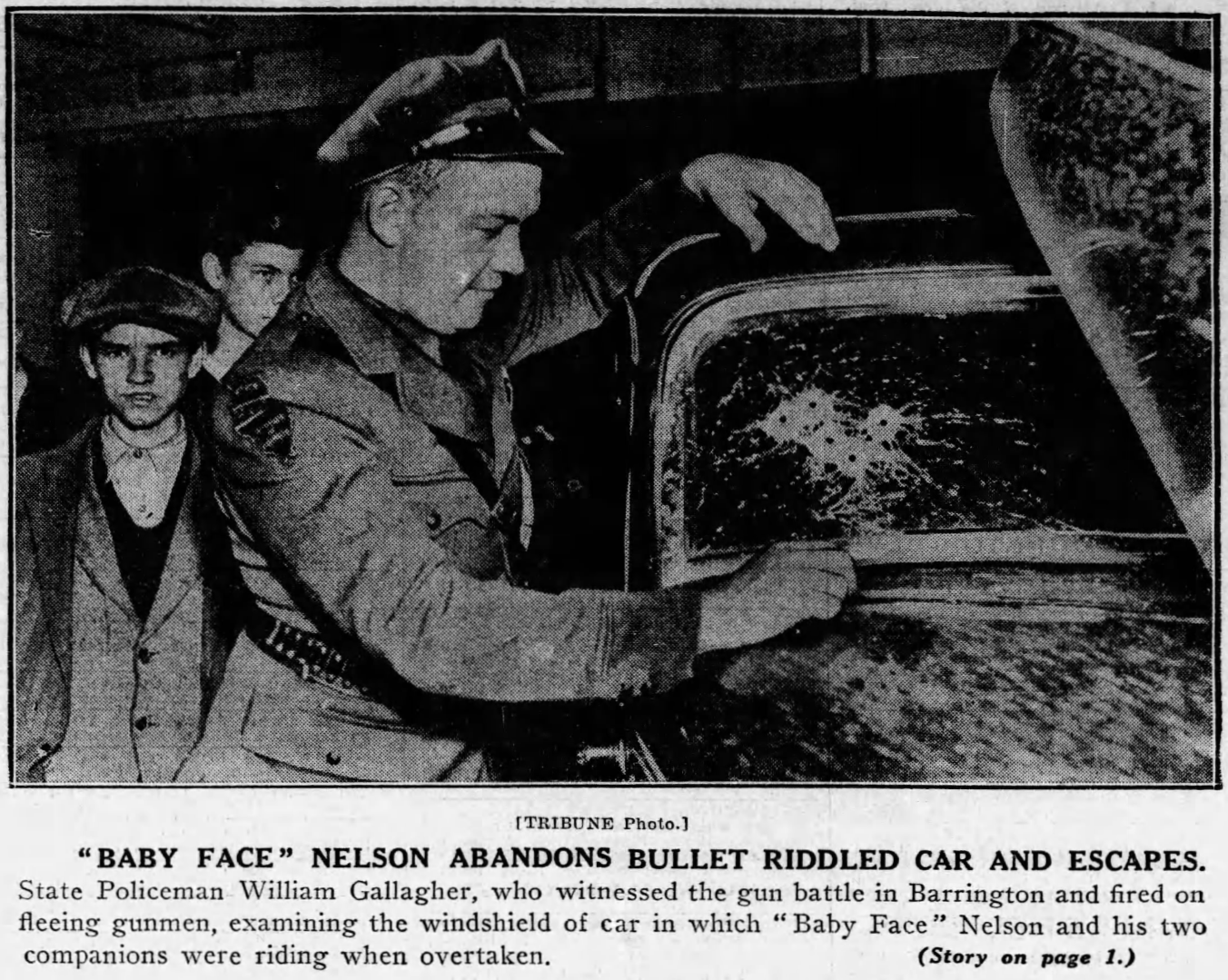
The archival photograph attached to this Story was published in the Chicago Tribune on November 28, 1934. Illinois State Policeman William Gallagher is shown examining the bullet-riddled windshield of the car used by Baby Face Nelson and his companions. The glass is physical evidence of the previous day’s firefight near Barrington, Illinois.
A second archival object—the body armor recovered after the shooting—is preserved by the FBI. These objects keep the story anchored in material evidence. By November 1934, John Dillinger had been dead for four months, but the network around him had not simply vanished. Lester Gillis, known as Baby Face Nelson, remained one of the Bureau’s most wanted fugitives, accompanied by his wife Helen and associate John Paul Chase.
On November 27, FBI Inspector Samuel P. Cowley received information that Nelson had been seen in a stolen car. Two agents spotted the vehicle near Barrington. According to the FBI, Nelson maneuvered behind them and Chase fired an automatic rifle into the agents’ car. One return shot pierced the radiator of Nelson’s vehicle, damaging it and helping set up the next confrontation.
Cowley and Special Agent Herman E. Hollis approached in another automobile. Near the entrance to a park in Barrington, Nelson stopped. Nelson and Chase opened fire as Cowley and Hollis arrived and began to get out. The gun battle lasted only minutes, but the consequences were fatal.
Hollis was killed that day. Cowley was mortally wounded and died the following morning. Nelson was also critically wounded. Chase helped him into the agents’ government car, transferred weapons and other items, and drove away with Helen Gillis. Nelson died later that evening.
The FBI’s later account describes Nelson as suffering numerous gunshot wounds. The precise choreography of every shot has been reconstructed in different ways over time, but the core facts are well documented by federal records and the Bureau’s memorial pages for Cowley and Hollis: the agents were trying to capture Nelson; Nelson and Chase opened fire; both agents were mortally wounded; Nelson was fatally wounded in the exchange.
The photograph of the damaged car should not be treated as a trophy image. It is a record of a confrontation in which three men died from their wounds. The holes in the windshield and the recovered armor are reminders of how militarized these encounters had become, with automatic weapons, stolen vehicles and protective equipment moving through civilian roads and towns.
Barrington also closes a loop begun at Little Bohemia. Nelson had killed Special Agent W. Carter Baum there in April. By November he had killed Hollis and Cowley as well. The FBI identifies Nelson as responsible for the deaths of three Bureau agents, an extraordinary concentration of violence during a short period.
John Paul Chase survived and was later captured. He became the first person tried under a law making it a federal offense to murder an FBI special agent in the performance of duty, according to the Bureau’s history. Helen Gillis was arrested and imprisoned for violating parole. The aftermath continued into courtrooms and prisons long after the shooting itself ended.
As the final chapter of this Story Arc, Barrington explains why Dillinger’s death cannot be used as a neat endpoint. The criminal network had its own momentum. People who had shared robberies, hideouts and escapes continued acting, and law enforcement continued following those connections.
The arc that began with prison relationships and a mass escape in 1933 therefore ends not with one famous outlaw’s death, but with another violent confrontation in late 1934. By then the federal response to interstate fugitives was becoming more powerful and organized. The era’s legends were being replaced by records, prosecutions, memorials and physical evidence such as the scarred vehicle in the photograph.## The road encounter that became a final battle
Barrington did not begin with agents surrounding a prepared hideout. It developed from sightings, pursuit and vehicles meeting on open roads. That made it fluid and dangerous. Ryan and McDade first encountered Nelson’s party and damaged the fugitives’ car. Cowley and Hollis then entered the pursuit. When the crippled vehicle stopped near the park, both sides had powerful weapons and only seconds to act.
The open setting also explains the importance of the surviving car photograph. Unlike a studio mug shot, the damaged windshield is part of the event’s physical aftermath. It records the direction of fire and the intensity of the encounter without requiring a later artist to visualize the exchange. The body armor recovered afterward provides another piece of material context: Nelson expected gunfire and carried equipment intended to help him survive it.
The agents who died
Hollis and Cowley should not be reduced to names in a body count. Hollis had served in the Bureau since 1927 and had been one of the agents who fired during the Dillinger confrontation outside the Biograph. Cowley, an inspector in the Chicago office, had been placed in charge of efforts to locate Nelson. Their Wall of Honor records provide institutional biographies as well as details of the firefight.
Hollis died on November 27. Cowley survived into the next morning. Their deaths gave the Barrington encounter a lasting place in Bureau history, while Nelson’s death ended the pursuit of a fugitive whom the FBI links to the killing of three of its agents in 1934.
Chase, Gillis and the legal aftermath
Nelson’s death was not the end of the case. John Paul Chase remained alive and at large for several weeks. After his capture, he was prosecuted for Cowley’s murder under the newly applicable federal law protecting agents killed in the performance of duty. That prosecution is another example of the legal environment changing during the same period as the manhunt itself.
Helen Gillis also faced consequences. The FBI records that she was arrested on November 29 and later sentenced for violating parole. Her presence in the car and field during the firefight is part of the event, but her role should not be collapsed into the gunmen’s actions.
Why this is the final chapter
Ending the arc at the Biograph would make the historical structure bend around celebrity. Ending it at Barrington shows the opposite: networks outlive their most famous members, and investigations follow relationships rather than fame. The surviving car, the agents’ memorial records and the later prosecution of Chase all point beyond Dillinger himself.
A reader arrives for Dillinger, follows him through Crown Point and the Biograph, then discovers that Hollis appears again at Barrington, Nelson appears at Little Bohemia and South Bend, and Chase opens an entirely different branch into the post-shootout prosecutions. The story does not end because the famous name disappears. It changes direction.
What the record establishes — and what it does not
FBI records and memorial pages establish the firefight, the deaths of Hollis and Cowley, and Nelson’s fatal wounds.
Minute-by-minute reconstructions vary; this Story limits precise claims to the federal record cited.
People and groups in this story
Don’t stop here
References
- John Dillinger · FBI · View source ↗
- Baby Face Nelson Body Armor · Federal Bureau of Investigation · View source ↗
- FBI Law Enforcement Bulletin, October 1936 — glass-fracture evidence · Federal Bureau of Investigation
- FBI: A Centennial History, 1908–2008 · Federal Bureau of Investigation
- Herman E. Hollis · Federal Bureau of Investigation · View source ↗
- Herman E. Hollis · Federal Bureau of Investigation
- Lester Gillis (“Baby Face” Nelson) · Federal Bureau of Investigation · View source ↗
- Lester Gillis (“Baby Face” Nelson) · Federal Bureau of Investigation
- Samuel P. Cowley · Federal Bureau of Investigation · View source ↗
- Samuel P. Cowley · Federal Bureau of Investigation
- The FBI and the American Gangster, 1924-1938 · Federal Bureau of Investigation · View source ↗