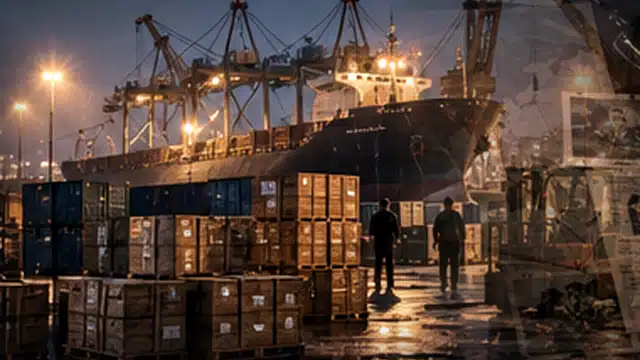
British law-enforcement cases repeatedly identify Albanian organized-crime groups in cocaine distribution. The pattern should be read through specific investigations and convictions rather than treated as evidence that Albanian nationality itself implies criminal affiliation.
Recent NCA cases
The UK National Crime Agency has prosecuted multiple Albanian nationals in cocaine investigations involving kilogram quantities of drugs, cash and firearms. In a 2026 case, two members of an Albanian organized-crime group were jailed after officers recovered 23 kilograms of cocaine, a loaded semi-automatic handgun, cash, false identification documents and cutting agents.
Other investigations have involved larger wholesale seizures and links between London, regional distribution centers and international supply chains. These cases support the conclusion that Albanian organized-crime groups have an established presence in parts of the British cocaine market.
Wholesale and street distribution
The strongest cases distinguish between importation, wholesale movement and local distribution. Some Balkan groups have developed access to cocaine close to source countries, while UK-based crews may handle storage, redistribution, cash collection or downstream sales.
No single Albanian hierarchy
The UK evidence does not establish a single national Albanian mafia commanding all groups. Networks can be family-based, partnership-based or temporary and may cooperate with non-Albanian criminals.
Wider connections
The UK branch belongs in the same network of documented connections as Kompania Bello, the 2024 South America–Italy crackdown and the broader South America–Western Balkans Cocaine Pipeline because all document different stages of Europe’s cocaine economy. The links represent shared markets and logistics, not automatic organizational membership.
Enforcement picture
The British cases show a recurring law-enforcement focus on groups involved in kilogram-level cocaine storage and redistribution. Some investigations also recover cash, false identity documents, firearms or drug-processing material, which helps authorities distinguish organized supply activity from simple possession.
The UK market is especially relevant to the wider Balkan graph because Britain is a high-value destination at the end of European cocaine routes. A network may be involved only in one stage of that chain: importation, transport, wholesale storage, money collection or local distribution. The graph should therefore connect cases through proven people, organizations and routes rather than through nationality alone.
People and groups in this story
Don’t stop here
References
- Albanian crime group duo jailed over cocaine and semi-automatic handgun · UK National Crime Agency · View source ↗