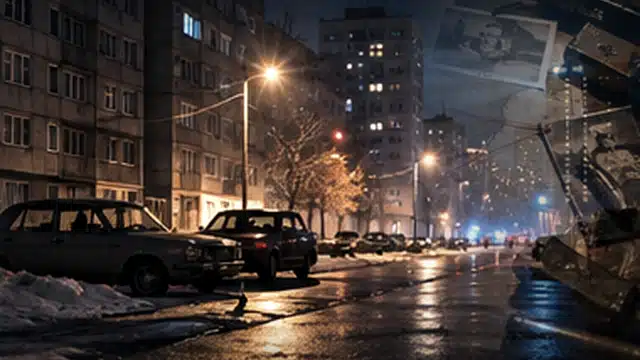
The Russian gang wars of the 1990s were not one national conflict. They were a series of local and regional struggles that unfolded as organized-crime groups competed for businesses, markets and political influence during the post-Soviet transition. Two well-documented examples are the Orekhovskaya succession crisis in Moscow and the Uralmash–Central conflict in Yekaterinburg.
Moscow: Orekhovskaya after Sylvester
In Moscow, the Orekhovskaya group rose under Sergei Timofeyev, known as Sylvester. His assassination by car bomb on September 13, 1994 removed the organization’s central leader and opened a prolonged succession struggle. Grigory Gusyatinsky, Sergei Ananyevsky and other figures were killed as leadership shifted.
Sergei Butorin eventually emerged as one of the principal surviving leaders. Years later, courts reconstructed a large body of Orekhovskaya violence. Butorin received a life sentence in 2011, and Dmitry Belkin received another life sentence in 2014. Those convictions provide a legal record for violence that had previously been known mainly through police and press accounts.
Yekaterinburg: Uralmash against the Central group
Yekaterinburg developed a different criminal landscape. U.S. government research identified Uralmash and a central network among the city’s main criminal power centers. Their rivalry became a gang war.
The murder of Central leader Oleg Vagin on October 26, 1992 was a major turning point. Investigators later attributed the attack to Uralmash members. Additional killings weakened the Central group and allowed Uralmash to dominate the city’s underworld.
What connects the conflicts
The common feature was the use of organized violence to redistribute economic control. The organizations themselves were separate, with different leaders, territories and relationships. Treating them as one unified “Russian Mafia” would erase those distinctions.
This story arc connects the major people, organizations and prosecutions while preserving those differences. It also points forward to the later evolution of Russian organized crime, when some networks moved increasingly into transnational finance and legitimate-looking business.
0 connected stories
No separate event chapters have been published for this series yet. Follow the documented sections above; the timeline is not an empty list of invented events.
References
- The Threat of Russian Organized Crime · U.S. National Institute of Justice · View source ↗
- Leader of Orekhovskaya group gets life sentence · Interfax · View source ↗
- Orekhovskaya leader sentenced to life · Interfax · View source ↗
- How Central Gang leader Oleg Vagin was killed · Kommersant · View source ↗
- Investigation of the killing of Sylvester · Kommersant · View source ↗
- Orekhovskaya cases reach court · Kommersant · View source ↗
- Uralmash: history of a criminal community · Kommersant · View source ↗