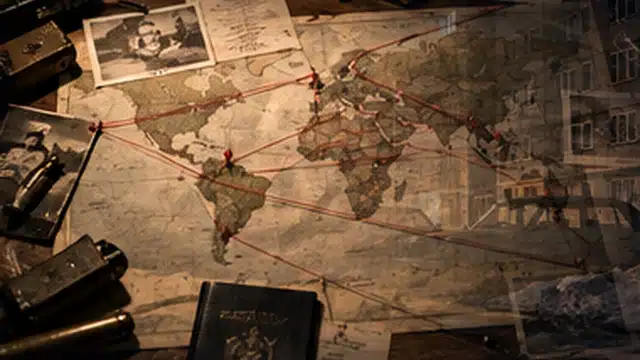
The collapse of the Medellín Cartel was not a single police operation. It was a decade-long confrontation involving trafficking networks, Colombian institutions, extradition policy, assassinations, bombings, rival cartels, surrender deals and an increasingly coordinated manhunt.
This story arc begins with the assassination of Justice Minister Rodrigo Lara Bonilla in 1984, a killing remembered by Colombian historical institutions as a decisive escalation in the state’s conflict with narcotics trafficking. It then follows the mass-casualty violence of 1989, including Avianca Flight 203 and the bombing of the DAS headquarters.
The later chapters trace the political consequences of the anti-extradition campaign: Pablo Escobar’s 1991 surrender, the extraordinary conditions at La Catedral, his escape in 1992 and the 17-month manhunt that ended with his death in Medellín on December 2, 1993.
The parallel rise of the Cali Cartel provides the final context. Medellín’s destruction did not eliminate the cocaine economy. It shifted power toward a rival organization that Colombian and U.S. authorities then spent the mid-1990s dismantling.
Chapters
1. Assassination of Rodrigo Lara Bonilla, 1984 2. Avianca Flight 203 bombing, 1989 3. DAS building bombing, 1989 4. Escobar surrenders and enters La Catedral, 1991 5. Escobar escapes La Catedral, 1992 6. Death of Pablo Escobar, 1993
The prison rupture and the final hunt
The story did not move directly from La Catedral to Escobar’s death. The killings of Gerardo Moncada and Fernando Galeano inside the prison complex accelerated the split in the Medellín underworld. Surviving enemies and former associates moved into the anti-Escobar camp.
After Escobar escaped in July 1992, the Colombian National Police re-created the Search Bloc. During 1993 the illegal Los Pepes alliance attacked Escobar’s support network while the official manhunt continued. Colombian truth-commission and judicial records document contacts involving particular state-security personnel and illegal anti-Escobar actors, while the precise scope of cooperation remains contested.
What survived Medellín
Escobar’s death ended the cartel’s dominant leadership but did not erase Medellín’s criminal infrastructure. U.S. Justice Department records trace the Oficina de Envigado to enforcement and collection services that had served the Medellín Cartel. Meanwhile the Cali Cartel expanded into the space left by Medellín’s decline.
The arc therefore ends with reorganization rather than disappearance: a kingpin was gone, but markets, armed actors and criminal services continued under different structures.
0 connected stories
No separate event chapters have been published for this series yet. Follow the documented sections above; the timeline is not an empty list of invented events.
References
- Línea del tiempo del Conflicto Armado en Colombia · Centro Nacional de Memoria Histórica · View source ↗
- Rodrigo Lara Bonilla — 30 April 1984 · Centro Nacional de Memoria Histórica · View source ↗
- Antioquia — Informe Final · Comisión de la Verdad · View source ↗
- Hallazgos y recomendaciones: responsabilidades en el conflicto armado · Comisión de la Verdad · View source ↗
- Pablo Escobar Life Mask · DEA Museum · View source ↗
- The Intelligence Division’s Role in Tracing the Rise and Fall of the Colombian Cartels · DEA Museum · View source ↗
- DEA History 1980–1985 · Drug Enforcement Administration · View source ↗
- The Drug Enforcement Administration, 1990–1994 · Drug Enforcement Administration · View source ↗
- Una guerra sin edad · Jurisdicción Especial para la Paz · View source ↗
- Sentencia de Justicia y Paz — antecedentes de Bloque de Búsqueda y Los Pepes · Tribunal Superior de Medellín / Procuraduría General de la Nación · View source ↗
- Alleged Members of La Oficina de Envigado Arrested for Drug Trafficking · U.S. Department of Justice · View source ↗
- Cali Cartel Leaders Plead Guilty to Drug and Money Laundering Conspiracy Charges · U.S. Department of Justice · View source ↗
- Department of Justice annual report: Avianca Flight 203 prosecution · U.S. Department of Justice · View source ↗
- Avianca Flight 203 forensic investigation review · U.S. Department of Justice Office of Inspector General · View source ↗
- Avianca prosecution and Medellín Cartel bombing evidence · U.S. Department of Justice Office of Inspector General · View source ↗