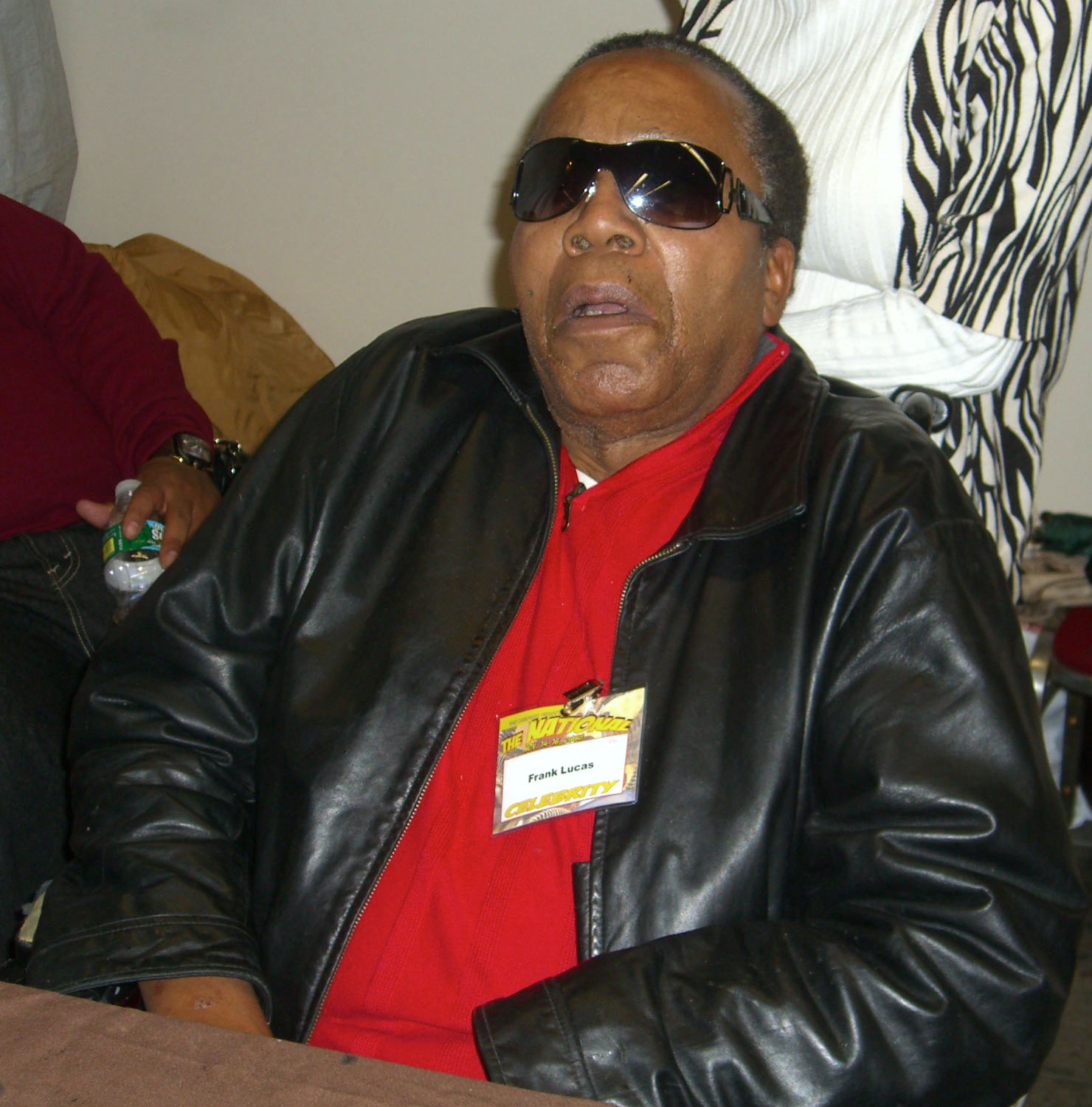
Frank Lucas became one of the best-known heroin traffickers associated with Harlem in the late 1960s and early 1970s. His later fame came largely from the 2007 film American Gangster, but the historical record is more complicated than the movie’s rise-and-fall narrative. Lucas was a major narcotics distributor, was arrested in a 1975 federal-state investigation, received extraordinarily long federal and New Jersey sentences, became a government cooperator, returned to prison after a later drug conviction, and spent his final decades living with the consequences of both his criminal career and his public notoriety.
The most useful way to understand Lucas is to separate the documented record from the stories that grew around him. He was unquestionably an important heroin trafficker. Some of the more cinematic claims attached to his name—especially stories about heroin being hidden in the coffins of American servicemen—have been disputed by people connected to the Southeast Asian supply chain and should not be treated as settled fact.
Harlem heroin network
Lucas operated in New York at a time when heroin caused enormous damage in the city. Contemporary reporting described him as a major supplier in Harlem and the South Bronx. His organization was not a traditional Mafia family. It was a narcotics network built around supply, wholesale distribution, trusted associates and the ability to move large quantities of heroin into street-level markets.
Lucas later emphasized the idea that he had bypassed conventional middlemen and obtained heroin directly from Southeast Asia. That part of his public image became central to magazine profiles, books and eventually American Gangster. The underlying fact that he had access to a powerful heroin supply network is well established. The exact mechanics of that supply chain, however, became entangled with Lucas’s own storytelling.
The 1975 raid and prosecution
Lucas’s criminal career was disrupted in January 1975. Contemporary United Press International reporting said federal agents searching his home in Teaneck, New Jersey, found $584,000 in cash. Authorities also seized evidence of the wealth surrounding him, including expensive vehicles and jewelry. He was indicted with 18 other people on charges connected to the distribution of large quantities of heroin in Harlem and the South Bronx.
The prosecution produced both federal and New Jersey state convictions. The sentence is often summarized as “70 years,” but the underlying structure is more precise: Lucas received a 40-year federal prison term and a 30-year New Jersey state term. Contemporary reporting in 1981 described those two sentences separately when courts considered reductions based on his cooperation.
Cooperation and sentence reduction
After conviction, Lucas became a government informant. By 1981, prosecutors publicly described his cooperation as extensive. UPI reported that authorities credited information supplied by Lucas with helping prosecute dozens of drug traffickers in several states and with producing additional indictments and convictions in the New York area.
His cooperation dramatically changed the time he actually served. In June 1981, his 40-year federal sentence was reduced to the roughly six years he had already served. Contemporary reporting also described the pending reduction of his 30-year New Jersey sentence. The broader result was that Lucas was released after only a fraction of the original federal and state terms and entered the witness-protection system because of threats against him.
This is an important part of his history because it changed his role from convicted trafficker to cooperating witness. It also became one of the central real-world elements behind American Gangster.
The 1984 conviction
Lucas’s release did not end his contact with the criminal justice system. In 1984 he was convicted in federal court in Brooklyn in another drug case. Contemporary accounts described the case as a conspiracy involving an attempted narcotics transaction with an undercover agent. Reporting from the period says the new conviction resulted in a seven-year prison sentence.
He remained in custody until 1991.
The later conviction complicates any simple story of permanent reform immediately after his cooperation. Lucas had already received one of the most significant sentence reductions of his era because of the information he provided, yet he returned to prison only a few years after release.
The legend and the disputed stories
Lucas was a skilled self-mythologizer. The best-known example is the story that heroin from Southeast Asia was smuggled into the United States in or beneath the coffins of American servicemen killed in Vietnam. Lucas repeated versions of that claim publicly, and the image became inseparable from his legend.
But the story has been challenged. Accounts involving Leslie “Ike” Atkinson, a figure associated with the Southeast Asian side of the supply network, disputed Lucas’s coffin narrative. Later reporting also emphasized that American Gangster should not be treated as a documentary.
That does not make Lucas a minor figure. It means the historical profile has to distinguish proven criminal conduct from anecdotes that became stronger through repetition.
American Gangster
Ridley Scott’s American Gangster brought Lucas to a much wider audience. Denzel Washington portrayed him, while Russell Crowe played Richie Roberts, the New Jersey law-enforcement and prosecution figure associated with the investigation.
The film uses real names, real institutions and real criminal history, but it also compresses people and events. Former New Jersey investigators publicly objected that the film concentrated investigative credit too heavily in Roberts’s character. Roberts himself acknowledged that a larger squad was involved.
Later years and death
Lucas remained a public figure long after leaving prison. His story was retold in interviews, books, television programs and documentaries. In later appearances he expressed regret for the damage caused by heroin and encouraged younger people to avoid his path.
He died on May 30, 2019, at a health-care facility in Cedar Grove, New Jersey. Family and contemporary reporting placed his age at 88. UPI reported that his nephew described the cause as natural causes. Funeral-home records confirm the date and location of death.
The contrast between the scale of his original sentences and the relatively limited time he actually served remains one of the most striking facts in his case. It reflects both the seriousness of the trafficking convictions and the value prosecutors placed on his cooperation.
Documented sentence record
Lucas’s original punishment should be stated precisely. The federal case produced a 40-year federal prison term. The New Jersey case produced a 30-year state prison term. Together they are often described as 70 years. In 1981, after his cooperation, the federal term was reduced to time already served and the state sentence was also reduced as part of the process that led to his release and witness protection.
The later 1984 federal drug conviction resulted in a seven-year prison sentence, after which Lucas remained incarcerated until 1991.
These sentence details are kept as structured data rather than flattened into a single number because they represent different cases and different courts.
connections
Lucas is connected directly to American Gangster, where Denzel Washington portrays him. The Screen page links back to this profile, and this profile links back to the film. The same graph also connects him to Richie Roberts, whose real career and later legal troubles are documented separately.
The purpose of those connections is not to validate every scene in the movie. It is to let readers move between the dramatized version and the historical people while keeping the differences visible.
Frank Lucas’s real story does not need embellishment. A major heroin organization, an enormous cash seizure, federal and state convictions, decades of prison sentences, cooperation with prosecutors, witness protection, a second drug conviction and a later Hollywood afterlife already form a complicated historical record. The strongest version of the story is the one that keeps those documented facts separate from the legend that grew around them.
Collectibles & memorabilia
Explore monetized Amazon results connected to Frank Lucas. Curated items appear first when available.
Search Amazon for related collectibles ↗As an Amazon Associate, RoguesBook earns from qualifying purchases.
References
-
[1]FrankLucas11.15.08ByLuigiNovi.jpgTier 1MentionsView source ↗
-
[2]Frank Lucas, druglord portrayed in 'American Gangster,' diesTier 2MentionsView source ↗
-
[3]Mr. Frank Lucas, Sr. ObituaryTier 2MentionsSupportsView source ↗
-
[4]Drug Dealer Gets New Prison TermTier 2MentionsView source ↗
-
[5]U.S. Jury Convicts Heroin InformantTier 2MentionsView source ↗
-
[6]Cops feel left out of 'Gangster' gloryTier 2MentionsView source ↗
-
[7]Drug lord Frank Lucas, depicted in 2007 film, dies at 88Tier 2MentionsSupportsView source ↗
-
[8]Frank Lucas, once rated among the top drug dealers...Tier 2MentionsView source ↗