The Pagans emerged in Maryland in 1959, far from the California origins of Hells Angels. Their expansion created a distinct East Coast motorcycle-club history—and its own trail of legal cases and rivalries.
The Pagans Motorcycle Club developed in the Mid-Atlantic United States and became one of the country’s most prominent motorcycle organizations classified by federal law enforcement as an outlaw motorcycle gang.
Its history is strongly tied to chapter territory in the eastern United States, rivalry with other clubs and repeated federal and state investigations.
Regional identity
Unlike motorcycle clubs whose public identity is centered in California or Texas, the Pagans are most closely associated with the Mid-Atlantic.
Federal profiles have historically placed chapters in states across the eastern United States.
That regional concentration shaped the club’s rivalries and relationships with other criminal organizations operating in cities such as Philadelphia, Pittsburgh and New York.
Colors and chapter culture
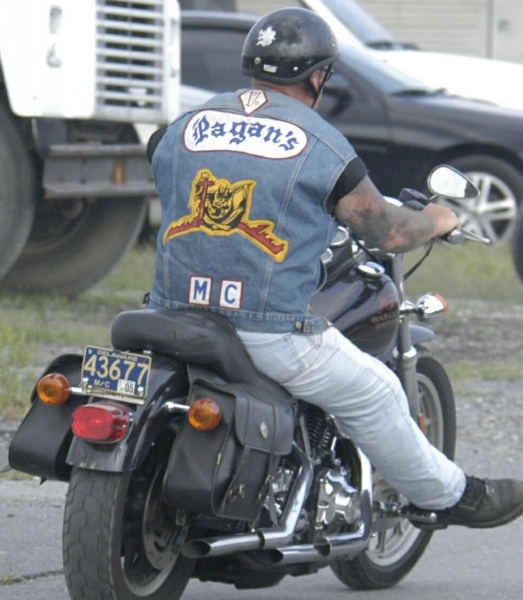
The club’s colors provide a visible organizational identity.
Government photographs of members wearing patches have appeared in federal intelligence materials and later in public archives.
The image is useful for identifying the organization, but it should not be used to imply that the photographed individual was convicted of the crimes described elsewhere in a club-level profile.
Federal assessments
The Department of Justice has described the Pagans as an outlaw motorcycle gang and has linked members in law-enforcement reporting to drug trafficking, extortion, assault, weapons offenses and other violent crimes.
More recent federal cases have continued to involve defendants identified as Pagans members.
Each case applies to named people and specific allegations or convictions.
Territorial conflict
The Pagans have appeared in rivalry narratives involving Hells Angels, Outlaws and other motorcycle clubs.
Territory can refer to more than a map boundary. It may involve motorcycle events, recruitment areas, support clubs and whether rival colors can be displayed without confrontation.
Federal indictments have alleged organized violence intended to intimidate rival clubs in contested areas.
Those allegations must be tied to their specific cases rather than generalized automatically to every chapter.
Connections beyond motorcycle clubs
Government reporting has also described historical ties between Pagans members and traditional organized-crime groups in parts of the Northeast.
Persistence
Like other large chapter-based organizations, the Pagans survived repeated arrests and prosecutions.
This persistence is one reason organization-level analysis matters.
A list of defendants can show who was arrested in one year. A historical profile shows how a network continues, changes leadership and adjusts after law-enforcement pressure.
Why the Pagans matter
The Pagans expand the motorcycle-club section beyond the western United States.
They provide a strong Mid-Atlantic node connected to territorial conflict, federal racketeering cases and traditional organized-crime networks.
That makes them an important counterpart to the Hells Angels, Outlaws, Mongols and Bandidos.
Rivals, allies and counterpart organizations
Related series
References
-
[1]2011 National Gang Threat AssessmentTier 1MentionsSupportsView source ↗
-
[2]Outlaw Motorcycle Gangs (OMGs)Tier 1MentionsSupportsView source ↗
-
[3]Outlaws Motorcycle Gang Members Found GuiltyTier 1SupportsView source ↗
-
[4]Pensacola Member of Outlaws Motorcycle Club Pleads Guilty to ArsonTier 1SupportsView source ↗
-
[5]Two Hells Angels Sentenced for Racketeering Attempted MurderTier 1SupportsView source ↗
-
[6]Members and Associates of Pagans Motorcycle Club Charged in Federal CourtTier 1SupportsMentionsView source ↗