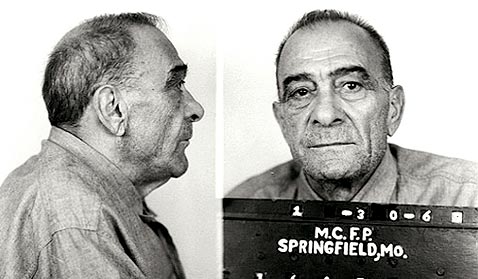
The Genovese crime family is one of New York City’s Five Families of La Cosa Nostra. Its lineage runs through some of the most important figures in the history of Italian-American organized crime: Joe Masseria, Charles “Lucky” Luciano, Frank Costello, Vito Genovese and Vincent “the Chin” Gigante. Federal histories have often described the family as unusually secretive and durable, with leadership structures designed to shield the people exercising real power.
The modern name comes from Vito Genovese, but the organization existed long before he took control. Its history is best understood as a succession of leadership regimes inside the same New York Mafia lineage rather than as a group founded by Genovese in the 1950s.
From Masseria to Luciano
By the late 1920s, Joe Masseria was one of the dominant Italian underworld leaders in New York. His conflict with Salvatore Maranzano became the Castellammarese War, a struggle that reshaped the city’s Mafia organizations.
Lucky Luciano operated within Masseria’s organization before turning against him. Masseria was murdered in 1931, and Maranzano briefly emerged as the leading Mafia figure in New York. He reorganized the city’s groups into families, but was himself murdered later that year.
Luciano then became the leading figure in the organization that would eventually be known as the Genovese family. The new system placed greater emphasis on cooperation among families through the Commission rather than on one permanent “boss of bosses.”
Frank Costello and political influence
Luciano was convicted in 1936 and later deported to Italy. Frank Costello became the most important day-to-day leader of the family. Costello cultivated relationships in politics, gambling and legitimate business and became famous for a style based more on influence than on public displays of violence.
During this period Vito Genovese, a senior figure in the organization, spent years in Italy while facing a U.S. murder charge. After returning to the United States, he rebuilt his position inside the family.
The struggle between Costello and Genovese culminated in 1957 when Vincent Gigante shot and wounded Costello. Costello survived but withdrew from active leadership. Genovese took control, and the family eventually became identified by his name.
Vito Genovese and the family’s name
Vito Genovese’s victory was short-lived. In 1959 he was convicted in a federal narcotics case and sentenced to prison. He nevertheless remained influential while incarcerated.
The fact that the organization survived his imprisonment is important. The family was not simply a personal gang. Capos, crews and administrators continued to operate, and leadership could be concealed behind acting bosses or front men.
Genovese died in federal custody in 1969, but his name remained attached to the family.
Joseph Valachi and the public exposure of La Cosa Nostra
Joseph Valachi, a made member associated with the Genovese family, became one of the most important cooperating witnesses in American Mafia history. While imprisoned, he came to believe that he had been marked for death and eventually began cooperating with federal authorities.
In 1963, Valachi testified before a U.S. Senate subcommittee. His testimony described Mafia membership, initiation ceremonies, organizational structure and the term La Cosa Nostra to a national audience.
Valachi did not destroy the family, but his cooperation changed public and government understanding of organized crime. It helped confirm that the Mafia was not just a loose collection of individual gangsters.
Hidden leadership and front bosses
The Genovese family became especially associated with concealed leadership. FBI histories describe Philip “Benny Squint” Lombardo as exercising power while other figures appeared to be the public boss. Frank Tieri and Anthony “Fat Tony” Salerno were among the men who occupied visible leadership roles during this period.
This model complicated law-enforcement efforts. Investigators had to prove not only criminal acts but who was actually directing the organization.
The strategy reached its best-known form under Vincent Gigante. Gigante was accused of running the family while publicly behaving as though he were mentally ill, wandering Greenwich Village in a bathrobe and presenting an image that generated the nickname “the Odd Father.”
Vincent Gigante
Gigante had been tied to the family for decades before becoming its dominant figure. Federal investigators ultimately built cases showing that his public behavior was part of an effort to avoid prosecution and conceal leadership.
He was convicted in 1997 on racketeering and conspiracy charges. In 2003 he pleaded guilty to obstruction of justice, admitting that his long-running display of mental illness had been deceptive. He died in federal custody in 2005.
Gigante’s era reinforced the family’s reputation for secrecy, but the organization’s resilience also depended on a broader crew structure and long-standing rackets.
Rackets and economic power
Federal cases have associated Genovese members and associates with illegal gambling, loansharking, extortion, labor racketeering, narcotics, fraud, money laundering and infiltration of legitimate businesses.
Labor influence was particularly important because control or intimidation around unions and industries could generate long-term income without the visibility of street-level crime. The waterfront, construction and other unionized sectors repeatedly became targets of organized-crime investigations.
The family also adapted to financial crime. FBI investigations have linked Genovese figures to stock manipulation and other schemes, showing that Mafia rackets did not remain frozen in the Prohibition era.
The Commission case and federal pressure
During the 1980s, prosecutors used RICO and electronic surveillance to attack the leadership of the Five Families. The Mafia Commission case led to convictions of senior New York Mafia figures and demonstrated the value of treating organized crime as an enterprise rather than prosecuting isolated offenses.
Genovese figures were also targeted through investigations into labor racketeering, gambling and murder conspiracies. Later coordinated Mafia takedowns continued to include Genovese members and associates.
The pattern is important: major convictions damaged leadership, but the family repeatedly replaced imprisoned or dead figures.
The family as a continuing institution
The Genovese family should not be reduced to a list of famous bosses. Its durability came from crews, captains, associates, revenue streams and rules that allowed the organization to continue when a leader disappeared.
That is why historical claims about “the boss” should always be dated and sourced. Mafia leadership can be contested, hidden or deliberately obscured, and official prosecutions often provide a more reliable snapshot than press speculation.
Why the Genovese family matters as a hub
The Genovese family connects the Castellammarese War, Lucky Luciano’s reorganization of New York’s Mafia, Frank Costello’s political era, Vito Genovese’s takeover, Joseph Valachi’s testimony, the use of front bosses, Vincent Gigante’s hidden leadership and the federal Commission prosecutions.
It is one of the clearest examples of how an organized-crime institution can survive repeated decapitation. Individuals changed, but the family structure remained a durable part of New York La Cosa Nostra.
Portrayed on Screen
The Alto Knights
Robert De Niro plays both Frank Costello and Vito Genovese in a dramatization of the rivalry that reshaped New York Mafia leadership in 1957.
People who shaped this story
Events that define the record
Attempted Assassination of Frank Costello, 1957
The May 2, 1957 shooting of Frank Costello by a gunman identified by federal histories as Vincent Gigante, a failed assassination that helped Vito…
Rivals, allies and counterpart organizations
References
-
[1]And Justice for All, 1954–1971Tier 1SupportsView source ↗
-
[2]Joe Pistone, Undercover AgentTier 1MentionsSupportsView source ↗
-
[3]La Cosa NostraTier 1SupportsMentionsView source ↗
-
[4]Mafia Takedown: Largest Coordinated Arrest in FBI HistoryTier 1MentionsSupportsView source ↗
-
[5]Thomas Ryan Eboli FBI VaultTier 1SupportsView source ↗
-
[6]The Origin of Organized Crime in America: The New York City Mafia, 1891–1931Tier 1SupportsView source ↗
-
[7]Genovese Family Leadership ConvictionsTier 1SupportsView source ↗
-
[8]Frank Costello Assassination AttemptTier 2SupportsView source ↗
-
[9]Mob Town movie spotlights notorious Mafia summitTier 2SupportsView source ↗
-
[10]The hit that could have sunk Las VegasTier 2SupportsView source ↗