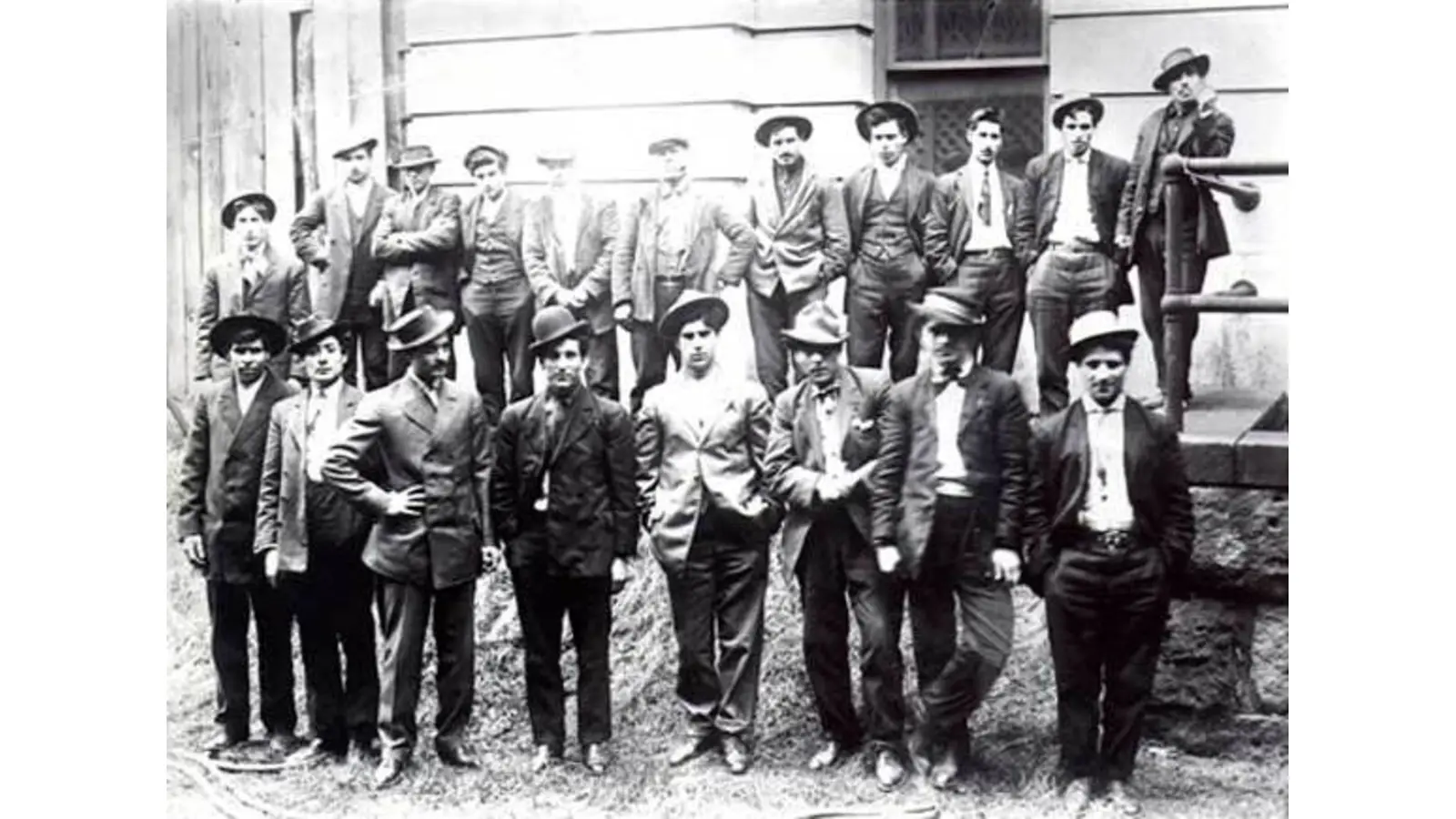
The Five Points Gang belonged to the generation before Prohibition transformed American organized crime.
Centered in Lower Manhattan around the turn of the twentieth century, it grew out of older neighborhood gang traditions but became more structured, more politically connected and more influential than many of the groups that preceded it.
Its most famous leader was Paul Kelly.
The Five Points environment
The Five Points neighborhood had already been associated with poverty, political machines, saloons and street gangs for decades.
By the 1890s, older groups such as the Whyos and Dead Rabbits had faded or fragmented.
Paul Kelly brought together remnants of neighborhood gangs and built a larger organization.
Historical accounts describe his headquarters at the New Brighton Athletic Club, a dance hall and social venue that gave the gang a legitimate-looking public base.
Paul Kelly
Kelly was born Paolo Antonio Vaccarelli and reinvented himself under an Irish-sounding name.
That self-reinvention reflected the political environment of New York.
Gang leaders could act as intermediaries between immigrant neighborhoods, saloons, labor disputes and the Tammany Hall political machine.
Kelly cultivated a polished public image compared with many street-gang leaders.
Behind that image was an organization involved in robbery, prostitution, racketeering and political violence.
Tammany Hall and political muscle
The Five Points Gang’s value to political operators was not only criminal.
Street gangs could mobilize men for rallies, intimidate opponents and influence elections.
This relationship between politics and organized violence is one of the most important reasons the gang matters historically.
It demonstrates that American organized crime did not suddenly appear during Prohibition.
The networks of protection, political exchange and neighborhood control already existed.
War with Monk Eastman
Kelly’s major rival was Monk Eastman.
The Five Points Gang and Eastman’s organization fought repeated street battles over territory and influence.
One famous confrontation involved a large gunfight beneath an elevated railway.
Political patrons eventually pressured the two sides toward a truce because uncontrolled violence threatened the same political system that benefited from gang support.
The episode reveals an important contradiction: political machines could use gang muscle while also needing to restrain it.
A school for later gangsters
The Five Points Gang is especially important because later organized-crime figures passed through its orbit.
Historical accounts associate Johnny Torrio, Lucky Luciano and Al Capone with the organization.
Those men later became central to the development of Prohibition-era and Mafia structures.
The connection should not be treated as if the Five Points Gang were simply an early version of the Chicago Outfit or the Luciano family.
It was a different organization operating in a different period.
But it helped create social and criminal networks that later figures could use.
Decline
The gang’s power declined in the 1910s as Kelly moved away from direct street leadership and New York’s underworld changed.
New criminal organizations became more specialized, more financially sophisticated and increasingly connected across neighborhoods and cities.
The old street-gang model did not disappear, but it was no longer the only path to power.
Why the Five Points Gang matters
It connects nineteenth-century neighborhood gangs to the more organized criminal systems of the twentieth century.
It also provides a bridge between Paul Kelly, Torrio, Luciano and Capone.
That bridge is historically valuable because it shows continuity: political corruption, protection and gang organization existed before Prohibition dramatically increased the available money.
People who shaped this story
Rivals, allies and counterpart organizations
References
-
[1]NYC Borough-Based Jail System Manhattan Site — Phase 1A Archaeological Documentary StudyTier 1SupportsView source ↗
-
[2]Rogues’ Gallery: The Birth of Modern Policing and Organized Crime in Gilded Age New YorkTier 1SupportsView source ↗
-
[3]7 Infamous Gangs of New YorkTier 2SupportsMentionsView source ↗
-
[4]Five Points neighborhood and New York criminal-history collectionsTier 2MentionsView source ↗
-
[5]Members of the Five Points Gang of New York CityTier 2MentionsView source ↗