International confidence man remembered for the 1925 Eiffel Tower fraud and later prosecuted in the United States for a major counterfeit-currency operation.
Narrative
Victor Lustig’s reputation rests on a mixture of documented criminal history and stories that grew in the telling. The safest way to understand him is to separate the two. Records and serious historical accounts establish a professional confidence man who operated under numerous names, staged elaborate deceptions, entered the counterfeiting business, was pursued by the U.S. Secret Service, escaped custody, and ultimately went to Alcatraz. Some biographical details—including elements of his claimed aristocratic background—remain uncertain because deception about identity was part of his trade.
His most famous confidence game unfolded in Paris in 1925. Exploiting public discussion about the cost of maintaining the Eiffel Tower, Lustig posed as a government official and privately approached scrap-metal dealers as though the government were preparing to sell the structure for demolition. The fraud worked by wrapping an implausible proposition in the rituals of bureaucracy: official-looking correspondence, an expensive hotel, secrecy, and a tour designed to make the transaction feel privileged rather than absurd. A dealer paid him, and Lustig left France before the victim’s embarrassment turned into a police complaint. Later retellings say he attempted the trick again; that detail is widely repeated, but the first transaction is the better documented core of the episode.
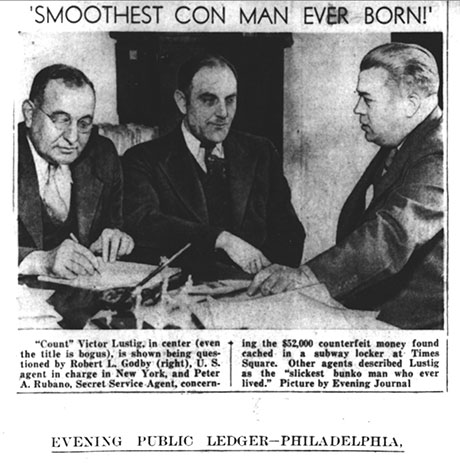
In the United States, Lustig eventually moved from confidence tricks into a more conventional federal priority: counterfeit currency. He worked with forger William Watts, and authorities regarded the notes as unusually convincing. In 1935 agents arrested Lustig in New York. A key found on him led to a locker containing counterfeit money and printing material. He then escaped from federal detention using an improvised rope, only to be caught again within weeks.
The criminal case ended the roaming career. Lustig was sentenced to a long federal term and imprisoned at Alcatraz. He later spent time in the federal medical facility at Springfield, Missouri, where he died in 1947. Smithsonian’s reconstruction, drawing on prison material and contemporary reporting, also emphasizes an important evidentiary point: even official records contain aliases, and some details Lustig supplied about himself cannot be treated as neutral biography.
Lustig’s historical significance lies in how he engineered trust. His schemes rarely depended on a single forged object. They depended on atmosphere—status, paperwork, controlled access, urgency, and the victim’s belief that he had been invited into an opportunity unavailable to ordinary people. The Eiffel Tower episode remains memorable because it makes visible the central mechanism of the confidence trick: the mark is persuaded not simply to believe a lie, but to participate in the world the swindler has constructed.
Criminal outcome
Federal authorities captured Lustig in 1935 in connection with counterfeiting. After escaping custody and being recaptured, he was convicted and received a federal sentence that sent him to Alcatraz; contemporary and later accounts describe a 20-year term.
Death
Lustig died on March 11, 1947, after his federal imprisonment and later treatment at the federal medical facility in Springfield, Missouri. The current source set establishes the date but does not establish a more specific medical cause with sufficient confidence.
Evidence note
This article distinguishes conviction, guilty plea, allegation, reported anecdote, and posthumous/institutional finding. Where totals, dates, identities, or individual episodes are disputed or inconsistently reported, the prose avoids converting them into exact proven facts.
Documented network
The Eiffel Tower Confidence Scheme (event): Lustig posed as a French official and induced a scrap dealer to pay for supposed rights to the Eiffel Tower.
Timeline and case connections
Structured events are kept separate from general biography so later audits can update dates, convictions, killings, organizational changes or court outcomes without rewriting unrelated material.
Date not specified in current profile sources — The Eiffel Tower Confidence Scheme. Lustig posed as a French official and induced a scrap dealer to pay for supposed rights to the Eiffel Tower.
1947-03-11 — Death of Victor Lustig. Death recorded in the canonical person record.
Status and record
The death record lists 1947-03-11.
Source record
The Master package currently attaches these sources to the profile: – The Man Who Sold the Eiffel Tower. Twice. — Smithsonian Magazine, Tier 2. – The Smoothest Con Man That Ever Lived — Smithsonian Magazine, Tier 2.
Claim-level source references remain in the structured data so later audits can trace evidence rather than relying on a generic bibliography.
Evidence and editorial boundaries
For living subjects especially, legal status and allegations require dated evidence. Future expansion should come from stronger records, court material, archives or newly processed canonical entities rather than generalized crime lore.
How this profile fits the archive
The source package currently includes The Man Who Sold the Eiffel Tower. Twice.; The Smoothest Con Man That Ever Lived. Those records define the safe editorial boundary for this version of the page. Unknown dates and unresolved associations remain explicit because a missing fact is a research task, not permission to speculate.
Key events
Death
Death of Victor Lustig.
The Eiffel Tower Confidence Scheme
Lustig posed as a French official and induced a scrap dealer to pay for supposed rights to the Eiffel Tower.
References
-
[1]The Man Who Sold the Eiffel Tower. Twice.Tier 2SupportsMentionsView source ↗
-
[2]The Smoothest Con Man That Ever LivedTier 2MentionsSupportsView source ↗