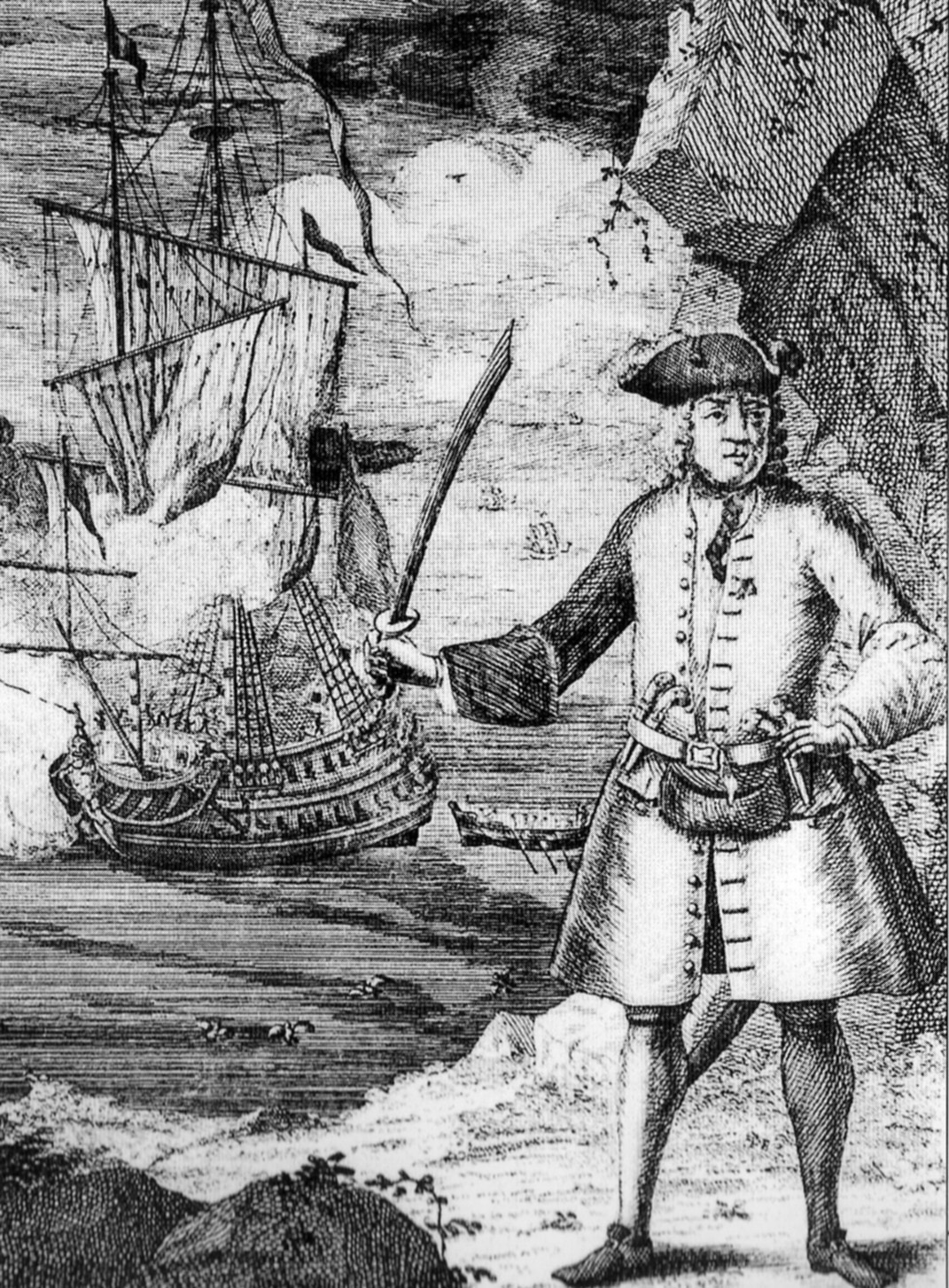
Overview
Henry Every led the 1695 seizure of the Mughal ship Ganj-i-Sawai, one of the most consequential pirate captures of the seventeenth century, and then disappeared before authorities could bring him to trial. Birth year and place are uncertain. Fate after 1696 is uncertain; no secure death date or place is known.
Career and network
Every emerged as captain after a mutiny aboard the Charles II, renamed Fancy, in 1694. His crew crossed the Atlantic and rounded the Cape into the Indian Ocean, where it joined other pirates preying on Red Sea and Mughal shipping. In September 1695 the pirate flotilla attacked a Mughal convoy returning from the pilgrimage route. Every’s Fancy captured the heavily laden Ganj-i-Sawai after an engagement in which failures aboard the Mughal ship helped the attackers. The value of the prize and abuses reported after the capture triggered an international crisis.
The wider setting matters. Piracy in this period was not a self-contained outlaw culture detached from empire. Wars, privateering commissions, colonial trade, naval demobilization, port politics and long-distance commodity routes all created opportunities for armed crews. The category “pirate” therefore has to be applied to specific conduct and legal settings rather than projected backward onto every privateering voyage. For Henry Every, the article uses the strongest documentary anchors available and treats retrospective narrative as a different class of evidence. [Sources: SRC-JAMESON-1923, SRC-HANNA-2015, SRC-CORDINGLY-1995, SRC-LOC-GHP-1725]
Documentary record
The capture can be reconstructed from East India Company correspondence, diplomatic and colonial records, proclamations and later documentary collections. Early pirate narratives added dramatic details, some of which cannot be corroborated. The core facts are firm: Every commanded Fancy, participated in the Red Sea cruise, took Ganj-i-Sawai, and became the target of a transoceanic manhunt because the attack threatened English trade relations with the Mughal Empire.
Final years and uncertain death
After dividing the proceeds, Every crossed back toward the Atlantic and vanished from reliable records. Several crewmen were later arrested and some were executed, but Every himself was never conclusively captured. Stories that he died poor in England, lived under an assumed identity, or enjoyed a secret retirement are later traditions rather than established biography. His disappearance is part of his historical importance because it exposed the weakness of contemporary imperial policing.
Documentation versus legend
Later literature turned Every into a “pirate king” who founded kingdoms, married Mughal royalty or retired with fabulous riches. Those stories should be separated from the documented captain. His real significance lies in the diplomatic shock caused by the Ganj-i-Sawai seizure, the multinational search that followed, and the way the case accelerated a more coordinated British campaign against piracy.
Why Henry Every matters
Core sources
– SRC-JAMESON-1923 — Privateering and Piracy in the Colonial Period: Illustrative Documents; Macmillan / documentary edition by J. Franklin Jameson — https://archive.org/details/privateeringpira00jame – SRC-HANNA-2015 — Pirate Nests and the Rise of the British Empire, 1570–1740; University of North Carolina Press – SRC-CORDINGLY-1995 — Under the Black Flag; Random House – SRC-LOC-GHP-1725 — The history and lives of all the most notorious pirates, and their crews; Library of Congress digitized early printed edition — https://www.loc.gov/resource/rbc0001.2019gen31667/?sp=39
Documented network
Thomas Tew (person): Henry Every is historically connected with Thomas Tew in the documented pirate network.
Status and record
The structured birth record lists Birth year and place are uncertain.. The death record lists Fate after 1696 is uncertain; no secure death date or place is known..
Source record
The Master package currently attaches these sources to the profile: – Privateering and Piracy in the Colonial Period: Illustrative Documents — Macmillan / documentary edition by J. Franklin Jameson, Tier 1. – Pirate Nests and the Rise of the British Empire, 1570–1740 — University of North Carolina Press, Tier 1. – Under the Black Flag — Random House, Tier 2. – The history and lives of all the most notorious pirates, and their crews — Library of Congress digitized early printed edition, Tier 2.
Claim-level source references remain in the structured data so later audits can trace evidence rather than relying on a generic bibliography.
Evidence and editorial boundaries
For living subjects especially, legal status and allegations require dated evidence. Future expansion should come from stronger records, court material, archives or newly processed canonical entities rather than generalized crime lore.
How this profile fits the archive
The source package currently includes Privateering and Piracy in the Colonial Period: Illustrative Documents; Pirate Nests and the Rise of the British Empire, 1570–1740; Under the Black Flag; The history and lives of all the most notorious pirates, and their crews. Those records define the safe editorial boundary for this version of the page. Unknown dates and unresolved associations remain explicit because a missing fact is a research task, not permission to speculate.
Research state
This depth pass expands the page from structured evidence already present in the Master. The next meaningful improvement should be a stronger primary source, a dated event, a verified legal-status change, a prison record, or a newly processed Book, Screen or Organization entity that creates a legitimate reverse link.
Media remains a separate completion gate. A portrait should be attached only after source page, provenance and reuse status are checked. Until then, text can be complete while media remains pending.
Key events
Born
Birth of Henry Every.
Capture of the Ganj-i-Sawai (1695)
Henry Every’s pirate force captured the Mughal ship Ganj-i-Sawai, provoking a diplomatic and commercial crisis for the English East India Company.
Death
Death of Henry Every.
People, groups and places
References
-
[1]Privateering and Piracy in the Colonial Period: Illustrative DocumentsTier 1SupportsMentionsView source ↗
-
[2]Pirate Nests and the Rise of the British Empire, 1570–1740Tier 1SupportsMentions
-
[3]The history and lives of all the most notorious pirates, and their crewsTier 2MentionsSupportsView source ↗
-
[4]Under the Black FlagTier 2MentionsSupports