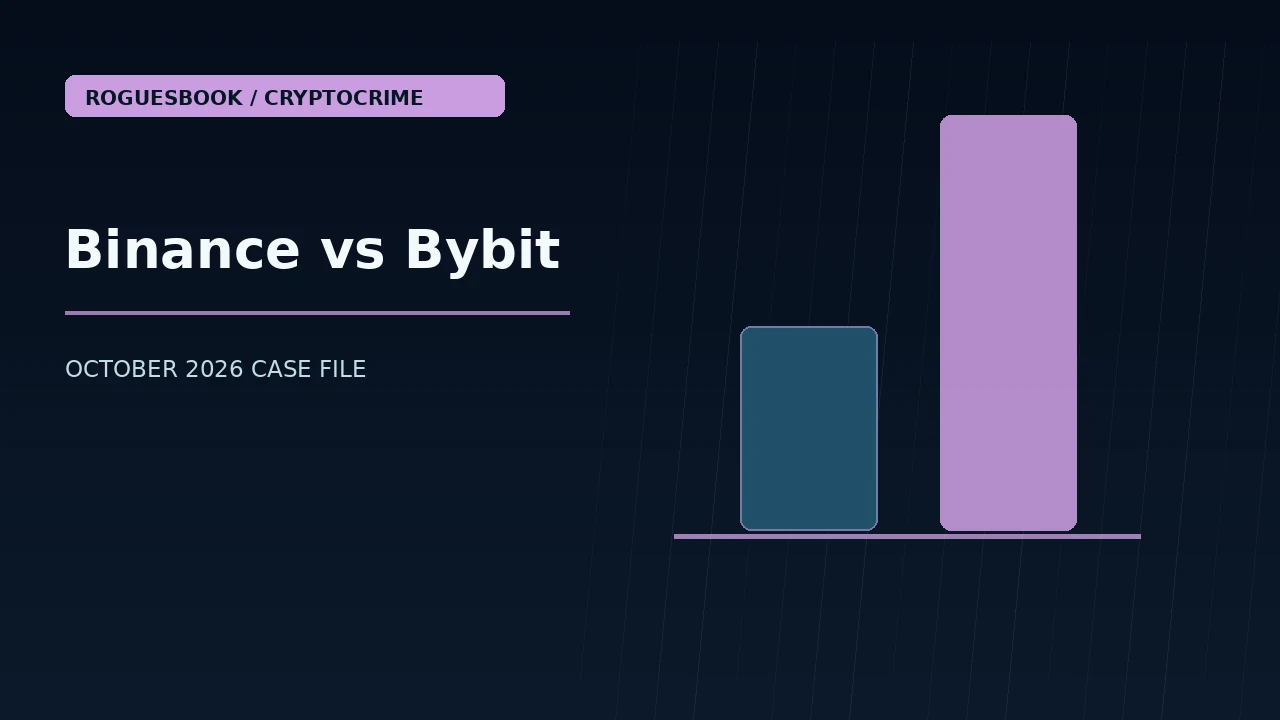
In February 2025, hackers took approximately $1.5 billion in digital assets from Bybit. The Federal Bureau of Investigation attributed the theft to North Korean actors it calls TraderTraitor. Less than two years later, Binance reported an incident with an estimated $6.3 billion impact. Blockchain investigators rapidly associated the newer attack with the same threat-actor designation.
The obvious comparison is the size: Binance's initial estimate was more than four times the Bybit figure. The more important comparison is how trusted transaction infrastructure can be made to authorize movements that a cryptocurrency company did not intend.
Bybit, February 21, 2025: a historic loss
Bybit reported a breach affecting a wallet used for Ethereum transactions, and the incident became the largest publicly reported cryptocurrency theft up to that point. On February 26 the FBI stated that North Korea was responsible for approximately $1.5 billion stolen around February 21. The agency identified the malicious activity as TraderTraitor and said actors were moving proceeds into Bitcoin and other assets across thousands of blockchain addresses.
The attack became a reference point because an apparently legitimate custody process could be subverted. Public accounts examined a compromised signing interface or transaction presentation in the wallet-management workflow. While details are more mature than those available for the October 2026 Binance case, the public should distinguish what agencies formally attributed from what external researchers inferred about every technical step.
The FBI's notice urged exchanges and other virtual-asset businesses to block transactions involving identified laundering addresses. That warning anticipated the broader problem: stolen crypto can pass through many services rapidly, and the recovery window can be short.
Binance, October 29, 2026: ten-chain breadth
Binance reported roughly $6.3 billion in affected funds. TRM Labs reconstructed $6.36 billion in transactions across ten blockchains, including Ethereum, Bitcoin, Tron, Solana and the XRP Ledger. Bitquery's narrower reconstruction counted nine chains. The observed breadth of the Binance incident distinguishes it from the central wallet focus of the Bybit theft.
On one Ethereum hot wallet, investigators found a transaction containing 50 EIP-7702 authorizations, with one matching authorization enabling attacker-associated contract code. Elsewhere, researchers identified conventional signed transactions on chains that do not use EIP-7702. This matters because the attack appears to involve more than the manipulation of one user interface or one wallet type.
Binance initially mentioned a possibly compromised DevOps engineer's laptop and access to a service container. The exchange later acknowledged additional breach points and said it had not found evidence that private keys leaked. Its full root-cause report was still pending October 30.
The shared vulnerability is not a broken blockchain
Neither case is best summarized as someone mathematically cracking Bitcoin or Ethereum. Blockchains can correctly accept properly signed transactions while the decision to issue those transactions has been compromised somewhere outside consensus. A custody interface, an approval process or a signing request can become the weaker boundary.
In Bybit's case, investigators focused on wallet-signing workflow deception. In Binance's, the public chain record and early exchange disclosures raised questions about signing services across multiple chains and a persistent Ethereum delegation. Those are not proven identical mechanisms. They reveal a recurring class of failure: malicious actions arriving with the appearance of legitimate authority.
Who carried out the two incidents?
The Bybit attribution is an FBI statement from February 2025 identifying North Korean TraderTraitor activity. For Binance, TRM assessed TraderTraitor with high confidence and Elliptic also pointed to a likely North Korean connection. Binance had not completed a public attribution by October 30, 2026.
That distinction must survive every headline. The fact that the FBI named TraderTraitor in Bybit does not legally prove the same actors committed a newer theft. Firms can share methods, tools and infrastructure; groups can change tactics, and imitators exist. Reliable reporting should state who made each attribution and how definite it is.
How the money moved after the attacks
The Bybit notice described stolen assets being rapidly converted and distributed across addresses on multiple blockchains. In Binance's case, TRM reported both fast conversions of freezable stablecoins into native assets and approximately $2.7 billion frozen or secured in its early snapshot. Binance later said partners had frozen about $3 billion.
Those frozen assets should not be equated with recovered cash. The newer case also involved a more diverse mix of assets, including tokens with issuer-administered blacklists and native coins that lack those mechanisms. Elliptic described the Binance theft as potentially the largest known theft of any kind, but the final net loss was not settled.
Another distinction is Binance's announced response: by October 30 it had pledged full coverage and said more than $6.34 billion in company resources had been reserved, including roughly $5 billion already held in the relevant token assets. This was a corporate reimbursement claim, distinct from recovering assets from attacker wallets.
A comparison without misleading precision
On scale, the FBI's Bybit estimate was approximately $1.5 billion; Binance's October 2026 estimate was about $6.3 billion. Those figures describe different incidents at different stages, but they show how dramatically the reported outflows grew.
On attribution, the FBI formally linked the older Bybit theft to TraderTraitor. For the newer Binance case, TRM and other blockchain investigators offered their own assessments while Binance's investigation remained unfinished.
On mechanism, Bybit's public forensic focus was a manipulated wallet-signing workflow. Binance investigators identified suspicious multi-chain withdrawals, a specific Ethereum delegation and an evolving internal entry-point investigation. Similarity in the importance of authorization does not establish an identical exploit.
On recovery, the FBI's Bybit notice described tracing and blocking laundering routes. Binance said partners had frozen roughly $3 billion by October 30, 2026, but frozen assets were not automatically returned to its custody.
The figures are snapshot estimates produced at different times. They are useful for scale, not an exact ledger of final loss for either case.
What the comparison says about digital-asset custody
A sophisticated exchange does not need to suffer a flaw in a blockchain to lose control of funds. Its high-speed operational processes can be targeted. More chains and more automated workflows can create more surfaces that require consistent controls. Conversely, emergency token issuer interventions can limit the value the attacker eventually moves, even after a legitimate-looking transfer has been recorded.
The unresolved Binance questions should eventually be answered by a detailed post-mortem and, where possible, independent findings. Until then, the Bybit case is a valuable historical parallel—not a substitute for missing evidence in the newer theft.
Record size is only one way to compare the two cases
The Binance incident was several times larger by estimated stolen dollar value than the February 2025 Bybit theft. But operational comparisons need their own terms: the number of chains affected, type of compromised signing workflow, speed of detected transfers, share of freezeable assets and how quickly an exchange could replace customer liabilities. A simple ratio of dollar losses does not compare the security architectures in a meaningful way.
The FBI made a formal public attribution in the Bybit case. By October 30, 2026, the Binance case had strong research-firm attribution but no equally final public account of its internal mechanism. That difference matters more than visually similar attack diagrams. Historical comparison is most useful when it separates a recurring threat pattern from unsupported claims that the hackers repeated precisely the same exploit.
The Evidence Behind the Attribution provides the sourcing hierarchy; The $786 Million Swap Race compares the early money movement with the FBI's described laundering concerns.
Questions readers ask
Was the Binance heist bigger than Bybit? Binance's estimated $6.3 billion impact is more than four times the FBI's approximate $1.5 billion Bybit figure.
Were the same hackers responsible? The FBI attributed Bybit to TraderTraitor; TRM and other analysts linked Binance to TraderTraitor, but Binance's formal investigation was ongoing.
Was Ethereum itself hacked in either incident? Available evidence focuses on manipulation of custody and authorization workflows, not a demonstrated break in Ethereum consensus or cryptography.
Was all the Binance money recovered? No. Around $3 billion was reported frozen by October 30, which is not the same thing as complete recovery.
For the complete case reconstruction, read The $6.3 Billion Binance Heist.
What the record establishes — and what it does not
Contemporaneous exchange statements and chain-specific findings as attributed in the story.
Full internal entry path, final net loss and identity of individual perpetrators were not established by October 30, 2026.
People and groups in this story
Don’t stop here
References
- Binance deposits are no longer affected; withdrawals paused · Binance · View source ↗
- Binance Reserves $6.34 Billion to Cover Security Incident · Binance · View source ↗
- Richard Teng: Binance Will Cover All Hacked Losses With Company Funds · Binance · View source ↗
- Security Incident Update · Binance · View source ↗
- Bybit Confirms Security Integrity Amid Safe Wallet Incident · Bybit · View source ↗
- North Korea Responsible for $1.5 Billion Bybit Hack · Federal Bureau of Investigation · View source ↗
- Crypto platform Binance confirms complex $6.3bn hack · AFP · View source ↗
- Binance Hack: $6.3B Drained on 9 Chains · Bitquery · View source ↗
- How an Ethereum upgrade helped drain part of Binance’s $6 billion loss · CoinDesk · View source ↗
- Binance Finds Additional Points of Breach in $6.3B Hack · Decrypt · View source ↗
- The largest theft in history: North Korea likely behind the $6.4 billion Binance hack · Elliptic · View source ↗
- Binance sets aside over $6.34 billion to cover losses from attack · Reuters · View source ↗
- Binance pauses withdrawals as hackers suspected of stealing billions in crypto · TechCrunch · View source ↗
- North Korea Steals USD 6.36 Billion From Binance in the Largest Hack in History · TRM Labs · View source ↗